Were these soldiers part of the 10,000 Immortals faced by Alexander the Great?
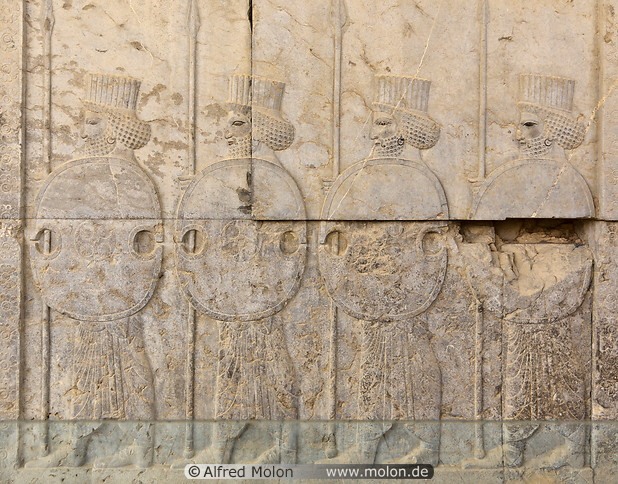
These ancient Persian archers were from the immortal guard at the Palace of Darius I "the Great" at ancient Susa (Sushan). In one ancient battle the Persian king surrounded himself by a picked body of Persian warriors called, "the immortals," consisting of 10,000 foot soldiers, the best and the bravest of his own native army. The Ten Thousand Immortals were known in history as the royal bodyguard of ancient Persia.
These 5 foot tall archers were the royal Immortal Guard from the palace of Darius at Susa (ancient Shushan). These archers are seen wearing colorful ceremonial clothing decorated with tiny stars, from their woven and twisted headbands, hair and beards, even to their shoes. Their clothes are decorated with tiny stars. Their bows, arrows and spears were gold and silver.
The bright colored enameled tiles used to line the entire walls, bringing to life the illustrious and lavish celebrations that existed at the palace of the kings of ancient Persia.
All the colors seen here are reminiscent of the lavish banquet mentioned in the Book of Esther in the Bible (white, green, blue, purple, silver, gold), when the king of Persia invited nobles and princes from all over his empire to a feast at his palace.
Guests would ascend a wide stone staircase entering a gate into the courtyard. All along the path there were the elaborate carvings along the walls, of nobles and princes, royal guards, horses and chariots. Representatives from the lands and provinces of the Persian Empire bringing tribute to the ruler of the world, king Darius (522-486 B.C.). Their destination was the great audience hall and palace of the king, a place of tremendous wealth and luxury. According to history when Alexander the Great marched into Susa he took 40,000 talents of gold which was about 1200 tons.
Alexander the Great faced hordes of soldiers like the archers shown here when he conquered the world of the Persians. The Persian Empire was vast, extending from India to Greece, and down to Ethiopia.
These archers of the royal guard revealed on these brilliantly glazed ceramic tiles of blue and gold discovered at Susa are important discovery in the study of Biblical archaeology. It shows us the enemies of Alexander the Great who is alluded to in the Book of Daniel, and the luxurious wealth of the Persians as mentioned in the Book of Esther regarding the royal banquet of the king of Persia.
Esther 1:2-4 "In the third year of his reign, he made a feast unto all his princes and his servants; the power of Persia and Media, the nobles and princes of the provinces, being before him: When he shewed the riches of his glorious kingdom and the honour of his excellent majesty many days, even an hundred and fourscore days."
List of Kings from the Achaemenid Dynasty
Achaemenid Dynasty Achaemenes Teispes Cyrus I Cambyses I (Kambiz)
Achaemenid Become an Empire Cyrus II the Great, 559BC -530BC Kambiz II, 530BC - 522BC Smerdis (the Magian), 522BC Darius I the Great, 522BC - 486BC Xerxes I (Khashyar), 486BC - 465BC Artaxerxes I , 465BC - 425BC Xerxes II, 425BC - 424BC (45 days) Darius II, 423BC - 404BC Artaxerxes II, 404BC - 359BC Artaxerxes III, 359BC - 339BC Arses, 338BC - 336BC Darius III, 336BC - 330BC
Note: Esther became queen of Persia around 478 B.C. during the reign of Xerxes I (Ahasuerus).
Louvre Museum Excerpt
Frieze of Archers Achaemenid Persian Period, reign of Darius I, c. 510 BC
Frieze of Archers
This decorative frieze of polychrome glazed brick shows an army, the men carrying spears, bows and quivers. Are they the royal guards of Darius I (522-486), whom Herodotus called “the Immortals,” or might they represent an idealized image of the Persian people? The frieze is probably inspired by the brick friezes of Babylon, although the technique is different. That may be a legacy from the Middle Elamite Period, which saw the appearance of decoration in glazed siliceous brick.
Description
Archers on parade
The Frieze of Archers had two symmetrical lines of soldiers, parading at a slow march. Each archer’s hands are joined together on the shaft of his spear, and hanging from his shoulders is a bow, its ends in the form of duck’s heads, and a quiver. The butt of the spear, held vertical, rests on the front foot, shod like the other in a laced ankle-boot. The archers wear the long Persian robe, braided and pleated over the legs, the outline of whose ample sleeve describes a curve towards the belted waist. They are bearded, and their thick curly hair is massed at the nape of the neck, held back by a diadem of beaten metal. Each brick is molded from a quart-based body; its outer face is rectangular, but the brick tapers towards the back, a little like a quoin, so as to leave room for mortar when the decorated faces are butted up against each other. The frieze combines low relief and color, with glazes of green, brown, white and yellow separated by fine cloisons of siliceous body.
An inheritance from the Elamite period?
Decorative frieze was certainly inspired by the Processional Way in Babylon, constructed by Nebuchadnezar II (604-562), but the technique is different. The Babylonians used clay for their bricks, rather than the siliceous material employed here. The artists who worked for Darius may have revived a technique developed at Susa by the Elamites in the Late Elamite Period at the end of the second millennium. Polychrome brick decoration in Iran would have a great future in the architecture of the Islamic age.
The Immortals?
Although the British archaeologist W. K. Loftus, the first to excavate at Susa, had identified the main lines of the apadana, he had recognized only isolated motifs, palmettes and rosettes, from its glazed brick decoration. When Marcel Dieulafoy continued his predecessor’s work he discovered enough bricks to make possible the fairly convincing reconstruction displayed at the Louvre: two panels representing a procession of archers, framed by decorative motifs and surmounted by crenellations inspired by the facades of the rock-tombs of Persepolis and Naqsh-e Rustam. The rare inscribed bricks, on which one can still make out the name of Darius, were positioned in the middle. The archers were then assembled as separate panels. While the Lion Frieze was found on the ground at its original position in the East Court of the palace, the exact location of the Frieze of Archers is unknown, countless bricks and fragments having been found more or less all over the place when the apadana was excavated. Their number does suggest a hypothesis: the archers may have been positioned at regular intervals in several registers, over the height of the wall, as at Babylon. They would then have occupied a great part of the exterior walls of the palace, extending over hundreds of metres. How should such a colossal ensemble be understood? Were these men the ‘Immortals,’ the wealthy élite regiment of 10,000 men? Or might they rather represent an ideal image, repeated to infinity, of the ‘Persian people,’ a constituent element of the unified empire brought together under the rule of the king, to whom it might have been necessary to accord a special place in the old Elamite capital of Susa?
Esther 1:6-7 "Where were white, green, and blue, hangings, fastened with cords of fine linen and purple to silver rings and pillars of marble: the beds were of gold and silver, upon a pavement of red, and blue, and white, and black, marble. And they gave them drink in vessels of gold, (the vessels being diverse one from another,) and royal wine in abundance, according to the state of the king."
Ezra 5:7 "They sent a letter unto him, wherein was written thus; Unto Darius the king, all peace."
Esther 1:2-5 "in those days, when the king Ahasuerus sat on the throne of his kingdom, which was in Shushan the palace, In the third year of his reign, he made a feast unto all his princes and his servants; the power of Persia and Media, the nobles and princes of the provinces, being before him: When he shewed the riches of his glorious kingdom and the honour of his excellent majesty many days, even an hundred and fourscore days. And when these days were expired, the king made a feast unto all the people that were present in Shushan the palace, both unto great and small, seven days, in the court of the garden of the king's palace;
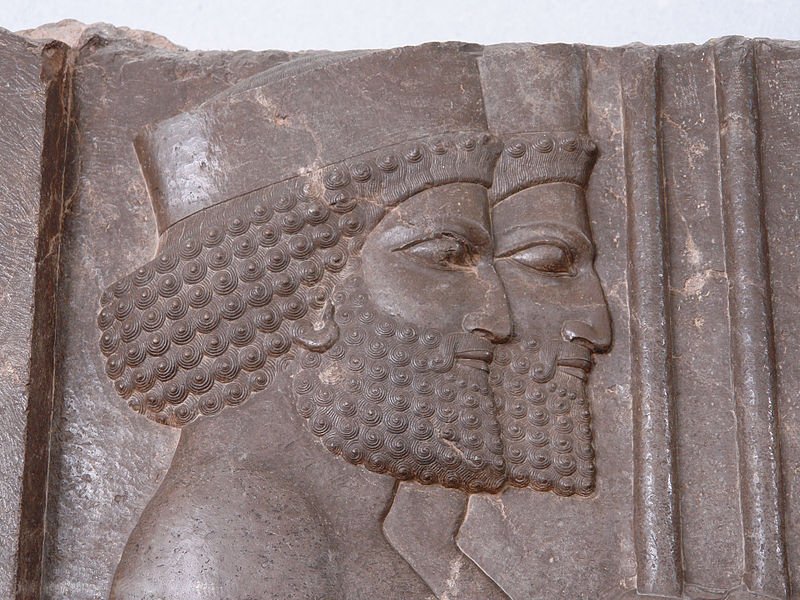
Apadana palace bas-reliefs. Iran - Persepolis: Apadana - Eastern stairs - central wall - Mede and Persian soldiers - relief
The "Immortals" (from the Greek Ἀθάνατοι, sometimes "Ten Thousand Immortals" or "Persian Immortals" In Persian سپاه جاویدان) was the name given by Herodotus to an elite force of soldiers who fought for the Achaemenid Empire. This force performed the dual roles of both Imperial Guard and standing army during the Persian Empire's expansion and during the Greco-Persian Wars. Its Persian name may have been Anûšiya ('companions'). Herodotus describes the 'Immortals' as being heavy infantry led by Hydarnes that were kept constantly at a strength of exactly 10,000 men. He claimed that the unit's name stemmed from the custom that every killed, seriously wounded or sick member was immediately replaced with a new one, maintaining the cohesion of the unit. This elite corps is only called the 'Immortals' in sources based on Herodotus. Whilst there is evidence for them from Persia, this does not mention this name for them. "Probably, Herodotus' informant has confused the name Anûšiya ('companions') with Anauša ('Immortals')." History. The 'Immortals' played an important role in Cyrus the Great's conquest of the Neo-Babylonian Empire in 547 BC, Cambyses' campaign against Egypt in 525 BC and Darius the Great's invasion of India's smaller western frontier kingdoms (western Punjab and Sindh, now in Pakistan) and Scythia in 520 BC and 513 BC. Immortals participated in the Battle of Thermopylae 480 BC[3] and were amongst the Persian occupation troops in Greece in 479 BC under Mardonius. [Wikipedia]
Ten Thousand Immortals, in Persian history, core troops in the Achaemenian army, so named because their number of 10,000 was immediately reestablished after every loss. Under the direct leadership of the hazarapat, or commander in chief, the Immortals, who formed the king’s personal bodyguard, consisted primarily of Persians but also included Medes and Elamites. They apparently had special privileges, such as being allowed to take concubines and servants along with them on the march. On coloured glazed bricks and carved reliefs found at the Achaemenian capitals, such as the Palace of Artaxerxes at Susa, the Immortals are often represented standing stiffly at attention, each soldier’s wooden spear with its silver blade and pomegranate insignia held upright and resting firmly on his toe. They wore elaborate robes and much gold jewelry. An elite 1,000 of the Immortals were further distinguished... [Ency Brit]
The Persian March. The Persians, like the Assyrians, usually avoided fighting during the winter, and marched out their armies against the enemy in early spring. With the great hosts which they moved a fixed order of march was most necessary ; and we find evidence of so much attention being paid to this point that confusion and disorder seem scarcely ever to have arisen. When the march lay within their own country, it was usual to send on the baggage and the sumpter-beasts in advance,4 after which came about half the troops moving slowly in a long and continuous column along the appointed line of route. At this point a considerable break occurred, in order that all might be clear for the most important part of the army, which was now to follow. A guard, consisting of a thousand horse and a thousand foot, picked men of the Persian people, prepared the way for what was most holy in the eyes of the nation—the emblems of their religion, and their king. The former consisted of sacred horses and cars, perhaps, in the later times, of silver altars also, bearing the perpetual and heaven-kindled fire, which was a special object of Persian religious regard, and which the superstition of the people viewed as a sort of palladium sure to bring the blessing of heaven upon their arms. Behind the sacred emblems followed the Great King himself, mounted on a car drawn by Niseean steeds, and perhaps protected on either side by a select band of his relatives. Behind the royal chariot came a second guard, consisting, like the first, of a thousand foot and a thousand horse. Then followed ten thousand picked foot, probably the famous " Immortals ; " then came a body of ten thousand picked Persian horsemen. After these a space of four hundred yards (nearly a quarter of a mile) was left vacant ; then marched, in a second continuous column, the remainder of the host...the land-force which he took with him into Europe amounted to nearly two millions of men...[Antiquities of Persia]
10,000 footmen. The king himself rode alternately in a chariot and in a litter. He was preceded immediately by ten sacred horses, and a sacred chariot drawn by eight milk-white steeds. Round him and about him were the choicest troops of the whole army, twelve thousand horse and the same number of foot, all Persians, and those too not taken at random, but selected carefully from the whole mass of the native soldiery. Among them seem to have been the famous " Immortals "— a picked body of 10,000 footmen, always maintained at exactly the same number and thence deriving their appellation [Herodotus]
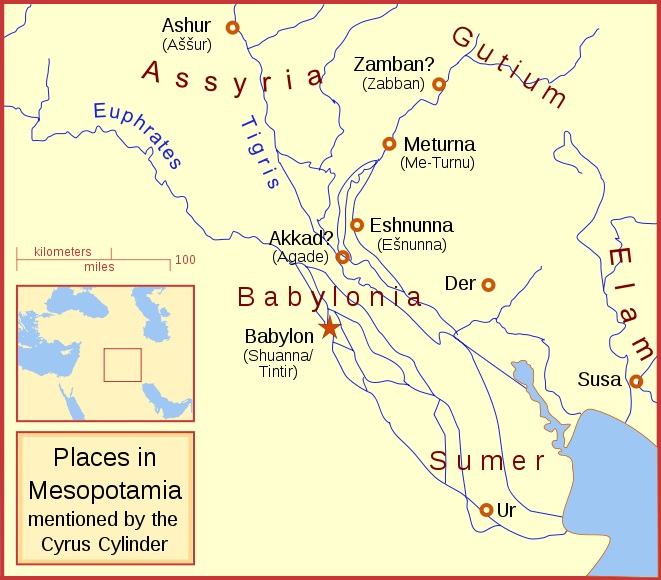
Judea had remained a Persian province for the next two hundred years until the time that the Bible records "the decree of Cyrus" giving permission to the Hebrew captives to go back to Jerusalem to rebuild their Temple.
Cyrus also restored the vessels of the House of the Lord which Nebuchadnezzar II had taken to Babylon, and provided the funds to bring cedar trees from Lebanon.
Two Persian Immortals from Persepolis
Ancient Persian Military
Despite its humble origins in Persis, the empire reached an enormous size under the leadership of Cyrus the Great. Cyrus created a multi-state empire where he allowed regional rulers, called the 'satrap' to rule as his proxy over a certain designated area of his empire called the satrapy. The basic rule of governance was based upon loyalty and obedience of each satrapy to the central power, or the king, and compliance with tax laws.[20] Due to the ethnocultural diversity of the subject nations under the rule of Persia, its enormous geographic size, and the constant struggle for power by regional competitors,[4] the creation of a professional army was necessary for both maintenance of the peace, and also to enforce the authority of the king in cases of rebellion and foreign threat.[7][46] Cyrus managed to create a strong land army, using it to advance in his campaigns in Babylonia, Lydia, and Asia Minor, which after his death was used by his son Cambyses II, in Egypt against Psamtik III. Cyrus would die battling a local Iranian insurgency in the empire, before he could have a chance to develop a naval force.[55] That task however would fall to Darius the Great, who would officially give Persians their own royal navy to allow them to engage their enemies on multiple seas of this vast empire, from the Black sea, and the Aegean Sea, to the Persian Gulf, Ionian Sea, and the Mediterranean sea. [Wikipedia]
"Now in the first year of Cyrus king of Persia, that the word of the LORD by the mouth of Jeremiah might be fulfilled, the LORD stirred up the spirit of Cyrus king of Persia, so that he made a proclamation throughout all his kingdom, and also put it in writing, saying, Thus says Cyrus king of Persia: All the kingdoms of the earth the LORD God of heaven has given me. And He has commanded me to build Him a house at Jerusalem which is in Judah. Who is among you of all His people? May the LORD his God be with him, and let him go up!" - 2 Chronicles 36:22-23
"Who says of Cyrus, 'He is My shepherd, And he shall perform all My pleasure, Saying to Jerusalem, "You shall be built," And to the temple, "Your foundation shall be laid." ' - Isaiah 44:28
"King Cyrus also brought out the articles of the house of the LORD, which Nebuchadnezzar had taken from Jerusalem and put in the temple of his gods; and Cyrus king of Persia brought them out by the hand of Mithredath the treasurer, and counted them out to Sheshbazzar the prince of Judah. This is the number of them: thirty gold platters, one thousand silver platters, twenty-nine knives, thirty gold basins, four hundred and ten silver basins of a similar kind, and one thousand other articles. All the articles of gold and silver were five thousand four hundred. All these Sheshbazzar took with the captives who were brought from Babylon to Jerusalem." - Ezra 1:7-11
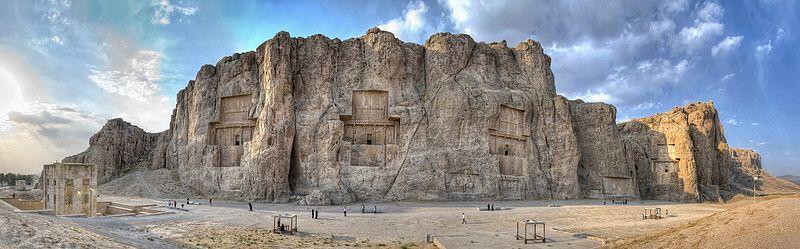
Panoramic view of the Naqsh-e Rustam. This site contains the tombs of four Achaemenid kings, including those of Darius I and Xerxes.
Kings of the Bible
David Solomon
The Kings of Israel (all wicked)
Jeroboam I (933-911 BC) twenty-two years
Nadab (911-910) two years
Baasha (910-887) twenty-four years
Elah (887-886) two years
Zimri (886) seven days
Omri (886-875) twelve years
Ahab (875-854) twenty-two years
Ahaziah (855-854) two years
Jehoram (Joram) (854-843) twelve years
Jehu (843-816) twenty-eight years
Jehoahaz (820-804) seventeen years
Jehoash (Joash) (806-790) sixteen years
Jeroboam II (790-749) forty-one years
Zechariah' (748) six months
Shallum (748) one month
Menahem (748-738) ten years
Pekahiah (738-736) two years
Pekah (748-730) twenty years
Hoshea (730-721) nine years
The Kings of Judah (8 were good)
Rehoboam (933-916 BC) seventeen years
Abijam (915-913) three years
Asa (Good) (912-872) forty-one years
Jehoshaphat (Good) (874-850) twenty-five years
Jehoram (850-843) eight years
Ahaziah (843) one year
Athaliah (843-837) six years
Joash (Good) (843-803) forty years
Amaziah (Good) (803-775) 29 years
Azariah (Uzziah) (Good) (787-735) fifty-two years
Jotham (Good) (749-734) sixteen years
Ahaz (741-726) sixteen years
Hezekiah (Good) (726-697) 29 years
Manasseh (697-642) fifty-five years
Amon (641-640) two years
Josiah (Good) (639-608) thirty-one years
Jehoahaz (608) three months
Jehoiachim (608-597) eleven years
Jehoiachin (597) three months
Zedekiah (597-586) eleven years
Some Scriptures mentioning the word "Persia"
Ezra 4:7 - And in the days of Artaxerxes wrote Bishlam, Mithredath, Tabeel, and the rest of their companions, unto Artaxerxes king of Persia; and the writing of the letter [was] written in the Syrian tongue, and interpreted in the Syrian tongue.
Ezra 4:3 - But Zerubbabel, and Jeshua, and the rest of the chief of the fathers of Israel, said unto them, Ye have nothing to do with us to build an house unto our God; but we ourselves together will build unto the LORD God of Israel, as king Cyrus the king of Persia hath commanded us.
Ezra 9:9 - For we [were] bondmen; yet our God hath not forsaken us in our bondage, but hath extended mercy unto us in the sight of the kings of Persia, to give us a reviving, to set up the house of our God, and to repair the desolations thereof, and to give us a wall in Judah and in Jerusalem.
Ezra 6:14 - And the elders of the Jews builded, and they prospered through the prophesying of Haggai the prophet and Zechariah the son of Iddo. And they builded, and finished [it], according to the commandment of the God of Israel, and according to the commandment of Cyrus, and Darius, and Artaxerxes king of Persia.
2 Chronicles 36:23 - Thus saith Cyrus king of Persia, All the kingdoms of the earth hath the LORD God of heaven given me; and he hath charged me to build him an house in Jerusalem, which [is] in Judah. Who [is there] among you of all his people? The LORD his God [be] with him, and let him go up.
Daniel 10:1 - In the third year of Cyrus king of Persia a thing was revealed unto Daniel, whose name was called Belteshazzar; and the thing [was] true, but the time appointed [was] long: and he understood the thing, and had understanding of the vision.
Ezra 1:2 - Thus saith Cyrus king of Persia, The LORD God of heaven hath given me all the kingdoms of the earth; and he hath charged me to build him an house at Jerusalem, which [is] in Judah.
Esther 1:3 - In the third year of his reign, he made a feast unto all his princes and his servants; the power of Persia and Media, the nobles and princes of the provinces, [being] before him:
Ezra 3:7 - They gave money also unto the masons, and to the carpenters; and meat, and drink, and oil, unto them of Zidon, and to them of Tyre, to bring cedar trees from Lebanon to the sea of Joppa, according to the grant that they had of Cyrus king of Persia.
Ezra 4:24 - Then ceased the work of the house of God which [is] at Jerusalem. So it ceased unto the second year of the reign of Darius king of Persia.
Daniel 10:20 - Then said he, Knowest thou wherefore I come unto thee? and now will I return to fight with the prince of Persia: and when I am gone forth, lo, the prince of Grecia shall come.
Esther 10:2 - And all the acts of his power and of his might, and the declaration of the greatness of Mordecai, whereunto the king advanced him, [are] they not written in the book of the chronicles of the kings of Media and Persia?
Daniel 11:2 - And now will I shew thee the truth. Behold, there shall stand up yet three kings in Persia; and the fourth shall be far richer than [they] all: and by his strength through his riches he shall stir up all against the realm of Grecia.
Esther 1:14 - And the next unto him [was] Carshena, Shethar, Admatha, Tarshish, Meres, Marsena, [and] Memucan, the seven princes of Persia and Media, which saw the king's face, [and] which sat the first in the kingdom;)
Esther 1:18 - [Likewise] shall the ladies of Persia and Media say this day unto all the king's princes, which have heard of the deed of the queen. Thus [shall there arise] too much contempt and wrath.
Ezra 1:8 - Even those did Cyrus king of Persia bring forth by the hand of Mithredath the treasurer, and numbered them unto Sheshbazzar, the prince of Judah.
2 Chronicles 36:20 - And them that had escaped from the sword carried he away to Babylon; where they were servants to him and his sons until the reign of the kingdom of Persia:
Ezra 7:1 - Now after these things, in the reign of Artaxerxes king of Persia, Ezra the son of Seraiah, the son of Azariah, the son of Hilkiah,
Ezekiel 27:10 - They of Persia and of Lud and of Phut were in thine army, thy men of war: they hanged the shield and helmet in thee; they set forth thy comeliness.
Daniel 8:20 - The ram which thou sawest having [two] horns [are] the kings of Media and Persia.
Ezekiel 38:5 - Persia, Ethiopia, and Libya with them; all of them with shield and helmet:
Ezra 1:1 - Now in the first year of Cyrus king of Persia, that the word of the LORD by the mouth of Jeremiah might be fulfilled, the LORD stirred up the spirit of Cyrus king of Persia, that he made a proclamation throughout all his kingdom, and [put it] also in writing, saying,
2 Chronicles 36:22 - Now in the first year of Cyrus king of Persia, that the word of the LORD [spoken] by the mouth of Jeremiah might be accomplished, the LORD stirred up the spirit of Cyrus king of Persia, that he made a proclamation throughout all his kingdom, and [put it] also in writing, saying,
Ezra 4:5 - And hired counsellors against them, to frustrate their purpose, all the days of Cyrus king of Persia, even until the reign of Darius king of Persia.
Daniel 10:13 - But the prince of the kingdom of Persia withstood me one and twenty days: but, lo, Michael, one of the chief princes, came to help me; and I remained there with the kings of Persia.
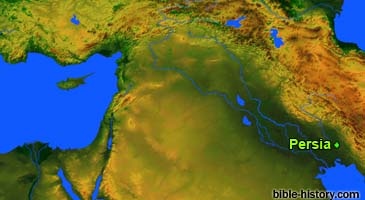
Persia in Easton's Bible Dictionary an ancient empire, extending from the Indus to Thrace, and from the Caspian Sea to the Red Sea and the Persian Gulf. The Persians were originally a Medic tribe which settled in Persia, on the eastern side of the Persian Gulf. They were Aryans, their language belonging to the eastern division of the Indo-European group. One of their chiefs, Teispes, conquered Elam in the time of the decay of the Assyrian Empire, and established himself in the district of Anzan. His descendants branched off into two lines, one line ruling in Anzan, while the other remained in Persia. Cyrus II., king of Anzan, finally united the divided power, conquered Media, Lydia, and Babylonia, and carried his arms into the far East. His son, Cambyses, added Egypt to the empire, which, however, fell to pieces after his death. It was reconquered and thoroughly organized by Darius, the son of Hystaspes, whose dominions extended from India to the Danube. https://bible-history.com/e...
Persia in Fausset's Bible Dictionary Ezekiel 27:10; Ezekiel 38:5. "Persia proper" was originally a small territory (Herodot. 9:22). On the N. and N.E. lay Media, on the S. the Persian gulf, Elam on the W., on the E. Carmania. Now Furs, Farsistan. Rugged, with pleasant valleys and plains in the mid region and mountains in the N. The S. toward the sea is a hot sandy plain, in places covered with salt. Persepolis (in the beautiful valley of the Bendamir), under Darius Hystaspes, took the place of Pasargadae the ancient capital; of its palace "Chehl Minar," "forty columns," still exist. Alexander in a drunken fit, to please a courtesan, burned the palace. Pasargadae, 40 miles to the N., was noted for Cyrus' tomb (Arrian) with the inscription, "I am Cyrus the Achaemenian." (See CYRUS.) The Persians came originally from the E., from the vicinity of the Sutlej (before the first contact of the Assyrians with Aryan tribes E. of Mount Zagros, 880 B.C.), down the Oxus, then S. of the Caspian Sea to India. There were ten castes or tribes: three noble, three agricultural, four nomadic; of the last were the "Dehavites" or Dali (Ezra 4:9). The Pasargadae were the noble tribes, in which the chief house was that of the Achaemenidae. Darius on the rock of Behistun inscribed: "from antiquity our race have been kings. There are eight of our race who have been kings before me, I am the ninth." frontELAM on its relation to Persia.) The Persian empire stretched at one time from India to Egypt and Thrace, including all western Asia between the Black Sea, the Caucasus, the Caspian, the Jaxartes upon the N., the Arabian desert, Persian gulf, and Indian ocean on the S. Darius in the inscription on his tomb at Nakhsh- irustam enumerates thirty countries besides Persia subject to him, Media, Susiana, Parthia, Aria, Bactria, Sogdiana, Chorasmia, Zarangia, Arachosia, Sattagydia, Gaudaria, India, Scythia, Babylonia, Assyria, Arabia, Egypt, Armenia, Cappadocia, Saparda, Ionia, the Aegean isles, the country of the Scodrae (European), Ionia, the Tacabri, Budians, Cushites, Mardians, and Colchians. The organization of the Persian kingdom and court as they appear in Ezra, Nehemiah, and Esther, accords with independent secular historians. The king, a despot, had a council, "seven princes of Persia and Media which see his face and sit the first in the kingdom" (Esther 1:14; Ezra 7:14). So Herodotus (iii. 70-79) and Behistun inscription mention seven chiefs who organized the revolt against Smerdis (the Behistun rock W. of Media has one inscription in three languages, Persian, Babylonian, and Stythic, read by Grotefend). "The law of the Persians and Medes which alters not" (Esther 1:19) also controlled him in some measure. In Scripture we read of 127 provinces (Esther 1:1) with satraps (Esther 3:12; Esther 8:9; Xerxes in boasting enlarged the list; 60 are the nations in his armament according to Herodotus) maintained from the palace (Ezra 4:14), having charge of the revenue, paid partly in money... https://bible-history.com/f...
Persia in Naves Topical Bible An empire which extended from India to Ethiopia, comprising one-hundred and twenty-seven provinces Es 1:1; Da 6:1 -Government of, restricted by constitutional limitations Es 8:8; Da 6:8-12 -Municipal governments in, provided with dual governors Ne 3:9,12,16-18 -The princes were advisors in matters of administration Da 6:1-7 -Status of women in; queen sat on the throne with the king Ne 2:6 -Vashti was divorced for refusing to appear before the king's courtiers Es 1:10-22; 2:4 -Israel captive in 2Ch 36:20 -Captivity foretold Ho 13:16 -Men of, in the Tyrian army Eze 27:10 -Rulers of Ahasuerus Es 1:3 -Darius Da 5:31; 6; 9:1 -Artaxerxes I Ezr 4:7-24 -Artaxerxes II Ezr 7; Ne 2; 5:14 -Cyrus 2Ch 36:22,23; Ezr 1; 3:7; 4:3; 5:13,14,17; 6:3; Isa 41:2,3; 44:28; 45:1-4,13; 46:11; 48:14,15 -Princes of Es 1:14 -System of justice Ezr 7:25 -Prophecies concerning Isa 13:17; 21:1-10; Jer 49:34-39; 51:11-64; Eze 32:24,25; 38:5; Da 2:31-45; 5:28; 7; 8; 11:1-4 https://bible-history.com/n...
Persia in Smiths Bible Dictionary (pure, splended), Per'sians. Persia proper was a tract of no very large dimensions on the Persian Gulf, which is still known as Fars or Farsistan, a corruption of the ancient appellation. This tract was bounded on the west by Susiana or Elam, on the north by Media on the south by the Persian Gulf and on the east by Carmania. But the name is more commonly applied, both in Scripture and by profane authors to the entire tract which came by degrees to be included within the limits of the Persian empire. This empire extended at one time from India on the east to Egypt and Thrace on the west, and included. besides portions of Europe and Africa, the whole of western Asia between the Black Sea, the Caucasus, the Caspian and the Jaxartes on the north, the Arabian desert the Persian Gulf and the Indian Ocean on the south. The only passage in Scripture where Persia designates the tract which has been called above "Persia proper" is Eze 38:5 Elsewhere the empire is intended. The Persians were of the same race as the Medes, both being branches of the great Aryan stock. 1. Character of the nation. --The Persians were a people of lively and impressible minds, brave and impetuous in war, witty, passionate, for Orientals truthful, not without some spirit of generosity: and of more intellectual capacity than the generality of Asiatics. In the times anterior to Cyrus they were noted for the simplicity of their habits, which offered a strong contrast to the luxuriousness of the Medes; but from the late of the Median overthrow this simplicity began to decline. Polygamy was commonly practiced among them. They were fond of the pleasures of the table. In war they fought bravely, but without discipline. 2. Religion. --The religion which the Persians brought with there into Persia proper seems to have been of a very simple character, differing from natural religion in little except that it was deeply tainted with Dualism. Like the other Aryans, the Persians worshipped one supreme God. They had few temples, and no altars or images. 3. Language. --The Persian language was closely akin to the Sanskrit, or ancient language of India. Modern Persian is its degenerate representative, being largely impregnated with Arabic. 4. History. --The history of Persia begins with the revolt from the Medes and the accession of Cyrus the Great, B.C. 558. Cyrus defeated Croesus, and added the Lydian empire to his dominions. This conquest was followed closely by the submission of the Greek settlements on the Asiatic coast, and by the reduction of Caria and Lycia The empire was soon afterward extended greatly toward the northeast and east. In B.C. 539 or 538, Babylon was attacked, and after a stout defence fell into the hands of Cyrus. This victory first brought the Persians into co... https://bible-history.com/s...
Persia in the Bible Encyclopedia - ISBE pur'-sha, (parats; Persia; in Assyrian Parsu, Parsua; in Achemenian Persian Parsa, modern Fars): In the Bible (2 Ch 36:20,22,23; Ezr 1:1,8; Est 1:3,14,18; 10:2; Ezek 27:10; 38:5; Dan 8:20; 10:1; 11:2) this name denotes properly the modern province of Fars, not the whole Persian empire. The latter was by its people called Airyaria, the present Iran (from the Sanskrit word arya, "noble"); and even now the Persians never call their country anything but Iran, never "Persia." The province of Persis lay to the East of Elam (Susiana), and stretched from the Persian Gulf to the Great Salt Desert, having Carmania on the Southeast. Its chief cities were Persepolis and Pasargadae. Along the Persian Gulf the land is low, hot and unhealthy, but it soon begins to rise as one travels inland. Most of the province consists of high and steep mountains and plateaus, with fertile valleys. The table-lands in which lie the modern city of Shiraz and the ruins of Persepolis and Pasargadae are well watered and productive. Nearer the desert, however, cultivation grows scanty for want of water. Persia was doubtless in early times included in Elam, and its population was then either Semitic or allied to the Accadians, who founded more than one state in the Babylonian plain. The Aryan Persians seem to have occupied the country in the 8th or 9th century BC. https://bible-history.com/i...
PERSEPOLIS, an ancient city of Persia, situated some 40 m. N.E. of Shiraz, not far from where the small river Pulwar flows into the Kur (Kyrus). The site is marked by a large terrace with its east side leaning on Kuhi Rahmet (" the Mount of Grace "). The other three sides are formed by a retaining wall, varying in height with the slope of the ground from 14 to 41 ft.; on the west side a magnificent double stair, of very easy steps, leads to the top. On this terrace are the ruins of a number of colossal buildings, all constructed of dark-grey marble from the adjacent mountain. The stones were laid without mortar, and many of them are still in situ. Especially striking are the huge pillars, of which a number still stand erect. Several of the buildings were never finished. F. Stolze has shown that in some cases even the mason's rubbish has not been removed.' These ruins, for which the name Kizil minare or Chihil menare (" the forty columns or minarets "), can be traced back to the 13th century, are now known as Takhti Jamshid (" the throne of Jamshid "). That they represent the Persepolis captured and partly destroyed by Alexander the Great has been beyond dispute at least since the time of Pietro della Valle.2 Behind Takhti Jamshid are three sepulchres hewn out of the rock in the hillside, the facades, one of which is incomplete, being richly ornamented with reliefs. About 8 m. N.N.E., on the opposite side of the Pulwar, rises a perpendicular wall of rock, in which four similar tombs are cut, at a considerable height from the bottom of the valley. The modern Persians call this place Nakshi Rustam (" the picture of Rustam ") from the Sassanian reliefs beneath the opening, which they take to be a representation of the mythical hero Rustam. That the ' Cf. J. Chardin, E. Kaempfer, C. Niebuhr and W. Ouseley. Niebuhr's drawings, though good, are, for the purposes of the architectural student, inferior to the great work of C. Texier, and still more to that of E. Flandin and P. Coste. Good sketches, chiefly after Flandin, are given by C. Kossowicz, Inscriptiones palaeopersicae (St Petersburg, 1872). In addition to these we have the photographic plates in F. Stolze's Persepolis (2 vols., Berlin, 1882).
Lettera XV. (ed. 'Brighton, 1843), ii. 246 seq.
occupants of these seven tombs were kings might be inferred from the sculptures, and one of those at Nakshi Rustam is expressly declared in its inscription to be the tomb of Darius Hystaspis, concerning whom Ctesias relates that his grave was in the face of a rock, and could only be reached by means of an apparatus of ropes. Ctesias mentions further, with regard to a number of Persians kings, either that their remains were brought " to the Persians," or that they died there.' Now we know that Cyrus was buried at Pasargadae and if there is any truth in the statement that the body of Cambyses was brought home " to the Persians " his burying-place must be sought somewhere beside that of his father. In order to identify the graves of Persepolis we must bear in mind that Ctesias assumes that it was the custom for a king to prepare his own tomb during his lifetime. Hence the kings buried at Nakshi Rustam are probably, besides Darius, Xerxes I., Artaxerxes I. and Darius II. Xerxes II., who reigned for a very short time, could scarcely have obtained so splendid a monument, and still less could the usurper Sogdianus (Secydianus). The two completed graves behind Takhti Jamshid would then belong to Artaxerxes II. and Artaxerxes III. The unfinished one is perhaps that of Arses, who reigned at the longest two years, or, if not his, then that of Darius III. (Codomannus), who is one of those whose bodies are said to have been brought " to the Persians "2 (see Architecture, fig. 12). Another small group of ruins in the same style is found at the village of Hajjiabad, on the Pulwar, a good hour's walk above Takhti Jamshid. These formed a single building, which was still intact goo years ago, and was used as the mosque of the then existing city of Istakhr.
Since Cyrus was buried in Pasargadae, which moreover is mentioned in Ctesias as his own city,' and since, to judge from the inscriptions, the buildings of Persepolis commenced with Darius I., it was probably under this king, with whom the sceptre passed to a new branch of the royal house, that Persepolis became the capital 4 (see Persia: Ancient History, V. 2) of Persia proper. As a residence, however, for the rulers of the empire, a remote place in a difficult alpine region was far from convenient, and the real capitals were Susa, Babylon and Ecbatana. This accounts for the fact that the Greeks were not acquainted with the city until it was taken and plundered by Alexander the Great. Ctesias must certainly have known of it, and it is possible that he may have named it simply IIEpvac, after the people, as is undoubtedly done by certain writers of a somewhat later date.' But whether the city really bore the name of the people and the country is another question. And it is extremely hazardous to assume, with Sir H. Rawlinson and J. Oppert, that the words and Pdrsd, " in this Persia," which occur in an inscription on the gateway built by Xerxes (D. 1.14), signify " in this city of Parsa," and consequently prove that the name of the city is identical with the name of the country. The form Persepolis (with a play on 71-ports, destruction) appears first in Cleitarchus, one of the earliest, but unfortunately one of the most imaginative annalists of the exploits of Alexander.
It has been universally admitted that " the palaces " or "the palace " (rd ,3aviXeca) burned down by Alexander are those now in ruins at Takhti Jamshid. From Stolze's investigations it appears that at least one of these, the castle built by Xerxes, bears evident traces of having been destroyed by fire. The locality described by Diodorus after Cleitarchus corresponds in important particulars with Takhti Jamshid, for example, in being supported by the ' This statement is not made in Ctesias (or rather in the extracts of Photius) about Darius II., which is probably accidental; in the case of Sogdianus, who as a usurper was not deemed worthy of honourable burial, there is a good reason for the omission.
Arrian, iii. 22, I.
' Cf. also in particular Plutarch, Artax. iii., where Pasargadae is distinctly looked on as the sacred cradle of the dynasty.
4 The story of Aelian (H. A. i. 59), who makes Cyrus build his royal palace in Persepolis, deserves no attention.
5 So Arrian (iii. 18, 1, lo), or rather his best authority, King Ptolemy. So, again, the Babylonian Berossus, shortly after Alexander. See Clemens Alex., Admon. ad gentes, c. 5, where, with Georg Hoffmann (Pers. Martyrer, 137), Kai is to be inserted before ll paacs, and this to be understood as the name of the metropolis.
mountain on the east.' There is, however, one formidable difficulty. Diodorus says that the rock at the back of the palace containing the royal sepulchres is so steep that the bodies could be raised to their last resting-place only by mechanical appliances. This is not true of the graves behind Takhti Jamshid, to which, as F. Stolze expressly observes, one can easily ride up; on the other hand, it is strictly true of the graves at Nakshi Rustam. Stolze accordingly started the theory that the royal castle of Persepolis stood close by Nakshi Rustam, and has sunk in course of time to shapeless heaps of earth, under which the remains may be concealed. The vast ruins, however, of Takhti Jamshid, and the terrace constructed with so much labour, can hardly be anything else than the ruins of palaces; as for temples, the Persians had no such thing, at least in the time of Darius and Xerxes. Moreover, Persian tradition at a very remote period knew of only three architectural wonders in that region, which it attributed to the fabulous queen Humai (Khumai) - the grave of Cyrus at. Murgab, the building at Hajjiabad, and those on the great terrace.' It is safest therefore to identify these last with the royal palaces destroyed by Alexander. Cleitarchus, who can scarcely have visited the place himself, with his usual recklessness of statement, confounded the tombs behind the palaces with those of Nakshi Rustam; indeed he appears to imagine that all the royal sepulchres were at the same place. In 316 B.C. Persepolis was still the capital of Persis as a province of the great Macedonian Empire (see Diod. xix, 21 seq., 46; probably after Hieronymus of Cardia, who was living about 316). The city must have gradually declined in the course of time; but the ruins of the Achaemenidae remained as a witness to its ancient glory. It is probable that the principal town of the country, or at least of the district, was always in this neighbourhood. About A.D. 200 we find there the city Istakhr (properly Stakhr) as the seat of the local governors. There the foundations of the second great Persian Empire were laid, and Istakhr acquired special importance as the centre of priestly wisdom and orthodoxy. The Sassanian kings have covered the face of the rocks in this neighbourhood, and in part even the Achaemenian ruins, with their sculptures and inscriptions, and must themselves have built largely here, although never on the same scale of magnificence as their ancient predecessors. The Romans knew as little about Istakhr as the Greeks had done about Persepolis - and this in spite of the fact that for four hundred years the Sassanians maintained relations, friendly or hostile, with the empire.
At the time of the Arabian conquest Istakhr offered a desperate resistance, but the city was still a place of considerable importance in the 1st century of Islam (see Caeiphate), although its greatness was speedily eclipsed by the new metropolis Shiraz. In the 10th century Istakhr had become an utterly insignificant place, as may be seen from the descriptions of Istakhr, a native (c. 950), and of Mukaddasi (c. 985). During the following centuries Istakhr gradually declines, until, as a city, it ceased to exist. This fruitful region, however, was covered with villages till the frightful devastations of the 18th century; and even now it is, comparatively speaking, well cultivated. The " castle of Istakhr " played a conspicuous part several times during the Mahommedan period as a strong fortress. It was the middlemost and the highest of the three steep crags which rise from the valley of the Kur, at some distance to the west or north-west of Nakshi Rustam. We learn from Oriental writers that one of the Buyid (Buwaihid) sultans in the 10th century of the Flight constructed the great cisterns, which may yet be seen, and have been visited, amongst others, by James Morier and E. Flandin. W. Ouseley points out that this castle was still used in the 16th century, at least as a state prison. But when Pietro della Valle was there in 1621 it was already in ruins. [Encyclopedia Britannica 1911]