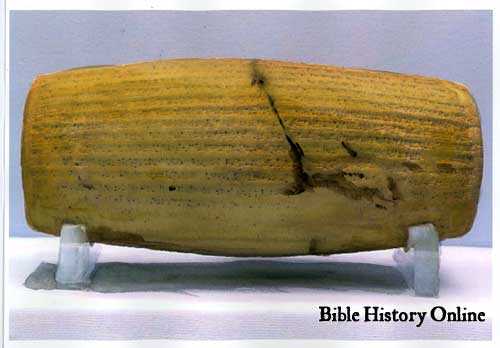
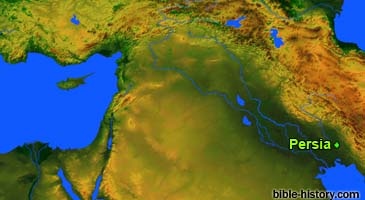
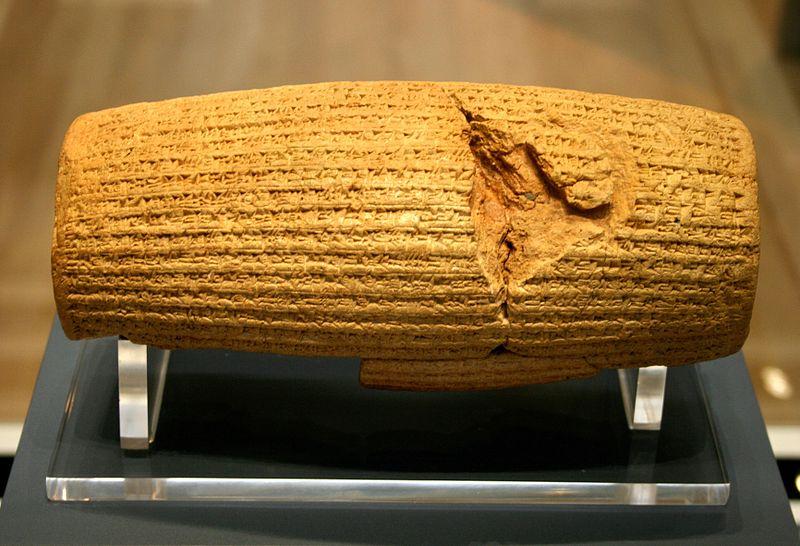
This clay cylinder is inscribed in Akkadian cuneiform script with an account made by the famous king Cyrus of Persia (559-530 BC). The Cyrus Cylinder records his conquest of Babylon in 539 BC and the capture of Nabonidus, the last of the Babylonian kings.
The Cyrus Cylinder is an important discovery in the study of Biblical Archaeology because it speaks of Cyrus the Persian and his conquest of Babylon in 539 BC. as mentioned in Scripture.
Cyrus II, the Great was the founder and ruler of the vast Persian Empire from 539 B.C. until his death in 530 B.C. Once Cyrus had defeated the Median king, Astyages and took Ecbatana he expanded his kingdom defeating Croesus, king of Lydia in 546 BC, and then conquered Babylon in 539 BC overthrowing Nabonidus, the last king of Babylon. The Persian Empire was formed. Cyrus was a generous ruler allowing various captives to return to their homelands, as recorded on the Cyrus Cylinder. Xenophon, Nabonidus and many others gave Cyrus praise for his generous leadership.
Judea had remained a Persian province for the next two hundred years until the time that the Bible records "the decree of Cyrus" giving permission to the Hebrew captives to go back to Jerusalem to rebuild their Temple.
Cyrus also restored the vessels of the House of the Lord which Nebuchadnezzar II had taken to Babylon, and provided the funds to bring cedar trees from Lebanon.
"Now in the first year of Cyrus king of Persia, that the word of the LORD by the mouth of Jeremiah might be fulfilled, the LORD stirred up the spirit of Cyrus king of Persia, so that he made a proclamation throughout all his kingdom, and also put it in writing, saying, Thus says Cyrus king of Persia: All the kingdoms of the earth the LORD God of heaven has given me. And He has commanded me to build Him a house at Jerusalem which is in Judah. Who is among you of all His people? May the LORD his God be with him, and let him go up!" - 2 Chronicles 36:22-23
"Who says of Cyrus, 'He is My shepherd, And he shall perform all My pleasure, Saying to Jerusalem, "You shall be built," And to the temple, "Your foundation shall be laid." ' - Isaiah 44:28
"King Cyrus also brought out the articles of the house of the LORD, which Nebuchadnezzar had taken from Jerusalem and put in the temple of his gods; and Cyrus king of Persia brought them out by the hand of Mithredath the treasurer, and counted them out to Sheshbazzar the prince of Judah. This is the number of them: thirty gold platters, one thousand silver platters, twenty-nine knives, thirty gold basins, four hundred and ten silver basins of a similar kind, and one thousand other articles. All the articles of gold and silver were five thousand four hundred. All these Sheshbazzar took with the captives who were brought from Babylon to Jerusalem." - Ezra 1:7-11
Material - Baked Clay Cylinder Persian dynasty Date: 559-530 BC. Length: 22.86 cm Babylon, southern Iraq Excavated by: Robert Koldeway 1899-1914 Location: British Museum, London Item: ANE 90920 Room 52, Ancient Iran, case 6, no. 7
British Museum Excerpt
Cyrus Cylinder
Babylonian, about 539-530 BC From Babylon, southern Iraq
A declaration of good kingship
This clay cylinder is inscribed in Babylonian cuneiform with an account by Cyrus, king of Persia (559-530 BC) of his conquest of Babylon in 539 BC and capture of Nabonidus, the last Babylonian king.
Cyrus claims to have achieved this with the aid of Marduk, the god of Babylon. He then describes measures of relief he brought to the inhabitants of the city, and tells how he returned a number of images of gods, which Nabonidus had collected in Babylon, to their proper temples throughout Mesopotamia and western Iran. At the same time he arranged for the restoration of these temples, and organized the return to their homelands of a number of people who had been held in Babylonia by the Babylonian kings. Although the Jews are not mentioned in this document, their return to Palestine following their deportation by Nebuchadnezzar II, was part of this policy.
This cylinder has sometimes been described as the 'first charter of human rights', but it in fact reflects a long tradition in Mesopotamia where, from as early as the third millennium BC, kings began their reigns with declarations of reforms.
Cyrus Cylinder Inscription translation:
[. . .] his troops [. . .four] quarters of the world [. . .] a weakling was established as ruler over his land and [. . .] a similar one he appointed over them, like Esagila he made [. . .] to Ur and the rest of the cities, a command dishonoring them [. . .] he planned daily and in enmity, he caused the daily offering to cease; he appointed [. . .] he established within the city. The worship of Marduk, king of the gods [. . .] he showed hostility toward his city daily [. . .] his people; he brought all of them to ruin through servitude without rest.
On account of their complaints, the lords of the gods became furiously angry and left their land; the gods, who dwelt among them, left their homes, in anger over his bringing into Babylon. Marduk [. . .] to all the dwelling places, which had become ruins, and the people of Sumer and Akkad, who were like corpses [. . . .] he turned and granted mercy. In all lands everywhere he searched; he looked through them and sought a righteous prince after his own heart, whom he took by the hand. He called Cyrus, king of Anshan, by name; he appointed him to lordship over the whole world.
The land of Qutu, all the Umman-manda, he cast down at his feet. The black-headed people, whom he gave his hands to conquer, he took them in justice and righteousness. Marduk, the great lord, looked joyously on the caring for his people, on his pious works and his righteous heart.
To his city, Babylon, he caused him to go; he made him take the road to Babylon, going as a friend and companion at his side. His numerous troops, in unknown numbers, like the waters of a river, marched armed at his side. Without battle and conflict, he permitted him to enter Babylon. He spared his city, Babylon, a calamity.
Nabonidus, the king, who did not fear him, he delivered into his hand. All the people of Babylon, Sumer, and Akkad, princes and governors, fell down before him and kissed his feet. They rejoiced in his sovereignty; their faces shone.
The lord, who by his power brings the dead to life, who amid destruction and injury had protected them, they joyously blessed him, honoring his name.
I am Cyrus, king of the world, the great king, the powerful king, king of Babylon, king of Sumer and Akkad, king of the four quarters of the world, son of Cambyses, the great king, king of the city of Anshan, grandson of Cyrus, the great king, king of the city of Anshan; great-grandson of Teispes, the great king, king of the city of Anshan; eternal seed of royalty whose rule Bel and Nabu love, in whose administration they rejoice in their heart. When I made my triumphal entrance into Babylon, I took up my lordly residence in the royal palace with joy and rejoicing; Marduk, the great lord, moved the noble heart of the residents of Babylon to me, while I gave daily attention to his worship.
My numerous troops marched peacefully into Babylon. In all Sumer and Akkad I permitted no enemy to enter. The needs of Babylon and of all its cities I gladly attended to. The people of Babylon [and . . .], and the shameful yoke was removed from them. Their dwellings, which had fallen, I restored. I cleared out their ruins. Marduk, the great lord, rejoiced in my pious deeds, and graciously blessed me, Cyrus, the king who worships him, and Cambyses, my own son, and all my troops, while we, before him, joyously praised his exalted godhead. All the kings dwelling in palaces, of all the quarters of the earth, from the Upper to the Lower sea dwelling [. . .] all the kings of the Westland dwelling in tents brought me their heavy tribute, and in Babylon kissed my feet.
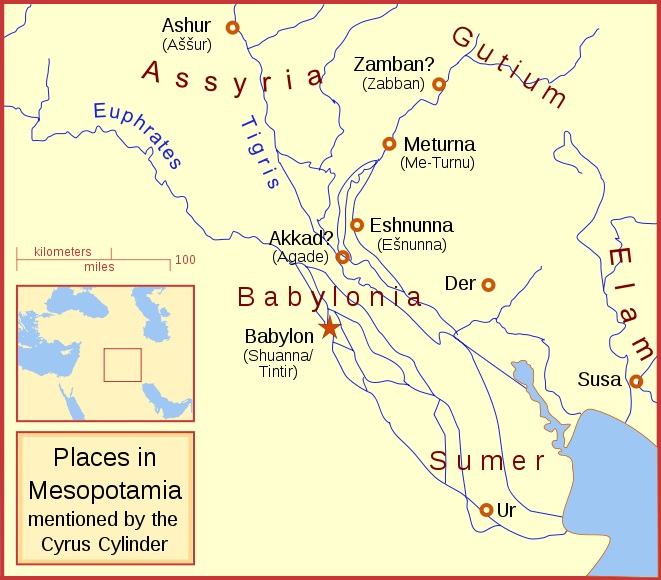
From [. . .] to Asshur and Susa, Agade, Eshnunak, Zamban, Meturnu, Deri, with the territory of the land of Qutu, the cities on the other side of the Tigris, whose sites were of ancient foundation - the gods, who resided in them, I brought back to their places, and caused them to dwell in a residence for all time, And the gods of Sumer and Akkad?whom Nabonidus, to the anger of the lord of the gods, had brought into Babylon?by the command of Marduk, the great lord, I caused them to take up their dwelling in residences that gladdened the heart. May all the gods, whom I brought into their cities, pray daily before B?l and Nab? for long life for me, and may they speak a gracious word for me and say to Marduk, my lord, "May Cyrus, the king who worships you, and Cambyses, his son, their [. . .] I permitted all to dwell in peace [. . .]
Translated by R. W. Rogers [1912]
Cyrus I in Wikipedia (Old Persian Kuru?), was King of Anshan in Persia from c. 600 to 580 BC or, according to others, from c. 652 to 600 BC. He should not be confused with his famous grandson Cyrus the Great, also known as Cyrus II. His name in Modern Persian is کوروش, while in Greek he was called Κύρος. Cyrus was an early member of the Achaemenid dynasty. He was apparently a grandson of its founder Achaemenes and son of Teispes, king of Anshan. Teispes' sons reportedly divided the kingdom among them after his death. Cyrus reigned as king of Anshan while his brother Ariaramnes was king of Parsa. The chronological placement of this event is uncertain. This is due to his suggested but still debated identification with the monarch known as "Kuras of Parsumas". Kuras is first mentioned c. 652 BC. At that year Shamash-shum-ukin, king of Babylon (668 - 648 BC) revolted against his older brother and overlord Ashurbanipal, of king of Assyria (668 - 627 BC). Cyrus is mentioned being in a military alliance with the former. The war between the two brothers ended in 648 BC with the defeat and reported suicide of Shamash-shum- ukin. Cyrus is mentioned again in 639 BC. At that year Ashurbanibal managed to defeat Elam and became overlord to several of its former allies. Kuras was apparently among them. His elder son "Arukku" was reportedly sent to Assyria to pay tribute to its King. Kuras then seems to vanish from historical record. His suggested identification with Cyrus would help connect the Achaemenid dynasty to the major events of the 7th century BC... http://en.wikipedia.org/wiki/C...
Cyrus in Easton's Bible Dictionary (Heb. Ko'resh), the celebrated "King of Persia" (Elam) who was conqueror of Babylon, and issued the decree of liberation to the Jews (Ezra 1:1, 2). He was the son of Cambyses, the prince of Persia, and was born about B.C. 599. In the year B.C. 559 he became king of Persia, the kingdom of Media being added to it partly by conquest. Cyrus was a great military leader, bent on universal conquest. Babylon fell before his army (B.C. 538) on the night of Belshazzar's feast (Dan. 5:30), and then the ancient dominion of Assyria was also added to his empire (cf., "Go up, O Elam", Isa.21:2). Hitherto the great kings of the earth had only oppressed the Jews. Cyrus was to them as a "shepherd" (Isa. 44:28; 45:1). God employed him in doing service to his ancient people. He may posibly have gained, through contact with the Jews, some knowledge of their religion. The "first year of Cyrus" (Ezra 1:1) is not the year of his elevation to power over the Medes, nor over the Persians, nor the year of the fall of Babylon, but the year succeeding the two years during which "Darius the Mede" was viceroy in Babylon after its fall. At this time only (B.C. 536) Cyrus became actual king over Israel, which became a part of his Babylonian empire. The edict of Cyrus for the rebuilding of Jerusalem marked a great epoch in the history of the Jewish people (2 Chr. 36:22, 23; Ezra 1:1-4; 4:3; 5:13-17; 6:3-5). This decree was discovered "at Achmetha [R.V. marg., "Ecbatana"], in the palace that is in the province of the Medes" (Ezra 6:2). A chronicle drawn up just after the conquest of Babylonia by Cyrus, gives the history of the reign of Nabonidus (Nabunahid), the last king of Babylon, and of the fall of the Babylonian empire. In B.C. 538 there was a revolt in Southern Babylonia, while the army of Cyrus entered the country from the north. In June the Babylonian army was completely defeated at Opis, and immediately afterwards Sippara opened its gates to the conqueror. Gobryas (Ugbaru), the governor of Kurdistan, was then sent to Babylon, which surrendered "without fighting," and the daily services in the temples continued without a break. In October, Cyrus himself arrived, and proclaimed a general amnesty, which was communicated by Gobryas to "all the province of Babylon," of which he had been made governor. Meanwhile, Nabonidus, who had concealed himself, was captured, but treated honourably; and when his wife died, Cambyses, the son of Cyrus, conducted the funeral. Cyrus now assumed the title of "king of Babylon," claimed to be the descendant of the ancient kings, and made rich offerings to the temples. At the same time he allowed the foreign populations who had been deported to Babylonia to return to their old homes, carrying with them the images of their gods. Among these populations were the Jews, who, as they had no images, took with them the sacred vessels of the temple. http://www.bible-history.com/e...
Cyrus in Fausset's Bible Dictionary Koresh, from the Persian kohr "the sun," as Pharaoh from phrah "the sun." Founder of the Persian empire. Represented as the son of Mandane, who was daughter of Astyages last king of Media, and married to Cambyses a Persian of the family of the Achaemenidae. Astyages, because of a dream, directed Harpagus his favorite to have the child Cyrus destroyed; but the herdsman to whom he was given preserved him. His kingly qualities, when he grew up, betrayed his birth. Astyages enraged served up at a feast to Harpagus the flesh of his own son. Harpagus in revenge helped Cyrus at Pasargadae near Persepolis, 559 B.C., to defeat and dethrone Astyages, and make himself king of both Medes and Persians. Afterward Cyrus conquered Croesus, and added Lydia to his empire. In 538 B.C. he took Babylon by diverting the course of the Euphrates into another channel, and entering the city by the dry bed during a feast at which the Babylonians were reveling, as Isaiah 21:44;Isaiah 21:27; Jeremiah 50:38; Jeremiah 51:57 foretell He finally fell in a battle against the Massagetae. (See BABYLON.)... http://www.bible-history.com/f...
Cyrus in Naves Topical Bible (King of Persia) -Issues a decree for the emancipation of the Jews and rebuilding the temple 2Ch 36:22,23; Ezr 1; 3:7; 4:3; 5:13,14; 6:3 -Prophecies concerning Isa 13:17-22; 21:2; 41:2; 44:28; 45:1-4,13; 46:11; 48:14,15 http://www.bible-history.com/n...
Cyrus in Smiths Bible Dictionary (the sun), the founder of the Persian empire --see 2Ch 36:22,23; Da 6:28; 10:1,13 --was, according to the common legend, the son of Cambyses, a Persian of the royal family of the Achaemenidae. When he grew up to manhood his courage and genius placed him at the head of the Persians. His conquests were numerous and brilliant. He defeated and captured the Median king B.C. 559. In B.V. 546 (?) he defeated Croesus, and the kingdom of lydia was the prize of his success. Babylon fell before his army, and the ancient dominions of Assyria were added to his empire B.C. 538. The prophet Daniel's home for a time was at his court. Da 6:28 The edict of Cyrus for the rebuilding of the temple, 2Ch 36:22,23; Ezr 1:1-4; 3:7; 4:3; 5:13,17; 6:3 was in fact the beginning of Judaism; and the great changes by which the nation was transformed into a church are clearly marked. His tomb is still shown at Pasargadae, the scene of his first decisive victory. http://www.bible-history.com/s...
Cyrus in the Bible Encyclopedia - ISBE 1. Genealogy of Cyrus: The son of the earlier Cambyses, of the royal race of the Achemenians. His genealogy, as given by himself, is as follows: "I am Cyrus, king of the host, the great king, the mighty king, king of Tindir (Babylon), king of the land of Sumeru and Akkadu, king of the four regions, son of Cambyses, the great king, king of the city Ansan, grandson of Cyrus, the great king, king of the city Ansan, great-grandson of Sispis (Teispes), the great king, king of the city Ansan, the all- enduring royal seed whose sovereignty Bel and Nebo love," etc. (WAI, V, plural 35, 20-22). http://www.bible-history.com/i...
Cyrus [the brilliancy of the suri], a prince, conqueror and statesman of great renown, and an instrument chosen by Jehovah to execute his purposes of mercy toward the Jews (Isa. 44 : 28 ; 45 : 1 ; Dan. 6 : 28). The early life of Cyrus is involved in obscurity. According to the common legend, he was the son of Mandane, the daughter of Astyages, the last king of Media, and Cambyses, a Persian of the royal family of Achaemenidae. In consequence of a dream, Astyages, it is said, designed the death of Cyrene. his infant grandson, but the child was spared by those whom he charged with the commission of the crime, and was reared in obscurity under the name of Agradates. When he grew up to manhood his courage and genius placed him at the head of the Persians. The tyranny of Astyages had, at that time, alienated a large faction of the Medes, and Cyrus headed a revolt which ended in the defeat and capture of the Median king, B. c. 559. After consolidating the enqire which he had thus gained, Cyrus entered on that career of conquest which has made him the hero of the East. His conquests extended over all Western Asia, but the most brilliant of them was that of Babylon, B.C. 538. After the reduction of Babylon he ordered a return to their own land of the Jews, who had been seventy years in captivity, and furnished them very liberally with the means of rebuilding their temple (Ezra 1 : 1-4). Hitherto, the great kings with whom the Jews had been brought into contact had been open oppressors or seductive allies, but Cyrus was a generous liberator and a just guardian of their rights. He fell in battle B. c. 529, and his tomb is still shown at Pasargadae, the scene of his victory over Astyages. [Westminster Bible Dictionary]
Persia, the great empire founded by Cyrus, whicli at the period of its greatest prosperity comprehended all the Asiatic countries from the Mediterranean to the Indus, and from the Black and Caspian seas to Arabia and the Indian Ocean. It was divided into several provinces. The Medes and Persians are generally mentioned in Scripture in conjunction, and most probably were kindred branches of that great Aryan family, which under different names ruled the A-ast region between Mesopotamia and what is now known as Burmah. In the time of Cyrus (b. c. 558) the Persian empire held sway over both Media and Persia. The most interesting circumstance to the biblical student connected with this empire and its royal master was the permission granted by Cyrus to the captive Jews to return to their own land (2 Chron. 36 : 22, 23; Ezra 6:3-5; Isa. 44 : 28). He was the special instrument also in the hand of the Almighty in fulfilling the threatenings against Babylon (Isa. 45 : 1-4; 46 : 1, 2; 47 : 1-15 ; Jer. chs. 50, and 51). The Persian monarch who permitted the Jews to rebuild their temple was Darius Hystaspes (Ezra 6 : 1-15). Upon his death (b. c. 485) Xerxes, the Ahasuerus of Esther and Mordecai and the defeated invader of Greece, ascended the throne. After a reign of twenty years Xerxes was assassinated by Artabanus, who, reigning but seven pionths, was succeeded by Artaxerxes Longimanus, the king wlio stood in such friendly relations toward Ezra and Nehemiah (Ezra 7 : 11-28; Neh. 2 : 1-9). This is the last of the Persian kings who had any special connection with the Jews. The empire was finally overthrown by Alexander the Great. In later ages the name and power of Persia revived, and at the present time the ancient country of Cyrus has a Mohammedan sovereign and most of its inhabitants are bigoted adherents of Islamism. [Westminster Bible Dictionary]