You are here:HomeBible Maps
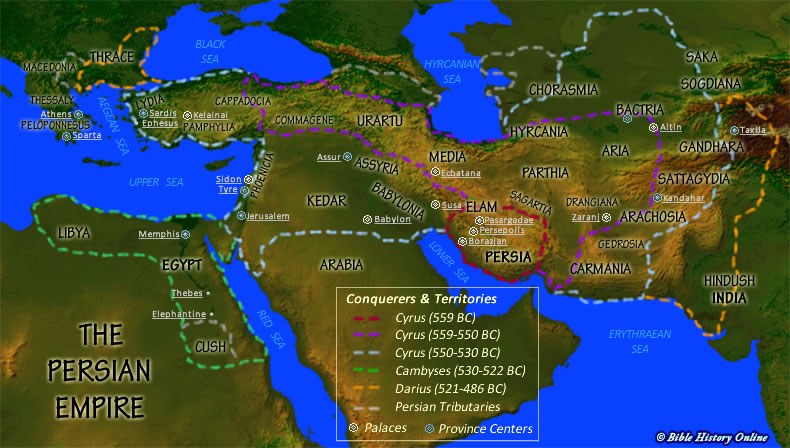
Map of the Persian Empire (550 - 486 B.C.)
Map of the Achaemenid Empire of Persia (PDF for Print) (Freely Distributed)
This map reveals the expansion of the Persian Empire from Cyrus the Great to Darius I, 550-486 BC. The Persian Achaemenid Empire was actually the last great empire of the ancient Near East. Its boundaries extended from the Aegean Sea in the west to the Indus River in the east, such a large empire was created in just a little over 10 years by Cyrus II the Great.
Cyrus the Great (559-530 BC)
Cyrus II, also known as Cyrus the Great was the founder of the Persian Empire. He was of the Achaemenid family and the vast Achaemenid Empire of the Persians reached from the Aegean Sea in the West all the way to Sagdiana in the East. It encompassed the former kingdom whom it had conquered, the Babylonian Empire.
Cyrus came to the throne about 559 BC when Persia was under the rule of the Medes, a kingdom to the north of Persia. The Median Empire extended from the middle of Turkey (Anatolia) in the West, to the area of Afghanistan in the East. In 550 BC Cyrus the Persian refused to submit to the Medes, and the King of Media immediately attacked Persia. Cyrus was victorious in battle at Pasargadae and moved on to capture the Median capital at Ecbatana. Cyrus brought into submission the whole former Median and Babylonian empires by 539 BC, and was finally killed in a battle against the pointed hats Scythian nomadic warriors in Central Asia.
Cyrus the Diplomat
Cyrus was a diplomatic ruler and this contributed greatly to his success. In contrast to the Babylonians and Assyrians Cyrus was merciful to his defeated enemies, and respected their customs and religions. He even allowed the conquered Jews in Babylon to return to their homeland and to rebuild the Temple of the Lord in Jerusalem.
The Decree of Cyrus
The Bible mentions in the book of Ezra that King Cyrus issued a decree from the Persian Palace at Achmetha (Ecbatana) to free the Jews, and allow them to return to Israel to rebuild their Temple in Jerusalem:
Ezra 6:2-3 "And there was found at Achmetha, in the palace that [is] in the province of the Medes, a roll, and therein [was] a record thus written: In the first year of Cyrus the king [the same] Cyrus the king made a decree [concerning] the house of God at Jerusalem, Let the house be builded, the place where they offered sacrifices, and let the foundations thereof be strongly laid."
The tomb of Cyrus epitaph reads "Oh man whoever you are, I am Cyrus who founded the empire of the Persians and was the king of Asia. Do not grudge me this monument."
Cambyses II (530-522 BC)
Later in 525 BC the son of Cyrus whose name was Cambyses came southward with the mighty Persian army and conquered Egypt in 529 BC, and he laid siege to several Egyptian cities including Memphis. His army marched all the way to the Mediterranean Sea and Libya surrendered to him. Though Egypt was conquered it relatively easily, maintaining Persian rule was not so easy. In fact the historian Herodotus records great disasters in the Persians attempts to subdue Nubia.
Note: It is interesting that the Elephantine Papyri documents written in Aramaic were discovered at Yeb (Elephantine) reveal that Cambyses found an armed Jewish colony at that location.
Cambyses suppressed any revolts in Egypt with brutality, but in 522 BC he learned about a revolt at Gaumata in his homeland and on his return he had an accident. According to Herodotus he cut himself with his own sword, got blood poisoning and died near Hamath in Syria. He had no sons to inherit the throne.
Darius I (521-486)
In 521 BC Darius I expanded the Persian Empire even further and conquered territories all the way to the Indus Valley, then he turned west all the way to Macedonia. Darius reorganized the empire into 20 provinces (satrapies) with heavy taxes. He also upgraded the 1600 mile Royal Road which ran from Susa, the capital of the Persian Empire, all the way to Sardis at the Aegean Sea. He had a massive relief carved on a cliff at Bisitun, along with a huge inscription commemorating his victories over his enemies. The inscription was written in the Persian, Elamite, and Akkadian languages. Part of this inscription was discovered at Elephantine. Darius I made Persepolis his capital city. When he conquered India he made it a satrapy of Hindush. In 513 BC he moved his armies across Thrace and Macedonia who immediately surrendered to him. The Ionian king Miletus revolted against him and Darius powerfully defeated him because of the burning of the provincial center at Sardis. Later in 490 BC the Persians were severely defeated by the Athenians at the battle of Marathon.
The History of Persia in Smith's Bible Dictionary
--The history of Persia begins with the revolt from the Medes and the accession of Cyrus the Great, B.C. 558. Cyrus defeated Croesus, and added the Lydian empire to his dominions. This conquest was followed closely by the submission of the Greek settlements on the Asiatic coast, and by the reduction of Caria and Lycia The empire was soon afterward extended greatly toward the northeast and east. In B.C. 539 or 538, Babylon was attacked, and after a stout defence fell into the hands of Cyrus. This victory first brought the Persians into contact with the Jews. The conquerors found in Babylon an oppressed race--like themselves, abhorrers of idols, and professors of a religion in which to a great extent they could sympathize. This race Cyrus determined to restore to their own country: which he did by the remarkable edict recorded in the first chapter of Ezra. Ezr 1:2-4 He was slain in an expedition against the Massagetae or the Derbices, after a reign of twenty-nine years. Under his son and successor, Cambyses, the conquest of Egypt took place, B.C. 525. This prince appears to be the Ahasuerus of Ezr 4:6 Gomates, Cambyses' successor, reversed the policy of Cyrus with respect to the Jews, and forbade by an edict the further building of the temple. Ezr 4:17-22 He reigned but seven months, and was succeeded by Darius. Appealed to, in his second year, by the Jews, who wished to resume the construction of their temple, Darius not only granted them this privilege, but assisted the work by grants from his own revenues, whereby the Jews were able to complete the temple as early as his sixth year. Ezr 6:1-15 Darius was succeeded by Xerxes, probably the Ahasuerus of Esther. Artaxerxes, the son of Xerxes, reigned for forty years after his death and is beyond doubt the king of that name who stood in such a friendly relation toward Ezra, Ezr 7:11-28 and Nehemiah. Ne 2:1-9 etc. He is the last of the Persian kings who had any special connection with the Jews, and the last but one mentioned in Scripture. His successors were Xerxes II., Sogdianus Darius Nothus, Artaxerxes Mnemon, Artaxerxes Ochus, and Darius Codomannus, who is probably the "Darius the Persian" of Nehemiah Ne 12:22 These monarchs reigned from B.C. 424 to B.C. 330. The collapse of the empire under the attack of Alexander the Great took place B.C. 330. More
Ezra 4:7 - And in the days of Artaxerxes wrote Bishlam, Mithredath, Tabeel, and the rest of their companions, unto Artaxerxes king of Persia; and the writing of the letter [was] written in the Syrian tongue, and interpreted in the Syrian tongue.
Ezra 4:3 - But Zerubbabel, and Jeshua, and the rest of the chief of the fathers of Israel, said unto them, Ye have nothing to do with us to build an house unto our God; but we ourselves together will build unto the LORD God of Israel, as king Cyrus the king of Persia hath commanded us.
Ezra 9:9 - For we [were] bondmen; yet our God hath not forsaken us in our bondage, but hath extended mercy unto us in the sight of the kings of Persia, to give us a reviving, to set up the house of our God, and to repair the desolations thereof, and to give us a wall in Judah and in Jerusalem.
Ezra 6:14 - And the elders of the Jews builded, and they prospered through the prophesying of Haggai the prophet and Zechariah the son of Iddo. And they builded, and finished [it], according to the commandment of the God of Israel, and according to the commandment of Cyrus, and Darius, and Artaxerxes king of Persia.
2 Chronicles 36:23 - Thus saith Cyrus king of Persia, All the kingdoms of the earth hath the LORD God of heaven given me; and he hath charged me to build him an house in Jerusalem, which [is] in Judah. Who [is there] among you of all his people? The LORD his God [be] with him, and let him go up.
Daniel 10:1 - In the third year of Cyrus king of Persia a thing was revealed unto Daniel, whose name was called Belteshazzar; and the thing [was] true, but the time appointed [was] long: and he understood the thing, and had understanding of the vision.
Ezra 1:2 - Thus saith Cyrus king of Persia, The LORD God of heaven hath given me all the kingdoms of the earth; and he hath charged me to build him an house at Jerusalem, which [is] in Judah.
Esther 1:3 - In the third year of his reign, he made a feast unto all his princes and his servants; the power of Persia and Media, the nobles and princes of the provinces, [being] before him:
Ezra 3:7 - They gave money also unto the masons, and to the carpenters; and meat, and drink, and oil, unto them of Zidon, and to them of Tyre, to bring cedar trees from Lebanon to the sea of Joppa, according to the grant that they had of Cyrus king of Persia.
Ezra 4:24 - Then ceased the work of the house of God which [is] at Jerusalem. So it ceased unto the second year of the reign of Darius king of Persia.
Daniel 10:20 - Then said he, Knowest thou wherefore I come unto thee? and now will I return to fight with the prince of Persia: and when I am gone forth, lo, the prince of Grecia shall come.
Esther 10:2 - And all the acts of his power and of his might, and the declaration of the greatness of Mordecai, whereunto the king advanced him, [are] they not written in the book of the chronicles of the kings of Media and Persia?
Daniel 11:2 - And now will I shew thee the truth. Behold, there shall stand up yet three kings in Persia; and the fourth shall be far richer than [they] all: and by his strength through his riches he shall stir up all against the realm of Grecia.
Esther 1:14 - And the next unto him [was] Carshena, Shethar, Admatha, Tarshish, Meres, Marsena, [and] Memucan, the seven princes of Persia and Media, which saw the king's face, [and] which sat the first in the kingdom;)
Esther 1:18 - [Likewise] shall the ladies of Persia and Media say this day unto all the king's princes, which have heard of the deed of the queen. Thus [shall there arise] too much contempt and wrath.
Ezra 1:8 - Even those did Cyrus king of Persia bring forth by the hand of Mithredath the treasurer, and numbered them unto Sheshbazzar, the prince of Judah.
2 Chronicles 36:20 - And them that had escaped from the sword carried he away to Babylon; where they were servants to him and his sons until the reign of the kingdom of Persia:
Ezra 7:1 - Now after these things, in the reign of Artaxerxes king of Persia, Ezra the son of Seraiah, the son of Azariah, the son of Hilkiah,
Ezekiel 27:10 - They of Persia and of Lud and of Phut were in thine army, thy men of war: they hanged the shield and helmet in thee; they set forth thy comeliness.
Daniel 8:20 - The ram which thou sawest having [two] horns [are] the kings of Media and Persia.
Ezekiel 38:5 - Persia, Ethiopia, and Libya with them; all of them with shield and helmet:
Ezra 1:1 - Now in the first year of Cyrus king of Persia, that the word of the LORD by the mouth of Jeremiah might be fulfilled, the LORD stirred up the spirit of Cyrus king of Persia, that he made a proclamation throughout all his kingdom, and [put it] also in writing, saying,
2 Chronicles 36:22 - Now in the first year of Cyrus king of Persia, that the word of the LORD [spoken] by the mouth of Jeremiah might be accomplished, the LORD stirred up the spirit of Cyrus king of Persia, that he made a proclamation throughout all his kingdom, and [put it] also in writing, saying,
Ezra 4:5 - And hired counsellors against them, to frustrate their purpose, all the days of Cyrus king of Persia, even until the reign of Darius king of Persia.
Daniel 10:13 - But the prince of the kingdom of Persia withstood me one and twenty days: but, lo, Michael, one of the chief princes, came to help me; and I remained there with the kings of Persia.