Geography & the Bible provides brief geographical insights about the ancient world.
What is Geography?
Geography comes from two Greek words "geo" which means 'of the earth', and "grapho" which means 'to write', and together they mean 'to write about or describe the earth.' To the ancient Greeks geography was a scientific method of describing the earth, its lands and all of its contents and details.
What is Biblical Geography?
Biblical Geography is the study of Bible lands, and an examination of the places and features that are within the boundaries of those lands. Becoming familiar with the geographical background of the ancient biblical world is essential for a better understanding of the Bible. The Bible mentions rivers, mountains, details about topography, and even nations and empires that all had geographical boundaries.
The Importance of Biblical Geography
Biblical Geography is important because God is in history, and history is forever connected to the geography of the land from which the events in history occurred. All the events in the Bible happened in time, and happened in a certain place, on a mountain or near a river, on a boat in a lake, in a valley, or on the seacoast. In fact the God of history also fashioned geography, because God is in control and even "the king's heart is in the hand of the Lord, as the rivers of the water he turns it wherever he wills." (Proverbs 21:1). God reveals in the Bible that he led Abraham to a certain land, and that he fashioned that land in a very special way. Geography is also important when studying the Bible because it brings more understanding and insight into the context of Scripture. The Bible is alive and the LORD illuminates our heart as the Scriptures enter us, and a geographical understanding can make the study of the word more beautiful. Probably the most important aspect of biblical geography is when looking at the life of Jesus Christ. When God chose to come to this world clothed in human flesh, the Bible says he came to his home (John 1:11 - RSV). Jesus was born in the land of Israel in a specific place called Bethlehem. He grew up in Nazareth, and went to Jerusalem for the Passover. He was baptized in the Jordan River and ministered throughout geographical areas within the land of Israel. Geography plays an important role in the life of Christ, and he was very aware of the rich history of each and every place he went in his life.
Biblical Geography and Archaeology
Archaeologists have made thorough examination of the ancient near East, the Roman Empire, and all the lands in Bible history. There have been absolutely no discrepancies ever discovered, and in fact many archaeologists stand in awe of the accuracy of the biblical text.
"There are more sure marks of authenticity in the Bible than in any profane history." - Sir Isaac Newton
Biblical Geography and Bible Study
The Bible is the word of God, and accurately reveals the locations where the events within the Bible happened in history. The study of geography is part of a good foundation for Bible study, and a good overview of the background of Bible lands is a worthwhile endeavor. It is highly recommended to use maps and a Bible dictionary when studying Scripture.
Maps
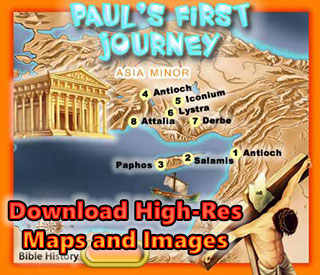
Bible MapsA growing database of maps for study and teaching.
ReconstructionsSketches of ancient cities & monuments from archaeology.
Kids Bible Maps- Educational maps for Bible students of all ages.
Ancient Israel Map. This growing map shows the cities existing during the time of Jesus, the first century AD.
Map of Old Testament Israel- This Growing Interactive map of ancient Israel has important locations mentioned in the Old Testament.
Map of the Roman Empire - This map contains important cities and regions within the Roman Empire during period of the New Testament.
Enlarged Map of the Roman Empire - This offers a much larger version of the Interactive map of the Roman Empire during the early first century AD.
Map of Ancient Jerusalem - Interactive map of Second Temple Jerusalem with information about Jerusalem during the first century AD.
Israel, The Center of the World.Little did the descendants of Abraham, also known as the Hebrews, realize what was in store for them as they entered into the land of Canaan. Their relatively small territory was right in the heart of the ancient world and on the borders of three gigantic land masses, Asia, Africa and Europe. Every great kingdom around them, from the north, south, east and west, along with their conquering monarchs would be confronted with Israel and learn about their people, their laws and the holy Oracles of the One whose kingdom will never pass away.
Seasons and Months in Palestine. Everyday life in ancient Israel was largely affected by that which was beyond the control of man, the seasons and the weather. This section contains a brief sketch of the seasons, climate, rainfall, dews, and months of Israel.
Jerusalem Fashioned For A King. Long before the threshing floor of Araunah was ever purchased by David or the Temple of Solomon had ever become a twinkle in Solomon's eye, Jerusalem had long been strategically set apart in the providence of an Almighty God as the city of the great King. Not until the foundations of the great Temple of Solomon were being laid was there even the slightest glimpse of the wealth of resources available below the ground level of the magnificent city of Jerusalem.
The Influence of the Mediterranean Sea. Everything came to Israel by way of the Great Sea. The Roman rule and the procurator who condemned Jesus to death; as well as the Greek language, and that Greek view of life which not only created the ten cities of Decapolis but deeply influenced the more liberal Jews.
Ancient Roman Roads. The Roman road was the bloodstream of the empire. Merchants paid taxes to Rome on all their transactions, and they needed the roads to carry their goods to an ever-widening market. Legionnaires marched upon them swiftly gaining efficient access to battle. In a sense, the roads were funding and facilitating Roman expansion. Yet God had a higher purpose. A new kind of merchant would soon be traversing the entire Mediterranean area, not one who transports his treasure to the city marketplace, but one who is a treasure, and who carries true riches, - not to sell, but to give away freely.
The Fertile Crescent. The Bible mentions that civilization began in the land between the two rivers, the Tigris and the Euphrates. The Fertile Crescent was an arc of land that was cultivated by these two rivers, which extended from ancient Mesopotamia up the Tigris and Euphrates rivers and over to the Mediterranean Sea, and down into Egypt and the Nile River.
Ur of the Chaldees. The Bible reveals the exact name of the city that Abraham lived in when God called him. It was called Ur of the Chaldees, and for centuries many scholars believed it to be a myth and a biblical legend along with other cities like Nineveh. Recently archaeologists have uncovered the ruins of this mighty Sumerian city in ancient Mesopotamia, the land between two rivers.
Coming SoonGrowing up in Nazareth. Nazareth was a special place chosen by God for Jesus to grow up. From His home in Nazareth he could see a wealth of historical landmarks, as well as the growing cultures of the world, and nature's allegorical lessons.
Coming SoonAncient City Search This searches cities of the ancient world and brings up a description about each city. Coming soon.