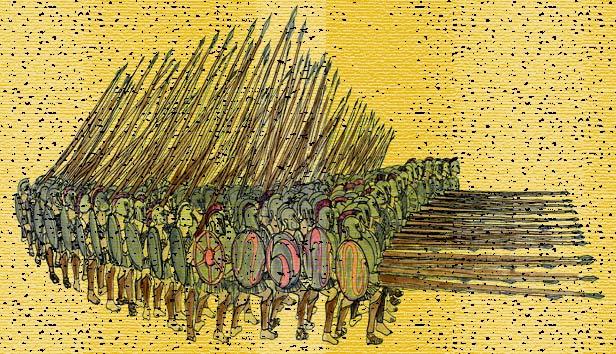
Illustration of the Greek Phalanx Positioned for Battle
The sketch illustrates the deadly formation of the Phalanx in ancient Greek warfare.
The Phalanx was a term used as far back as the writings of Homer, but the deadly combat formation was perfected around the seventh century B.C. The hoplite soldiers lined up in single file about 8 men in each line, side by side. Their formation was about 8 feet apart per hoplite which was open enough for a skirmisher to pass through to the back. Just when the battle was about to commence the men in the back would swiftly close their line to 3 feet distance per soldier and he would speedily maneuver the left side of his shield to cover the soldier to his left and lock shields. The hoplite soldier could easily thrust his spear over this wall of shields. If a soldier fell, one from the rear would replace him. Officers and even generals would often fight in the front line of battle to risk his life with the soldier next to him. The Phalanx battle formation moved like one man and was designed to swiftly force the enemy off the battlefield.
The Bible mentions a lot Concerning "Warfare"
1 Corinthians 9:7 - Who goeth a warfare any time at his own charges? who planteth a vineyard, and eateth not of the fruit thereof? or who feedeth a flock, and eateth not of the milk of the flock?
1 Samuel 28:1 - And it came to pass in those days, that the Philistines gathered their armies together for warfare, to fight with Israel. And Achish said unto David, Know thou assuredly, that thou shalt go out with me to battle, thou and thy men.
1 Timothy 1:18 - This charge I commit unto thee, son Timothy, according to the prophecies which went before on thee, that thou by them mightest war a good warfare;
Isaiah 40:2 - Speak ye comfortably to Jerusalem, and cry unto her, that her warfare is accomplished, that her iniquity is pardoned: for she hath received of the LORD'S hand double for all her sins.
2 Corinthians 10:4 - (For the weapons of our warfare [are] not carnal, but mighty through God to the pulling down of strong holds;)
The weapons man has used throughout the centuries have become increasingly lethal and efficient killing machines, keeping pace with our development and education. Ancient warfare can seem brutal and barbaric but it pales in comparison to our modern battlefields and the destructive capability we have achieved today.
Assyrian bowmen can rain havoc on an army when shot simultaneously by thousands of warriors. And today we can now release unfathomable destruction from a single Ohio Class Submarine capable of launching 24 Trident nuclear missiles from underwater within a 4,000 mile range, with each missile carrying 8 independently targeted 100KT warheads.
By comparison, the nuclear bomb dropped on Hiroshima on August 6, 1945 was a 13KT weapon which killed 70,000 people instantly and an estimated 140,000 due to injuries. The plutonium weapon dropped on Nagasaki on August 9, 1945 was 21KT weapon which produced an estimated 80,000 total deaths, the lower number due to the drop site being within in an industrial valley with some containment provided by surrounding mountains.
Living in the western world with World War II a subject in history books, and residing in relative peace in our own lands, we can think of ourselves as sort of a more evolved being than those we study from the past. But is this really true? What would happen if reality suddenly changed and we became under attack in our neighborhoods from a hostile force?
Rod Serling in his famous series "The Twilight Zone" dedicated an episode to exploring the idea of placing a middle class neighborhood of typical good friends under the sudden pressure of an impending attack to see what our character would produce. It's in three short parts on YouTube called "The Shelter". How would our character respond if the peace we take for granted suddenly disappeared?