You are here:HomeResources
The Eruption of Mount Vesuvius
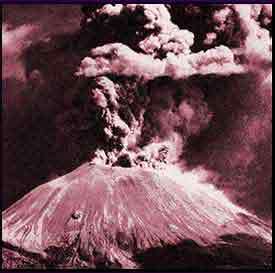
1944 Navy photograph of a Vesuvius Eruption.
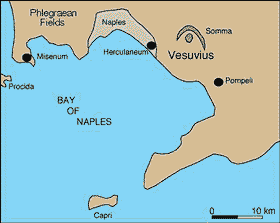
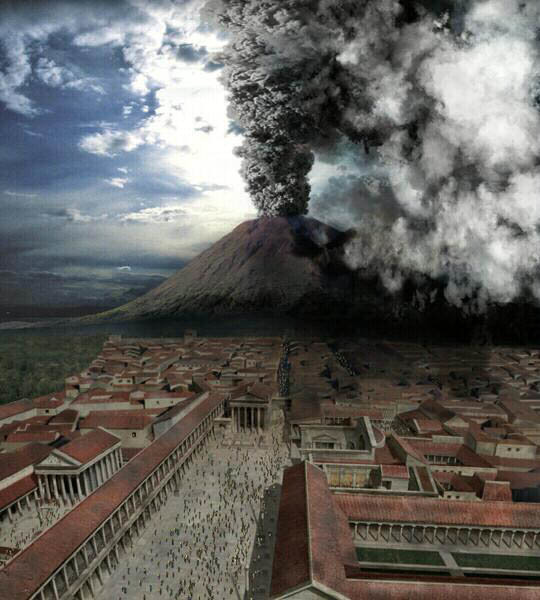
The Eruption of Mt. Vesuvius When Mount Vesuvius erupted in 79 A.D. the cities of Pompeii and Herculaneum were buried by an avalanche of boiling mud and lava. Pompeii was buried about 20-40 feet underground and Herculaneum about 60-75 feet. A young historian named Pliny the Younger witnessed the whole event from Misenum, about 20 miles away.
Pliny The Younger Saw The Whole Thing In the summertime of 79 A.D. a young student around the age of 18 named Gaius Plinius (Pliny the Younger) had no idea that he would spectate one of the most unbelievable catastrophies in the history of the world. He was staying with his mother and his uncle (Pliny the Elder) at a villa in the city of Misenum, which is located on the Bay of Naples, about 20 miles from Mount Vesuvius.
He witnessed Mount Vesuvius erupt and completely bury the cities of Pompeii and Herculaneum. His uncle, Pliny the Elder, died that day but Gaius survived and wrote a startling account to the Roman historian Tacitus of what he saw, in 2 long letters. Here are some translated excerpts of what he wrote:
"On August 24, about one in the afternoon, my mother drew my uncle's attention to a cloud of unusual size and appearance. It was not clear from a distance as to which mountain the cloud was rising from, although it was afterward known to be Vesuvius. The cloud's appearance can best be described as looking like an umbrella pine (Meditteranean pine tree), for it rose to a great height on sort of a trunk and then split off into branches. I believe, because it was first driven by a sudden gust of air (recenti spiritu eiecta), then, with its diminution or because of the weight, the cloud expanded laterally, sometimes white, sometimes dark and stained by the sustained sand and ash (pondere suo victa in latitudinem vanescebat, candida interdum, interdum sordida et maculosa prout terram cineremque sustulerat)."
His uncle (Pliny the Elder) being commander of the naval fleet at Misenum, apparently realized, according to Gaius's account, that Vesuvius was erupting and decided to take some ships across the bay to rescue whoever he could. It was impossible to come too close to land because of the hot, thick ashes and pumice (large chunks of lava), and so they headed for Stabiae, a city 3 miles south of Pompeii, and he came to the home of a friend, Pomponianus, who could not leave because of the opposing wind. So they waited. They watched Vesuvius, of which it is said that there was:
"broad streets of fire and leaping flames blazed at many points, their brightglow empasized by the darkness of night."
Pliny the Elder was completely helpless to do anything and his hope of a rescue mission was impossible and he and the men with him were in great danger. Gaius wrote about this also:
"they debated whether to stay indoors or take their chances out in the open, for buildings were shaking with violent shocks and seemed to be swaying to and fro as if torn from their foundations. Outside, on the otherhand, there was danger of falling pumice stones..."
To see a 17th Century Painting of Vesuvius erupting click here
Coming to Stabiae proved to be a fatal decision. They decided to leave at daybreak and the flames and sulfer fumes were too unbearable for Pliny the Elder and he passed out and died. It is recorded that he was also asthmatic. Some of his men made it to Misenum and Gaius heard the news about his uncle. Things were still in turmoil and Gaius and his mother ran to an open field to avoid the collapsing buildings. He wrote:
"even the sea seemed to roll back on itself, pushed back by earth tremors. Many fish were beached on the sand. In the other direction gaped a horrible black cloud torn by zigzag flashes and masses of flames, like lightning but much larger...at night time we were enveloped, not a moonless night or one dimmed by cloud, but the darkness of a sealed room without a lamp. After a while we were reached by another cloud - Again the obscurity, again the ash, dense and heavy. We raised some time to shake away the ash as we could have been covered and choked by its weight- ("Tenebrae rursus, cinis rursus, multus et gravis. Hunc identidem adsurgentes excutiebamus; operti alioqui atque etiam oblisi pondere essemus."
"Only the shrill cries of women, the wailing of children, and the shouting of men. Some were calling to their to their parents, others to their children, others to their wives...Many lifted up their hands to the gods, but most were convinced that there were now no gods at all and that this night was the end of the world. Finally the darkness lightened, and then like smoke or cloud dissolved away. Daylight returned, and the sun shone out, though luridly, as it does when an eclipse is coming"
Mount Vesuvius The peak of the volcano was completely blown off and Vesuvius was split into two smaller peaks. The column of ash was around 20 miles tall. Vesuvius has erupted over 30 times since the great 79 A.D eruption. In fact there has been a lot of activity this century, especially from 1913-1944 which scientists believe to be an end of an eruptive cycle that began in the 17th century. There are no signs of volcanic unrest at Vesuvius at the present time.
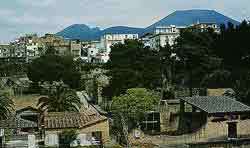
Herculaneum with Vesuvius in the background. To see Vesuvius from the temple of Apollo in Pompeii click here
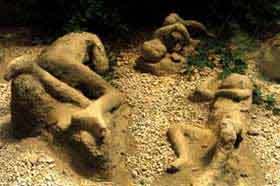
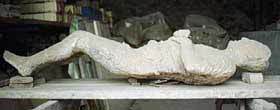
Pompeii and Herculaneum The cities of Pompeii and Herculaneum were buried by an avalanche of boiling mud and lava. Pompeii was buried about 20-40 feet under and Herculaneum was under 60-75 feet. The cities were abandoned and their location forgotten. In 1595 their were some expeditions in the area of Pompeii by the order of Charles III, King of the Two Sicilies, and some artifacts were discovered which caused much pillaging. Then some Archeological excavations began in the mid-nineteenth century. Today much of Pompeii has been excavated, and along with it ghostly stories of people who had been trying to save their lives. There are numerous molds of people and animals found.
To see more photos click: photo one, two, three Also you may want to try a Zsearch on Pompeii.
The excavations have taught us much of how the people lived during that time period. There are other records of the destruction of Herculaneum and Pompeii in writings such as those of Marcus Aurelius (121-180 AD) and in Dio Cassius (AD 150-235) who also reports that the ashes of the eruption reached Africa (the modern Libya), Syria and Egypt, and caused pestilence.
The poem of Martial (40-104 AD) describes Vesuvius:
"once covered by green grapes, now submerged under flames and lapilli."
Mount Vesuvius in Wikipedia
Mount Vesuvius By the 1st century, Pompeii was only one of a number of towns located around the base of Mount Vesuvius. The area had a substantial population which grew prosperous from the region's renowned agricultural fertility. Many of Pompeii's neighboring communities, most famously Herculaneum, also suffered damage or destruction during the 79 eruption. The 79 eruption, which is thought to have lasted about 19 hours, released about 1 cubic mile (4 cubic kilometres) of ash and rock over a wide area to the south and south-east of the crater, with about 3 m (10 ft) of tephra falling on Pompeii. The white ash produced by this eruption is mainly of leucite and phonolite. Full Article
Mount Vesuvius Eruption Re-Enactment
The Bible Mentions the Fire, Smoke and "Brimstone" in Volcano Eruptions
Isaiah 34:9 - And the streams thereof shall be turned into pitch, and the dust thereof into brimstone, and the land thereof shall become burning pitch.
Revelation 19:20 - And the beast was taken, and with him the false prophet that wrought miracles before him, with which he deceived them that had received the mark of the beast, and them that worshipped his image. These both were cast alive into a lake of fire burning with brimstone.
Revelation 14:10 - The same shall drink of the wine of the wrath of God, which is poured out without mixture into the cup of his indignation; and he shall be tormented with fire and brimstone in the presence of the holy angels, and in the presence of the Lamb:
Deuteronomy 29:23 - [And that] the whole land thereof [is] brimstone, and salt, [and] burning, [that] it is not sown, nor beareth, nor any grass groweth therein, like the overthrow of Sodom, and Gomorrah, Admah, and Zeboim, which the LORD overthrew in his anger, and in his wrath:
Isaiah 30:33 - For Tophet [is] ordained of old; yea, for the king it is prepared; he hath made [it] deep [and] large: the pile thereof [is] fire and much wood; the breath of the LORD, like a stream of brimstone, doth kindle it.
Ezekiel 38:22 - And I will plead against him with pestilence and with blood; and I will rain upon him, and upon his bands, and upon the many people that [are] with him, an overflowing rain, and great hailstones, fire, and brimstone.
Genesis 19:24 - Then the LORD rained upon Sodom and upon Gomorrah brimstone and fire from the LORD out of heaven;
Revelation 21:8 - But the fearful, and unbelieving, and the abominable, and murderers, and whoremongers, and sorcerers, and idolaters, and all liars, shall have their part in the lake which burneth with fire and brimstone: which is the second death.
Revelation 20:10 - And the devil that deceived them was cast into the lake of fire and brimstone, where the beast and the false prophet [are], and shall be tormented day and night for ever and ever.
Psalms 11:6 - Upon the wicked he shall rain snares, fire and brimstone, and an horrible tempest: [this shall be] the portion of their cup.
Revelation 9:18 - By these three was the third part of men killed, by the fire, and by the smoke, and by the brimstone, which issued out of their mouths.
Luke 17:29 - But the same day that Lot went out of Sodom it rained fire and brimstone from heaven, and destroyed [them] all.
Job 18:15 - It shall dwell in his tabernacle, because [it is] none of his: brimstone shall be scattered upon his habitation.
Revelation 9:17 - And thus I saw the horses in the vision, and them that sat on them, having breastplates of fire, and of jacinth, and brimstone: and the heads of the horses [were] as the heads of lions; and out of their mouths issued fire and smoke and brimstone.