You are here:HomeResources
The Burial Place of Herod the Great
Herod's Desert Fortification - The Herodium
King Herod the Great was one of the most powerful men, and greatest builders of all time. Yet, he was so despised that at his death he ordered the death of many prominent Jews so that there would be weeping in Jerusalem. He was buried at his desert palace, the Herodium.
"Two hundred steps of purest white marble led up to it. Its top was crowned with circular towers; its courtyard contained splendid structures." - Jewish Wars FLAVIUS JOSEPHUS
Herodthe Great
For 40 years, Jewish history was dominated by HEROD THE GREAT. He was born in about 73 BC, the son of ANTIPATER, who was an Idumean. The Idumaeans were a tribe who had been forced by the Nabatean Arabs westwards into southern Judea, where they had been forcibly converted to Judaism by the Hasmonean rulers of Palestine. The Idumaeans were for this reason Jews of a recent and suspect background. At the same time they were shrewd, and had no problem with making political deals with the Romans for their own advantage.
King Herod's father, Antipater, governed them from about 47 BC. He also served as an advisor to Hyrcanus, and gained the confidence of Pompey. When Julius Caesar was besieged in Alexandria in 48 BC it was Antipater who persuaded the Jews to aid Caesar. In gratitude Caesar gave the Jews important privileges.
Antipater's son, Herod the Great, was an opportunist of the highest order. During the tumultuous years of the Roman civil wars he skillfully shifted his allegiance from Pompey to Caesar to Antony to Octavian (Augustus). Because he was such an able soldier the Romans valued his services. Rome needed a shrewd and capable agent in Palestine, and in Herod the Great they felt they had found such a man. He provided a strong buffer-state for Rome against the Nabatean Arabs to the south and the Parthians to the east.
Matthew 2:1 "Now when Jesus was born in Bethlehem of Judaea in the days of Herod the king, behold, there came wise men from the east to Jerusalem"
Herod Appointed King
Herod was appointed king of Judea by Marc Antony in 40 BC, and was supported by Roman soldiers in his fight to gain control of Judea in 37. From that time he relied on Gentile soldiers, including the Celtic bodyguard of Cleopatra which had been granted to him by Octavian. He transformed the ancient city of Samaria into Sebaste for his foreign mercenaries. He also built Palestine's first deep-water port of Caesarea. He built fortresses and palaces, including Masada, and a magnificent new temple. He also presided at the Olympic Games.
Herod's Pathological Character
Though successful in politics, Herod was bitterly unhappy in his private life. He married ten wives, including the beautiful Hasmonean princess, Mariamme, the granddaughter of both Hyrcan and Aristobulus. Though he loved her passionately, he suspected her of infidelity and had her executed along with her mother. Later, in 7 BC, he had her two sons killed. Herod kept an uneasy peace by dealing ruthlessly with suspected rivals and troublemakers. He systematically killed off all living claimants to the Hasmonean kingship, including his young brother-in-law, the high priest Aristobulus. When he found that his favorite son, Antipater, had been plotting against him, he had him executed along with two of their brothers - just five days before his own death in 4 BC.
The Roman Emperor Augustus said about Herod: "I would rather be Herod's pig than Herod's son." It is easy to imagine such a man ordering the massacre of all male infants in Bethlehem for no better reason than a vague rumor that one had been born "King of the Jews." This event vividly reflects the pathological character of the king. He murdered members of his own family, yet scrupulously observed Mosaic dietary laws and would eat no pork.
His court was Hellenized and cultured. He ruled as an autocrat, supported by police, and, despite his rebuilding of the Temple, to the Jews he remained a detested foreigner and a usurper. Most Jews openly hoped for his death calling him "the wicked."
Herod's Buildings
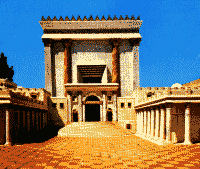
Herod was a prodigious builder, as recent archaeological excavations have shown His rebuilding of the temple in Jerusalem, begun in 19 BC, was an architectural marvel. Final work on the temple was completed just six years before it was destroyed by the Romans in AD 70. All that remains today is the great platform whose western side is the Wailing Wall, where Jews today still lament the destruction of the temple. You can see the size of the Wailing Wall compared to its original size by clicking here and be sure to notice the reddish rectangular box which is the area known today as the Western Wall.
The Jews prided in Herod's accomplishment until Herod placed a huge Roman eagle over the most important gate of the new Temple. Before long there was a conspiracy to pull the eagle down. When rumor circulated that Herod was dying, a group of young men gathered before the gate on which the golden eagle was set and began to pull it down. The soldiers interfered and arrested about forty of them. Herod was so enraged at this sign of insubordination and insult to Rome, that he had the "rebels" burned alive.
Spectacular remains have also been uncovered at the fortress of Masada on the western shore and of Machaerus on the eastern shore of the Dead Sea. Machaerus was the fortress where John the Baptist was imprisoned. Other splendid structures from Herod's time have been found at Jericho, where Herod died, and at Herodium, where he was buried. If you want to see some of the marvelous buildings of Herod's Jerusalem then go to the category "Jesus" and to the sub-category "Images and Art" and check out the various buildings photos. They are between 50-100k in filesize but should be fast loading.
The Death of Herod Herod died in 4 BC at the age of 69. Remember in the Bible where it talks about how Joseph stayed in Egypt until the death of Herod to fulfill what the Lord has said through the prophet: "Out of Egypt l have called my son." Matt 2:15.
Matthew 2:19 - But when Herod was dead, behold, an angel of the Lord appeareth in a dream to Joseph in Egypt,
The historian, Josephus, describes the death of Herod at great length. I will summarize the event:
When Herod's health began to fail him rapidly, he was moved to his winter capital in Jericho. From there he was carried by stretcher to the hot springs on the shores of the Dead Sea. The springs did no good; Herod returned home. Racked by despondency, Herod attempted suicide. Rumors of the attempt caused loud wailing throughout the palace. Herod's son, imprisoned by his paranoid father, mistook the cries to mean his father was dead. Immediately, he tried to bribe his jailers, who reported the bribery attempt to Herod. The sick king ordered his son executed on the spot. Now Herod plunged deeper into depression. He was only days away from his own death- and he knew it. What pained him most was the knowledge that his death would be met with joy in Judea. To forestall this, he devised an incredible plan.
"Having assembled the most distinguished men from every village from one end of Judea to the other, he ordered them to be locked in the hippodrome at Jericho."
- Jewish Wars FLAVIUS JOSEPHUS
Herod then gave the order to execute them at the very moment he, himself, died. His sick mind reasoned that their death would dispel any joy in Judea over his own death. The order was never carried out. After Herod's death, his body was carried in procession from Jericho to the Herodium outside Bethlehem for burial. Herod's body was adorned in purple, a crown of gold rested on his head, and a scepter of gold was placed in his hand. The bier bearing his body was made of gold and studded with jewels that sparkled as it was carried along under the desert sun. Following the bier was Herod's household and hundreds of slaves, swinging censers. Slowly, the procession inched its way up the mountainside to the Herodium, where it was laid to rest.
Today, the excavated ruins of the Herodium stand out grandly against the clear blue sky- reminding Bethlehem-bound tourists of the king who sought to kill the child whom they have come so far to honor.
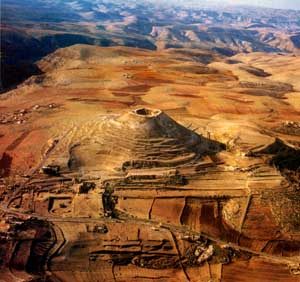
The Herodium Herod the great built this fortification in the desert in 37 BCE. Looking like a volcano, the Herodium is one of several fortress-palaces built by Herod the Great. It was artificially shaped, with everything placed inside its protected craterlike top.
Josephus wrote of this astounding complex, the Herodium:
"Herod built round towers all about the top, and filled the remaining space with costly palaces...he brought a mighty quantity of water from a great distance, and raised an ascent of two hundred steps of purest white marble that led up to it. Its top was crowned with circular towers; its courtyard contained splendid structures."
Testifying to this description, beginning in the 1960s archaeologists have unearthed remains of the fortification towers, palace, and the courtyard with colonnaded halls, the walls painted with frescoes, can still be seen. A classical Roman bath house, one of the earliest synagogues ever found, and huge underground cisterns all helped to create one of the largest and most sumptuous palaces of the Roman Empire.
Interesting note: Our system of dating BC/AD was devised by a monk in the sixth century AD. However, he miscalculated the reign of the Emperor Augustus by four years. Jesus must have been born before Herod's death in 4 BC.
Herod the Great in Smith's Bible Dictionary
Herod I. HEROD THE GREAT was the second son of Antipater, an Idumean, who was appointed procurator of Judea by Julius Caesar, B.C. 47. Immediately after his father's elevation when only fifteen years old, he received the government of Galilee and shortly afterward that of Coele-Syria. Though Josephus says he was 15 years old at this time, it is generally conceded that there must be some mistake, as he lived to be 69 or 70 years old, and died B.C. 4; hence he must have been 25 years old at this time.--ED.) In B.C. 41 he was appointed by Antony tetrarch of Judea. Forced to abandon Judea the following year, he fled to Rome, and received the appointment of king of Judea. In the course of a few years, by the help of the Romans he took Jerusalem (B.C. 37), and completely established his authority throughout his dominions. The terrible acts of bloodshed which Herod perpetrated in his own family were accompanied by others among his subjects equally terrible, from the number who fell victims to them. According to the well-known story) he ordered the nobles whom he had called to him in his last moment to be executed immediately after his decease, that so at least his death might be attended by universal mourning. It was at the time of his fatal illness that he must have caused the slaughter of the infants at Bethlehem. Mt 2:16-18 He adorned Jerusalem with many splendid monuments of his taste and magnificence. The temple, which he built with scrupulous care, was the greatest of these works. The restoration was begun B.C. 20, and the temple itself was completed in a year and a half. But fresh additions were constantly made in succeeding years, so that it was said that the temple was "built in forty and six years," Joh 2:20 the work continued long after Herod's death. (Herod died of a terrible disease at Jericho, in April, B.C. 4, at the age of 69, after a long reign of 37 years. Full Article
Herod the Great in the Bible Encyclopedia - ISBE
Herod (3) Characteristics and Domestic Life. The personality of Herod was impressive, and he was possessed of great physical strength. His intellectual powers were far beyond the ordinary; his will was indomitable; he was possessed of great tact, when he saw fit to employ it; in the great crises of his life he was never at a loss what to do; and no one has ever accused Herod the Great of cowardice. There were in him two distinct individualities, as was the case with Nero. Two powers struggled in him for the mastery, and the lower one at last gained complete control. During the first part of his reign there were evidences of large-heartedness, of great possibilities in the man. But the bitter experiences of his life, the endless whisperings and warnings of his court, the irreconcilable spirit of the Jews, as well as the consciousness of his own wrongdoing, changed him into a Jewish Nero: a tyrant, who bathed his own house and his own people in blood. The demons of Herod's life were jealousy of power, and suspicion, its necessary companion. He was the incarnation of brute lust, which in turn became the burden of the lives of his children. History tells of few more immoral families than the house of Herod, which by intermarriage of its members so entangled the genealogical tree as to make it a veritable puzzle. As these marriages were nearly all within the line of forbidden consanguinity, under the Jewish law, they still further embittered the people of Israel against the Herodian family. When Herod came to the throne of Judea, Phasael was dead. Joseph his younger brother had fallen in battle (Ant., XIV, xv, 10), and only Pheroras and Salome survived. The first, as we have seen, nominally shared the government with Herod, but was of little consequence and only proved a thorn in the king's flesh by his endless interference and plotting. To him were allotted the revenues of the East Jordanic territory. Salome, his sister, was ever neck-deep in the intrigues of the Herodian family, but had the cunning of a fox and succeeded in making Herod believe in her unchangeable loyalty, although the king had killed her own son-in-law and her nephew, Aristobulus, his own son. The will of Herod, made shortly before his death, is a convincing proof of his regard for his sister (Ant., XVII, viii, 1). His domestic relations were very unhappy. Of his marriage with Doris and of her son, Antipater, he reaped only misery, the son, as stated above, ultimately falling a victim to his father's wrath, when the crown, for which he plotted, was practically within his grasp. Herod appears to have been deeply in love with Mariamne, the grandchild of Hyrcanus, in so far as he was capable of such a feeling, but his attitude toward the entire Asmonean family and his fixed determination to make an end of it changed whatever love Mariamne had for him into hatred. Ultimately she, as well as her two sons, fell victims to Herod's insane jealousy of power. Like Nero, however, in a similar situation, Herod felt the keenest remorse after her death. As his sons grew up, the family tragedy thickened, and the court of Herod became a veritable hotbed of mutual recriminations, intrigues and catastrophes. The trials and executions of his own conspiring sons were conducted with the acquiescence of the Roman power, for Herod was shrewd enough not to make a move without it. Yet so thoroughly was the condition of the Jewish court understood at Rome, that Augustus, after the death of Mariamne's sons (7 BC), is said to have exclaimed: "I would rather be Herod's hog hus than his son huios." At the time of his death, the remaining sons were these: Herod, son of Mariamne, Simon's daughter; Archelaus and Antipas, sons of Malthace, and Herod Philip, son of Cleopatra of Jerusalem. Alexander and Aristobulus were killed, through the persistent intrigues of Antipater, the oldest son and heir presumptive to the crown, and he himself fell into the grave he had dug for his brothers. Full Article
The Bible Mentions a lot Concerning "Herod"
Matthew 2:1 - Now when Jesus was born in Bethlehem of Judaea in the days of Herod the king, behold, there came wise men from the east to Jerusalem,
Matthew 2:13 - And when they were departed, behold, the angel of the Lord appeareth to Joseph in a dream, saying, Arise, and take the young child and his mother, and flee into Egypt, and be thou there until I bring thee word: for Herod will seek the young child to destroy him.
Matthew 2:16 - Then Herod, when he saw that he was mocked of the wise men, was exceeding wroth, and sent forth, and slew all the children that were in Bethlehem, and in all the coasts thereof, from two years old and under, according to the time which he had diligently enquired of the wise men.
Matthew 2:22 - But when he heard that Archelaus did reign in Judaea in the room of his father Herod, he was afraid to go thither: notwithstanding, being warned of God in a dream, he turned aside into the parts of Galilee:
Luke 1:5 - There was in the days of Herod, the king of Judaea, a certain priest named Zacharias, of the course of Abia: and his wife [was] of the daughters of Aaron, and her name [was] Elisabeth.
Matthew 2:7 - Then Herod, when he had privily called the wise men, enquired of them diligently what time the star appeared.
Matthew 2:19 - But when Herod was dead, behold, an angel of the Lord appeareth in a dream to Joseph in Egypt,
Matthew 2:15 - And was there until the death of Herod: that it might be fulfilled which was spoken of the Lord by the prophet, saying, Out of Egypt have I called my son.