Who built the Great Pyramid and how did they build it? Since the earliest of times the "Great Pyramid" of Giza (Arab. Al Jizah ) along with its 2 other main pyramids have been considered one of the wonders of the world.
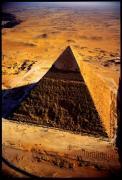
One of the Wonders of the Ancient World The Great Pyramid is still among the world's largest structures, standing almost as tall as a 50 story skyscraper. The 3 main pyramids were built as tombs for 3 Egyptian Pharaohs who were considered to be gods on earth. The first and largest pyramid, known as the Great Pyramid was a tomb for Pharaoh Khufu (Cheops to the Greeks), who ruled the 4th dynasty around 2575 BC, which would have been centuries before Abraham, the first Hebrew. But the real marvel of this Great Pyramid was its massive size.
"We're talking about a society where they didn't have cameras, You didn't see great images. And so here are these stupendous, gigantic things thrusted up to the sky, polished white limestone, blazing in the sunshine. and there's Khufu, the biggest thing on the planet actually in the way of a building until the turn of the century -- our century. And you see, for the first time in your life, not a few hundred, but thousands...of workers and people and industries of all kinds." - Mark Lehner
Size and Description The true pyramid exists only in Egypt, though the term has also been applied to similar structures in other countries. The Great Pyramid stands 480 feet tall with a base of 750 feet in each direction forming a square at the bottom. The pyramid contains around 2,300,000 individual blocks of stones each weighing over 2.5 tons on the average, with some weighing over 16 tons and the granite roof slabs of Khufu's burial chamber weigh over 50 tons. The stones form a giant staircase with each step being waist high. The foundation below the pyramid is solid rock. Today the city of Cairo is extended out very close to the pyramids but in ancient times it stood out in the desert. Originally the stones were incased in brilliant white polished limestone which gave it a glittering appearance so much so that one Greek historian named Diodorus Siculus who lived during the 1st century BC said:
"The Pyramids...by the immensity of the work and the skill of their construction strike those who see them with wonder and awe."
A Masterpiece of Engineering Khufu is perhaps the greatest single building ever erected by mankind. Its sides rise at an angle of 51°52' and are accurately oriented to the four cardinal points of the compass. The Great Pyramid is a masterpiece of technical skill and engineering ability. The geometric precision of its layout and the accuracy of its stonecutting are truly amazing, especially when you consider the colossal proportions of its massive size and the weight of the blocks used in it. The internal walls as well as the outer-casing stones that still remain in place, some of which weigh as much as 16 tons, show finer joints than any other masonry constructed in possibly the whole world. The casing stones which were custom cut and set, one to another, with so much accuracy that you can't get a knife blade in between the joints is truly amazing.
Who Built the Pyramids and How Was It Built? The question of who built the pyramids, and how, has long been debated by Egyptologists and historians and there is really no completely satisfactory answer. According to the earliest known historian of the Egyptian Pyramid Age, the ancient Greek historian Herodotus (5th cent. BC), the Great Pyramid took 20 years to construct and demanded the labor of 100,000 men, yet it is hard to believe that any of these enormous monuments could have been built in one pharaoh's lifetime. Even the ancient Herodotus was still 2200 years after the actual building of the pyramids.
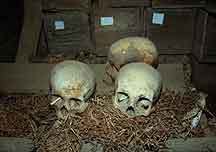
What Archaeologists Have Found Archaeologists have been trying to solve the puzzle of where the possibly 100,000 laborers who built the pyramids lived. Once they find the workers' living area, they can learn more about the workforce, their daily lives, and perhaps where they came from. Thus the settlement of the camps have been discovered, Bakeries have been found to feed the workers, as well as cemetaries, tools, hieroglyphical inscriptions, names of the craftsmen, overseers, inspectors, 25 unique new titles, and more. They even found 600 skeletons of Egyptians, some of which had emergency medical treatment having been injured while working on the pyramid. There is also evidence that these workers worked all year round, seeing that, according to their beliefs, they were assured a certain place in the afterlife. Their hard labor for their king and Pharaoh would also benefit the future and prosperity of Egypt as a whole.
According to MARK LEHNER, Archaeologist, Oriental Institute of the University of Chicago, and Harvard Semitic Museum,
"Everything I saw (at Giza) told me, day by day, year by year, that they were very human and the marks of humanity are everywhere on them....my respect increases for those people and that society, that they could do it...it's a very impressive job, extraordinary for the people who lived then and there, but it could be done. They are human monuments."
They hauled these blocks with oxen and gangs of men with various group names like: "boat Gang," Vigourous Gang," "North Gang," Friends of Khufu Gang," "Powerful Gang," etc. We know this because these names are still marked on some of the blocks. None of these names indicate that they were slaves but rather were devoted laborors for Khufu, who they believed to be god on earth. There is also evidence that these laborors also owed a labor tax, yet they rotated from in and out of the labor force. So it seems that the builders were Egyptians as stated by ZAHI HAWASS, Director General of Giza:
"There is support (that) the builders of the pyramids were Egyptians. They are not the Jews as has been said, they are not people from a lost civilization. They are not out of space. They are Egyptian and their skeletons are here, and were examined by scholars, doctors and the race of all the people we found are completely supporting that they are Egyptians."
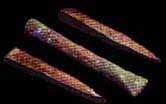
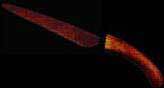
The Tools It is interesting that the wheel wasn't invented for a few centuries later yet with primitive tools the Egyptians had to quarry and cut to size the massive blocks of rock. Only 2 alloys were known to the Egyptians during this time, gold and copper. Since gold was too soft they used copper tools, such as a saw, chisel, and drill, (sharpened by the many metalworkers) with strong handles of wood, and others. Here are some of the tools that have been discovered:
Copper Chisels. Since gold was the only other available metal they chose the stronger copper for their tool-making. They pounded with granite dolerite rock balls and wooden mallets into granite to split the bedrock.
Copper Saws. These were used to cut the soft stone blocks. They also sawed into large wooden posts that were used to lever the blocks into place.
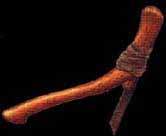
Adze with a Copper Blade. They used this as a plane and to smooth the objects and shape them to the correct finish.
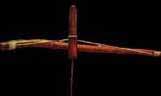
Copper Drills. These were spun by twine attached to a cross-piece that was moved back and forth like a bow. They were also used to make furniture and other tools.
Where Did They Get The Stones? HAWASS states that:
"All the stones have been taken from the plateau, except the casing stones that came from Tura, and the granite in the burial chamber that came from Aswan."
They quarried the blocks (mostly limestone) and dressed them to size. The fine white limestone came from Tura, about 8 miles away on the other side of the Nile. The granite came from quarries at Aswan, around 600 miles upstream. In some of these sites there are clear marks left in the rock. They used the copper chisels, hardened and tempered by heat and quenching, to cut their way down into the limestone, gradually separating block after block from the rock face. Limestone is a sedimentary rock that will split along its layers, while granite, being an igneous rock had to be heated by fire with a sudden pouring of cold water which would cause the imperfections to split off leaving the best quality granite underneath.
Leveling the Site. They had no levels like we have today and knowing that water finds its own level they would run a channel around the hill filled with water, and then dug many more channels back and forth and then filling them with rocks and sand.
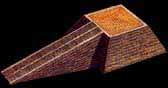
How Was it Raised? The most plausible answer is that the Egyptians, who lacked tackle and pulleys for lifting heavy weights, employed a sloping embankment of brick, earth, and sand, which was increased in height and in length as the pyramid rose and up which the stone blocks were hauled by means of sledges, rollers, and levers. They could have used one ramp or 4 (one for each corner).
Facing North, South, East, and West. They were very particular about the direction the pyramid would be facing. The Egyptian astonomers had incredible skill lining up the sides of the pyramids on a particular star which causes the sides to face almost exactly north, south, east, and west. Since the Egyptians were known for their ability in mathematics, they were familiar with triangles and that a triangle with sides of 3, 4, and 5 units would autimatically yield a right angle and using squares similar to what builders and masons use today making sure that the corners were perfectly square. The work of the surveyors was so brilliant that the sides of the Great Pyramid are not more than 7 inches different in length out of 750 feet. A masterpiece in engineering. The study of the burial chamber and how the Pharaoh was entombed will have to come later.
There is little doubt that many of the characters mentioned in the Bible had seen the Great Pyramid at Giza at some time or another.
Click here to see a 3D image of the great Pyramid.
Egypt in Smith's Bible Dictionary
Egypt (land of the Copts), a country occupying the northeast angle of Africa. Its limits appear always to have been very nearly the same. It is bounded on the north by the Mediterranean Sea, on the east by Palestine, Arabia and the Red Sea, on the south by Nubia, and on the west by the Great Desert. It is divided into upper Egypt --the valley of the Nile --and lower Egypt, the plain of the Delta, from the Greek letter; it is formed by the branching mouths of the Nile, and the Mediterranean Sea. The portions made fertile by the Nile comprise about 9582 square geographical miles, of which only about 5600 is under cultivation. --Encyc. Brit. The Delta extends about 200 miles along the Mediterranean, and Egypt is 520 miles long from north to south from the sea to the First Cataract. NAMES. --The common name of Egypt in the Bible is "Mizraim." It is in the dual number, which indicates the two natural divisions of the country into an upper and a lower region. The Arabic name of Egypt --Mizr-- signifies "red mud." Egypt is also called in the Bible "the land of Ham," Ps 105:23,27 comp. Psal 78:51 Full Article
Egyptian Writing in the Bible Encyclopedia - ISBE
Egypt 4. Four Views of Future Life: The religion of Egypt is an enormous subject, and that by which Egypt is perhaps most known. Here we can only give an outline of the growth and subdivisions of it. There never was any one religion in Egypt during historic times. There were at least four religions, all incompatible, and all believed in at once in varying degrees. The different religions can best be seen apart by their incongruity regarding the future life. (1) The dead wandered about the cemetery seeking food, and were partly fed by the goddess in the sycamore tree. They therefore needed to have plates of food and jars of water in the tomb, and provided perpetually by their descendants in front of the doorway to the grave. The deceased is represented as looking out over this doorway in one case. Here came in the great principle of substitution. For the food, substitute its image which cannot decay, and the carved table of offerings results. For the farmstead of animals, substitute its carved image on the walls and the animal sculptures result. For the life of the family, substitute their carved figures doing all that was wanted, sacrificing and serving, and the family sculptures result. For the house, substitute a model upon the grave, and the pottery soul-houses appear with their furniture and provisions. For the servants, put their figures doing household work, and their service is eternal. For the master himself, put the most lifelike image that can be made, and his soul will occupy that as a restful home fitted for it. This principle is still believed in. Funeral offerings of food are still put even in Muslim graves, and a woman will visit a grave, and, removing a tile, will talk through a hole to her dead husband. (2) The dead went to the kingdom of Osiris, to which only the good were admitted, while the evil were rejected, and consumed either by monsters or by fire. This heavenly kingdom was a complete duplicate of the earthly life. They planted and reaped, sported and played. And as the Egyptian felicity consisted in making others work for them, so each man was provided with a retinue of serfs to cultivate the land for him. These ushabti figures in later times usually number 400, and often 1 in 10 of them is clad as an overseer. A special chapter of the Book of the Dead is to be recited to animate them, and this, more or less abbreviated, is often inscribed upon the figures. (3) The dead joined the company of the immortal gods, who float on the heavenly ocean in the boat of the sun. With them they have to face the terrors of the hours of the night when the sun goes through the underworld. Long charms and directions are needed for safety in this passage, and these form a large part of the funerary tests, especially on the Tombs of the Kings in the XVIIIth-XXIst Dynasties. To reach the boat of the sun a boat must be provided in the tomb, with its sailors and sails and oars. Such are frequent from the VIth-XIIIth Dynasties. (4) The dead were carried off by the Hathor cow, or a bull, to wait for a bodily resurrection. In order to preserve the body for some life after the present age, each part must be protected by an appropriate amulet; hence, dozens of different amulets were placed on the body, especially from about 600-400 BC. Now it will be seen that each of these beliefs contradicts the other three, and they represent, therefore, different religious origins. 5. Four Groups of Gods: The mythology is similarly diverse, and was unified by uniting analogous gods. Hence, when we see the compounds such as Ptah-Sokar-Osiris, or Amen-Ra or Osiris-Khentamenti, it is clear that each god of the compound belongs to a different religion, like Pallas-Athene or Zeus-Labrandeus, in Greek compounds. So far as we can at present see, the gods linked with each of the beliefs about the soul are as follows: (1) The Soul in the Tombs and Cemetery. With this belief belong the animal gods, which form the earliest stratum of the religion; also Sokar the god of "Silence," and Mert Sokar, the "Lover of Silence," as the gods of the dead. With this was allied a belief in the soul sometimes going to the west, and hence, Khent-amenti, a jackal-headed god, "he who is in the west," became the god of the dead. (2) The Soul in the Heavenly Kingdom. Osiris is the lord of this kingdom, Isis his sister-wife, Horus their son, Nebhat (Nephthys) the sister of Isis, and Set her husband. Set also was regarded as coequal with Horus. This whole mythology results probably from the fusion of tribes who were originally monotheistic, and who each worshipped one of these deities. It is certain that the later parts of this mythology are tribal history, regarded as the victories and defeats of the gods whom the tribes worshipped. (3) The Soul in the Sun-Boat. Ra was the Sun-god, and in other forms worshipped as Khepera and Atmu. The other cosmic gods of the same group are Nut, the heaven, and her husband Geb, the earth; Shu, space, and his sister Tefnut. Anher the Sky-god belongs to Upper Egypt. (4) The Mummy with Amulets, Preserved for a Future Life. Probably to this group belong the gods of principles, Hathor the female principle; Min the male principle; Ptah the architect and creator of the universe; his spouse Maat, abstract truth and justice. Full Article
The Bible Mentions "Egypt" Often
Exodus 34:18 - The feast of unleavened bread shalt thou keep. Seven days thou shalt eat unleavened bread, as I commanded thee, in the time of the month Abib: for in the month Abib thou camest out from Egypt.
Genesis 46:7 - His sons, and his sons' sons with him, his daughters, and his sons' daughters, and all his seed brought he with him into Egypt.
Jeremiah 2:18 - And now what hast thou to do in the way of Egypt, to drink the waters of Sihor? or what hast thou to do in the way of Assyria, to drink the waters of the river?
Jeremiah 44:14 - So that none of the remnant of Judah, which are gone into the land of Egypt to sojourn there, shall escape or remain, that they should return into the land of Judah, to the which they have a desire to return to dwell there: for none shall return but such as shall escape.
Isaiah 19:22 - And the LORD shall smite Egypt: he shall smite and heal [it]: and they shall return [even] to the LORD, and he shall be intreated of them, and shall heal them.
2 Kings 17:4 - And the king of Assyria found conspiracy in Hoshea: for he had sent messengers to So king of Egypt, and brought no present to the king of Assyria, as [he had done] year by year: therefore the king of Assyria shut him up, and bound him in prison.
Exodus 23:15 - Thou shalt keep the feast of unleavened bread: (thou shalt eat unleavened bread seven days, as I commanded thee, in the time appointed of the month Abib; for in it thou camest out from Egypt: and none shall appear before me empty:)
Exodus 10:13 - And Moses stretched forth his rod over the land of Egypt, and the LORD brought an east wind upon the land all that day, and all [that] night; [and] when it was morning, the east wind brought the locusts.
Exodus 9:25 - And the hail smote throughout all the land of Egypt all that [was] in the field, both man and beast; and the hail smote every herb of the field, and brake every tree of the field.
Jeremiah 44:30 - Thus saith the LORD; Behold, I will give Pharaohhophra king of Egypt into the hand of his enemies, and into the hand of them that seek his life; as I gave Zedekiah king of Judah into the hand of Nebuchadrezzar king of Babylon, his enemy, and that sought his life.
Ezekiel 20:5 - And say unto them, Thus saith the Lord GOD; In the day when I chose Israel, and lifted up mine hand unto the seed of the house of Jacob, and made myself known unto them in the land of Egypt, when I lifted up mine hand unto them, saying, I [am] the LORD your God;
Numbers 11:18 - And say thou unto the people, Sanctify yourselves against to morrow, and ye shall eat flesh: for ye have wept in the ears of the LORD, saying, Who shall give us flesh to eat? for [it was] well with us in Egypt: therefore the LORD will give you flesh, and ye shall eat.
1 Kings 8:16 - Since the day that I brought forth my people Israel out of Egypt, I chose no city out of all the tribes of Israel to build an house, that my name might be therein; but I chose David to be over my people Israel.
Joshua 5:6 - For the children of Israel walked forty years in the wilderness, till all the people [that were] men of war, which came out of Egypt, were consumed, because they obeyed not the voice of the LORD: unto whom the LORD sware that he would not shew them the land, which the LORD sware unto their fathers that he would give us, a land that floweth with milk and honey.
Jeremiah 43:11 - And when he cometh, he shall smite the land of Egypt, [and deliver] such [as are] for death to death; and such [as are] for captivity to captivity; and such [as are] for the sword to the sword.
Genesis 47:6 - The land of Egypt [is] before thee; in the best of the land make thy father and brethren to dwell; in the land of Goshen let them dwell: and if thou knowest [any] men of activity among them, then make them rulers over my cattle.
Ezekiel 29:12 - And I will make the land of Egypt desolate in the midst of the countries [that are] desolate, and her cities among the cities [that are] laid waste shall be desolate forty years: and I will scatter the Egyptians among the nations, and will disperse them through the countries.
Exodus 12:42 - It [is] a night to be much observed unto the LORD for bringing them out from the land of Egypt: this [is] that night of the LORD to be observed of all the children of Israel in their generations.
Deuteronomy 16:1 - Observe the month of Abib, and keep the passover unto the LORD thy God: for in the month of Abib the LORD thy God brought thee forth out of Egypt by night.
Deuteronomy 17:16 - But he shall not multiply horses to himself, nor cause the people to return to Egypt, to the end that he should multiply horses: forasmuch as the LORD hath said unto you, Ye shall henceforth return no more that way.
Joshua 24:4 - And I gave unto Isaac Jacob and Esau: and I gave unto Esau mount Seir, to possess it; but Jacob and his children went down into Egypt.
Judges 6:8 - That the LORD sent a prophet unto the children of Israel, which said unto them, Thus saith the LORD God of Israel, I brought you up from Egypt, and brought you forth out of the house of bondage;
Genesis 41:36 - And that food shall be for store to the land against the seven years of famine, which shall be in the land of Egypt; that the land perish not through the famine.
Deuteronomy 13:5 - And that prophet, or that dreamer of dreams, shall be put to death; because he hath spoken to turn [you] away from the LORD your God, which brought you out of the land of Egypt, and redeemed you out of the house of bondage, to thrust thee out of the way which the LORD thy God commanded thee to walk in. So shalt thou put the evil away from the midst of thee.
Joshua 24:32 - And the bones of Joseph, which the children of Israel brought up out of Egypt, buried they in Shechem, in a parcel of ground which Jacob bought of the sons of Hamor the father of Shechem for an hundred pieces of silver: and it became the inheritance of the children of Joseph.
Joshua 5:5 - Now all the people that came out were circumcised: but all the people [that were] born in the wilderness by the way as they came forth out of Egypt, [them] they had not circumcised.
Genesis 45:23 - And to his father he sent after this [manner]; ten asses laden with the good things of Egypt, and ten she asses laden with corn and bread and meat for his father by the way.
Exodus 8:17 - And they did so; for Aaron stretched out his hand with his rod, and smote the dust of the earth, and it became lice in man, and in beast; all the dust of the land became lice throughout all the land of Egypt.
Ezekiel 30:6 - Thus saith the LORD; They also that uphold Egypt shall fall; and the pride of her power shall come down: from the tower of Syene shall they fall in it by the sword, saith the Lord GOD.
2 Chronicles 6:5 - Since the day that I brought forth my people out of the land of Egypt I chose no city among all the tribes of Israel to build an house in, that my name might be there; neither chose I any man to be a ruler over my people Israel.