You are here:HomeResources
Archimedes' Principle of Buoyancy
How do Ships Float?
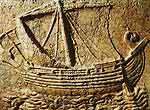
How could ships weighing thousands of pounds float on water when a small coin sinks right to the bottom? The key was a discovery by a Greek mathematician and inventor named Archimedes.
Archimedes' Solves a Problem The Greek Mathematician and inventor Archimedes lived during the 3rd century BC. According to history he was in the bath one day when he discovered the principle of buoyancy which is the reason why huge Greek ships weighing thousands of pounds could float on water. He noticed that as he lowered himself into the bath, the water displaced by his body overflowed the sides and he realised that there was a relationship between his weight and the volume of water displaced. It is said that he ran naked into the street yelling "heurEka" which is where we get our word "eureka!" (I found it), Greek heurEka I have found, from heuriskein to find.
Archimedes was not thinking about ships at the time, he was on a mission to solve a question that was asked of him by King Hieron II of Syracuse, the home of Archimedes which was a Greek city at the time. The question that the king had asked was about his crown. Was it pure gold or partly silver? Archimedes reasoned that if the crown had any silver in it, it would take up more space than a pure gold crown of the same weight because silver is not as dense as gold. He compared the crown's volume (measured by the amount of water displaced) with the volume of equal weights of gold and then silver, he found the answer. He had to inform his king that the crown was not pure gold.
The Buoyancy Principle Archimedes continued to do more experiments and came up with a buoyancy principle, that a ship will float when the weight of the water it displaces equals the weight of the ship and anything will float if it is shaped to displace its own weight of water before it reaches the point where it will submerge.
This is kind of a technical way of looking at it. A ship that is launched sinks into the sea until the weight of the water it displaces is equal to its own weight. As the ship is loaded, it sinks deeper, displacing more water, and so the magnitude of the buoyant force continuously matches the weight of the ship and its cargo.
The Metacenter Archimedes figured out that the metacenter had to be determined which is a point where an imaginary vertical line (through the center of buoyancy) intersects another imaginary vertical line (through a new centre of buoyancy) created after the ship is displaced, or tilted, in the water.
The center of buoyancy in a floating ship is the point in which all the body parts exactly balance each other and make each other float. In other words, the metacenter remains directly above the center of buoyancy regardless of the tilt of the floating ship. When a ship tilts, one side displaces more water than the other side, and the center of buoyancy moves and is no longer directly under the center of gravity; but regardless of the amount of the tilt, the center of buoyancy remains directly below the metacenter. If the metacenter is above the center of gravity, buoyancy restores stability when the ship tilts. If the metacenter is below the center of gravity, the boat is unstable and capsizes.
Why is this important in the study of Biblical history? Good question! As the study of physics and various sciences were being developed in ancient Greece it, among other things, opened a door for the Lord to bring new learning and new technology into the world that would eventually help to prepare the world at just the right time for the coming of the Savior and His gospel. We have to keep in mind that men were living in darkness and the darkness was increasing in its intensity and the only hope for mankind was the message that Jesus Christ and His followers would bring. God is very aware of the times and seasons and the rising and falling of the nations of the world and the Bible says that "at the fullness of time God sent forth His Son," and His coming was an epochal event that changed the culture of western civilization forever and hurled it into a new direction.
Greeks in the Bible Encyclopedia - ISBE
GRECIANS; GREEKS gre'-shanz, greks: In the Old Testament the word "Grecians" occurs but once (Joel 3 (4):6). For references to Greece in the Old Testament see JAVAN. In the King James Version of the Old Testament Apocrypha "Grecians" and "Greeks" are used without distinction, e.g. 1 Macc 1:10; 6:2; 8:9; 2 Macc 4:15,36. Thus, in 1 Macc 1:1, Alexander the Great is spoken of as king of Greece, and in 1 Macc 1:10 the Macedonian empire is called "the kingdom of the Greeks" (basileia Hellenon). In 2 Macc 13:2 the army of Antiochus, king of Syria, is called "Grecian" (dunamis Hellenike), and in 2 Macc 6:8 the "Greek cities" (poleis Hellenides) are Macedonian colonies. Reference is made in 2 Macc 6:1 to an aged Athenian who was sent by Antiochus the king charged with the duty of Hellenizing the Jews; in 2 Macc 9:15 Antiochus vows that he will make the Jews equal to the Athenians; in 1 Macc 12 through 14, reference is made to negotiations of Jonathan, the high priest, with the Spartans, whom he calls brethren, seeking the renewal of a treaty of alliance and amity against the Syrians. With the spread of Greek power and influence, everything not specifically Jewish was called Greek; thus in 2 Macc 4:36; 11:2; 3 Macc 3:3,1 the "Greeks" contrasted with the Jews are simply non-Jews, so called because of the prevalence of Greek institutions and culture, and "Greek" even came to be used in the sense of "anti-Jewish" (2 Macc 4:10,15; 6:9; 11:24). Full Article
The Bible Mentions a lot Concerning "Greeks"
Acts 21:28 - Crying out, Men of Israel, help: This is the man, that teacheth all [men] every where against the people, and the law, and this place: and further brought Greeks also into the temple, and hath polluted this holy place.
Acts 14:1 - And it came to pass in Iconium, that they went both together into the synagogue of the Jews, and so spake, that a great multitude both of the Jews and also of the Greeks believed.
Acts 18:17 - Then all the Greeks took Sosthenes, the chief ruler of the synagogue, and beat [him] before the judgment seat. And Gallio cared for none of those things.
Acts 19:10 - And this continued by the space of two years; so that all they which dwelt in Asia heard the word of the Lord Jesus, both Jews and Greeks.
Acts 17:4 - And some of them believed, and consorted with Paul and Silas; and of the devout Greeks a great multitude, and of the chief women not a few.
Acts 19:17 - And this was known to all the Jews and Greeks also dwelling at Ephesus; and fear fell on them all, and the name of the Lord Jesus was magnified.
Acts 20:21 - Testifying both to the Jews, and also to the Greeks, repentance toward God, and faith toward our Lord Jesus Christ.
1 Corinthians 1:23 - But we preach Christ crucified, unto the Jews a stumblingblock, and unto the Greeks foolishness;
Acts 18:4 - And he reasoned in the synagogue every sabbath, and persuaded the Jews and the Greeks.
1 Corinthians 1:22 - For the Jews require a sign, and the Greeks seek after wisdom:
1 Corinthians 1:24 - But unto them which are called, both Jews and Greeks, Christ the power of God, and the wisdom of God.
Romans 1:14 - I am debtor both to the Greeks, and to the Barbarians; both to the wise, and to the unwise.
Acts 17:12 - Therefore many of them believed; also of honourable women which were Greeks, and of men, not a few.
John 12:20 - And there were certain Greeks among them that came up to worship at the feast