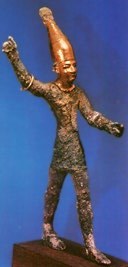
This excavated bronze figurine of Baal reveals a haughty look, given to him by a Canaanite craftsmen.
Baal the Life Giver
Baal (ba'al) was an ancient Canaanite and Mesopotamian deity associated with agriculture. He was believed to be the "giver of life" and mankind was dependant upon him for providing what was necessary to sustain the farms, flocks and herds. He was also called the "son of Dagon" (who was in control of the grain), and "Hadad" the storm god who would provide plentiful rains after hearing his voice (thunder).
The Canaanites
The land of Canaan was devoted to the worship of Baal. The Semitic word Baal means "lord" or "master" and the Canaanites believed that Baal was in absolute control over nature and over people. They believed that the only god who was superior to Baal was his father El, but Baal was the principal deity of the land. It was he who was in charge of the rain and the weather, and man's survival was dependent upon Baal's provision.
"One may question that those ancient enemies of Israel were as evil as the Bible claims that they were, but even a superficial glance at Canaanite religion alone ably demonstrates their iniquity. Base sex worship was prevalent, and religious prostitution even commanded; human sacrifice was common; and it was a frequent practice--in an effort to placate their gods--to kill young children and bury them in the foundations of a house or public building at the time of construction: Joshua 6:26 "In his days did Hiel the Bethelite build Jericho: he laid the foundation thereof in Abiram his firstborn..."
Howard E. Vos, "An Introduction To Bible Archaeology" Revised ed. (Chicago: Moody Press, 1953) pp. 17-19.
Archaeological Discoveries
Many clay tablets have been unearthed from Ras Shamra the prehistoric city of Ugarit of the Amarna Letters, many of them revealing the myths told about the deities of the Canaanite pantheon including its chief male god Baal. One story reveals an interesting account about Baal's conflict with Mot, the powerful god of death, who was represented by drought and sterility. The Canaanites saw this conflict between Baal and Mot as ongoing. Mot demanded Baal, the life givers' surrender, and the cry when forth:
"Baal is dead! What will return him to life; whereupon all nature blossomed again and El proclaimed: "Baal the conqueror lives; the prince, the lord of the earth, has revived."
The Powerful Attraction to Baal in Israel and Judah
1 Kings 16:30-34 Now Ahab the son of Omri did evil in the sight of the LORD, more than all who were before him. And it came to pass, as though it had been a trivial thing for him to walk in the sins of Jeroboam the son of Nebat, that he took as wife Jezebel the daughter of Ethbaal, king of the Sidonians; and he went and served Baal and worshiped him. Then he set up an altar for Baal in the temple of Baal, which he had built in Samaria. And Ahab made a wooden image. Ahab did more to provoke the LORD God of Israel to anger than all the kings of Israel who were before him. In his days Hiel of Bethel built Jericho. He laid its foundation with Abiram his firstborn, and with his youngest son Segub he set up its gates, according to the word of the LORD, which He had spoken through Joshua the son of Nun.
Yahweh, the God of Israel, continually condemned the worship of Baal, and the Lord sent His prophets to warn them of this idolatry and of the corruption of Baal's fertility rites. During the period of the kings of Israel Baal worship was prevalent, and even commanded. Queen Jezebel, the Phoenician wife of king Ahab, had 450 prophets of Baal as her court counselors. Elijah challenged them on Mount Carmel and Yahweh proved to be the true God.
It wasn't long before the Kings of Judah followed in the footsteps of their brother in the North:
1 Kings 14:22-24 Now Judah did evil in the sight of the LORD, and they provoked Him to jealousy with their sins which they committed, more than all that their fathers had done. For they also built for themselves high places, sacred pillars, and wooden images on every high hill and under every green tree. And there were also perverted persons in the land. They did according to all the abominations of the nations which the LORD had cast out before the children of Israel.
Baal worship was a powerful attraction to the people of Israel and eventually led to their destruction and exile. The Northern Kingdom of Israel wanted idolatry and the Lord gave them over to Assyria, the Southern Kingdom of Judah wanted idolatry and the Lord gave them over to Babylon, both lands filled to the brink with idolatry.
Various Names of Baal in Scripture
Baal-gad ( "lord of good fortune," Josh 11:17) Baal-hamon ( "lord of wealth," Song 8:11) Baal-hazor ( "Baal's village," 2 Sam 13:23) Baal-meon ( "lord of the dwelling," Num 32:38) Baal-peor ( "lord of the opening," Deut 4:3) Baal-tamar ( "lord of the palm tree," Judg 20:33), and others.
Ba'al-ze'bub was the form of the name of Baal who was worshiped at the Philistine city of Ekron. Baal, under this aspect of worship, was viewed as the producer of flies and therefore able to control this pest so common in the East..
Some Interesting Quotes about Baal
In Biblical Canaan "on the hillsides are grown vines and lives, which, with natural pine and cedar forests in the Lebanon and Amanus, were the main products of the land. Moreover, soil which is eroded builds up fertile pockets of earth and even considerable plains. Such cultivable land was regarded as 'Baal's land', that is to say, land where cultivation depends on the activity of the god manifest in the autumn and winter rains. These rains are heralded by thunder, and 'the lord' (Baal) was known to the Canaanites by his proper name Hadad, 'the Thunderer', or Rimmon, which means the same. The term 'Baal-land' as distinct from irrigated land has survived down to the present day in Muslim law when making tax assessment for poor relief."
- John Gray, Near Eastern Mythology
"Baal, one of the sons of El [the chief god of the Canaanites], was the executive god of the pantheon, the god of thunder and winter storms, the dynamic warrior god who champions the divine order against the menacing forces of chaos. He is also identified with vegetation and the seasonal fertility cycle...Baal is sometimes called the 'son of Dagon'. Dagon was also a god of vegetation, specifically corn, which is what his name means....As the summer drew to an end and the rains were due, the peasants would suffer a crisis of anxiety - would the rains come? By calling upon Baal, the rain god, and encouraging his intervention by rituals of imitative magic involving sexual union, their tensions were released and purged."
- Magnus Magnusson, BC - The Archaeology of the Bible Lands
"The goddess peculiarly associated with Baal is Anat, like Ishtar a goddess of love and war. She complements Baal, abetting him in his conflict and vindicating him when he succumbs, possibly reflecting the role of women at the critical seasons of transition in popular religion or when the order of the gods is temporarily in eclipse. Related to such phases is certainly the weeping of the women in Jerusalem for Tammuz (Ezekiel 8:14) and possibly the annual lamentation of the maidens of Israel, which may be only secondarily related to the mourning for Jephthah's daughter (Judges 11-39-40)."
- John Gray, Near Eastern Mythology
"Verily Baal has fallen to the earth, Dead is Baal the Might! Perished is the Prince, lord of the earth! Then the Kindly One, El the Merciful Comes down from his throne, he sits on the footstool, And (coming) off the footstool, he sits on the ground He sprinkles dirt signifying grief on his head, On his pate the dust in which he wallows; For clothing he covers himself with a loincloth; He scrapes his skin with a stone, With a chipped flint as a razor He cuts off side-whiskers and beard; He rends his shoulder (with his finger-nails); He scores his chest as a garden plot, Even as a valley-bottom his trunk he lacerates. He raises his voice and cries: Baal is dead! What will become of the people? The Son of Dagan (is dead)! What of the multitudes (of men)? After Baal I shall go down to the underworld!
- Ras Shamra texts
"Here we have the mourning rites, familiar among the ancient Semites and in Israel. Generally at death, which is a crisis in society when the community is especially open to the influences of the supernatural, normal activities were suspended to thwart those forces. Thus the normal resorts were avoided, one forsook one's usual seat to sit on the ground, like Job on the village midden (Job 2:8), or begrimed the personal or the clothes with dust and scored the face or the body. that last practice was specifically banned in Israel (Deuteronomy 14:1) in protest against what was seen as a barbarous Canaanite rite."
- John Gray, Near Eastern Mythology
Baal in Smith's Bible Dictionary
Baal (2) the supreme male divinity of the Phoenician and Canaanitish nations, as Ashtoreth was their supreme female divinity. Some suppose Baal to correspond to the sun and Ashtoreth to the moon; others that Baal was Jupiter and Ashtoreth Venus. There can be no doubt of the very high antiquity of the worship of Baal. It prevailed in the time of Moses among the Moabites and Midianites, Nu 22:41 and through them spread to the Israelites. Nu 25:3-18; De 4:3 In the times of the kings it became the religion of the court and people of the ten tribes, 1Ki 16:31-33; 18:19,22 and appears never to have been permanently abolished among them. 2Ki 17:16 Temples were erected to Baal in Judah, 1Ki 16:32 and he was worshipped with much ceremony. 1Ki 18:19,26-28; 2Ki 10:22 The attractiveness of this worship to the Jews undoubtedly grew out of its licentious character. We find this worship also in Phoenician colonies. The religion of the ancient British islands much resembled this ancient worship of Baal, and may have been derived from it. Nor need we hesitate to regard the Babylonian Bel, Isa 46:1 or Beaus, as essentially identical with Baal, though perhaps under some modified form. The plural, BAALIM, is found frequently, showing that he was probably worshipped under different compounds, among which appear-- 1. BAAL-BERITH (the covenant Baal), Jud 8:33; 9:4 the god who comes into covenant with the worshippers. 2. BAAL-ZEBUB (lord of the fly), and worshipped at Ekron. 2Ki 1:2,3,16 3. BAAL-HANAN. a. The name of one of the early kings of Edom. Ge 36:38,39; 1Ch 1:49,50 b. The name of one of David's officers, who had the superintendence of his olive and sycamore plantations. 1Ch 27:28 4. BAAL-PEOR (lord of the opening, i.e. for others to join in the worship). We have already referred to the worship of this god. The narrative (Numb 25) seems clearly to show that this form of Baal-worship was connected with licentious rites. Full Article
Baal in the Bible Encyclopedia - ISBE
VI. FORMS OF BAAL 1. Baal-berith 2. Baal-gad 3. Baal-hamon 4. Baal-hermon 5. Baal-peor 6. Baal-zebub I. Name and Character of Baal: In Babylonia it was the title specially applied to Merodach of Babylon, which in time came to be used in place of his actual name. As the word in Hebrew also means "possessor," it has been supposed to have originally signified, when used in a religious sense, the god of a particular piece of land or soil. Of this, however, there is no proof, and the sense of "possessor" is derived from that of "lord." The Babylonian Bel-Merodach was a Sun-god, and so too was the Can Baal whose full title was Baal-Shemaim, "lord of heaven." The Phoenician writer Sanchuniathon (Philo Byblius, Fragmenta II) accordingly says that the children of the first generation of mankind "in time of drought stretched forth their hands to heaven toward the sun; for they regarded him as the sole Lord of heaven, and called him Beel-samen, which means `Lord of Heaven' in the Phoenician language and is equivalent to Zeus in Greek" Baal-Shemaim had a temple at Umm el-Awamid between Acre and Tyre, and his name is found in inscriptions from the Phoenician colonies of Sardinia and Carthage. II. Attributes of Baal: As the Sun-god, Baal was worshipped under two aspects, beneficent and destructive. On the one hand he gave light and warmth to his worshippers; on the other hand the fierce heats of summer destroyed the vegetation he had himself brought into being. Hence, human victims were sacrificed to him in order to appease his anger in time of plague or other trouble, the victim being usually the first-born of the sacrificer and being burnt alive. In the Old Testament this is euphemistically termed "passing" the victim "through the fire" (2 Ki 16:3; 21:6). The forms under which Baal was worshipped were necessarily as numerous as the communities which worshipped him. Each locality had its own Baal or divine "Lord" who frequently took his name from the city or place to which he belonged. Hence, there was a Baal-Zur, "Baal of Tyre"; Baal-hermon, "Baal of Hermon" (Jdg 3:3); Baal-Lebanon, "Baal of Lebanon"; Baal-Tarz, "Baal of Tarsus." At other times the title was attached to the name of an individual god; thus we have Bel-Merodach, "the Lord Merodach" (or "Bel is Merodach") at Babylon, Baal-Melkarth at Tyre, Baal-gad (Josh 11:17) in the north of Palestine. Occasionally the second element was noun as in Baal-Shemaim, "lord of heaven," Baalzebub (2 Ki 1:2), "Lord of flies," Baal-Hamman, usually interpreted "Lord of heat," but more probably "Lord of the sunpillar," the tutelary deity of Carthage. All these various forms of the Sun-god were collectively known as the Baalim or "Baals" who took their place by the side of the female Ashtaroth and Ashtrim. At Carthage the female consort of Baal was termed Pene-Baal, "the face" or "reflection of Baal." III. Baal-Worship: In the earlier days of Hebrew history the title Baal, or "Lord," was applied to the national God of Israel, a usage which was revived in later times, and is familiar to us in the King James Version. Hence both Jonathan and David had sons called Merib-baal (1 Ch 8:31; 9:40) and Beeliada (1 Ch 14:7). After the time of Ahab, however, the name became associated with the worship and rites of the Phoenician deity introduced into Samaria by Jezebel, and its idolatrous associations accordingly caused it to fall into disrepute. Hosea (2:16) declares that henceforth the God of Israel should no longer be called Baali, "my Baal," and personal names like Esh-baal (1 Ch 8:33; 9:39), and Beelinda into which it entered were changed in form, Baal being turned into bosheth which in Heb at any rate conveyed the sense of "shame." Full Article
The Bible Mentions a lot Concerning "Baal"
2 Kings 23:5 - And he put down the idolatrous priests, whom the kings of Judah had ordained to burn incense in the high places in the cities of Judah, and in the places round about Jerusalem; them also that burned incense unto Baal, to the sun, and to the moon, and to the planets, and to all the host of heaven.
2 Kings 10:25 - And it came to pass, as soon as he had made an end of offering the burnt offering, that Jehu said to the guard and to the captains, Go in, [and] slay them; let none come forth. And they smote them with the edge of the sword; and the guard and the captains cast [them] out, and went to the city of the house of Baal.
Jeremiah 11:17 - For the LORD of hosts, that planted thee, hath pronounced evil against thee, for the evil of the house of Israel and of the house of Judah, which they have done against themselves to provoke me to anger in offering incense unto Baal.
Jeremiah 12:16 - And it shall come to pass, if they will diligently learn the ways of my people, to swear by my name, The LORD liveth; as they taught my people to swear by Baal; then shall they be built in the midst of my people.
2 Kings 23:4 - And the king commanded Hilkiah the high priest, and the priests of the second order, and the keepers of the door, to bring forth out of the temple of the LORD all the vessels that were made for Baal, and for the grove, and for all the host of heaven: and he burned them without Jerusalem in the fields of Kidron, and carried the ashes of them unto Bethel.
1 Kings 18:21 - And Elijah came unto all the people, and said, How long halt ye between two opinions? if the LORD [be] God, follow him: but if Baal, [then] follow him. And the people answered him not a word.
1 Kings 18:19 - Now therefore send, [and] gather to me all Israel unto mount Carmel, and the prophets of Baal four hundred and fifty, and the prophets of the groves four hundred, which eat at Jezebel's table.
Jeremiah 11:13 - For [according to] the number of thy cities were thy gods, O Judah; and [according to] the number of the streets of Jerusalem have ye set up altars to [that] shameful thing, [even] altars to burn incense unto Baal.
Judges 6:31 - And Joash said unto all that stood against him, Will ye plead for Baal? will ye save him? he that will plead for him, let him be put to death whilst [it is yet] morning: if he [be] a god, let him plead for himself, because [one] hath cast down his altar.
Jeremiah 32:29 - And the Chaldeans, that fight against this city, shall come and set fire on this city, and burn it with the houses, upon whose roofs they have offered incense unto Baal, and poured out drink offerings unto other gods, to provoke me to anger.
Judges 6:25 - And it came to pass the same night, that the LORD said unto him, Take thy father's young bullock, even the second bullock of seven years old, and throw down the altar of Baal that thy father hath, and cut down the grove that [is] by it:
2 Kings 17:16 - And they left all the commandments of the LORD their God, and made them molten images, [even] two calves, and made a grove, and worshipped all the host of heaven, and served Baal.
2 Kings 21:3 - For he built up again the high places which Hezekiah his father had destroyed; and he reared up altars for Baal, and made a grove, as did Ahab king of Israel; and worshipped all the host of heaven, and served them.
Judges 6:28 - And when the men of the city arose early in the morning, behold, the altar of Baal was cast down, and the grove was cut down that [was] by it, and the second bullock was offered upon the altar [that was] built.
2 Kings 10:22 - And he said unto him that [was] over the vestry, Bring forth vestments for all the worshippers of Baal. And he brought them forth vestments.
2 Kings 3:2 - And he wrought evil in the sight of the LORD; but not like his father, and like his mother: for he put away the image of Baal that his father had made.
2 Kings 10:18 - And Jehu gathered all the people together, and said unto them, Ahab served Baal a little; [but] Jehu shall serve him much.
Judges 6:30 - Then the men of the city said unto Joash, Bring out thy son, that he may die: because he hath cast down the altar of Baal, and because he hath cut down the grove that [was] by it.
1 Kings 18:40 - And Elijah said unto them, Take the prophets of Baal; let not one of them escape. And they took them: and Elijah brought them down to the brook Kishon, and slew them there.
1 Kings 16:31 - And it came to pass, as if it had been a light thing for him to walk in the sins of Jeroboam the son of Nebat, that he took to wife Jezebel the daughter of Ethbaal king of the Zidonians, and went and served Baal, and worshipped him.
Jeremiah 32:35 - And they built the high places of Baal, which [are] in the valley of the son of Hinnom, to cause their sons and their daughters to pass through [the fire] unto Molech; which I commanded them not, neither came it into my mind, that they should do this abomination, to cause Judah to sin.
Jeremiah 2:8 - The priests said not, Where [is] the LORD? and they that handle the law knew me not: the pastors also transgressed against me, and the prophets prophesied by Baal, and walked after [things that] do not profit.
Numbers 22:41 - And it came to pass on the morrow, that Balak took Balaam, and brought him up into the high places of Baal, that thence he might see the utmost [part] of the people.
Jeremiah 7:9 - Will ye steal, murder, and commit adultery, and swear falsely, and burn incense unto Baal, and walk after other gods whom ye know not;
Zephaniah 1:4 - I will also stretch out mine hand upon Judah, and upon all the inhabitants of Jerusalem; and I will cut off the remnant of Baal from this place, [and] the name of the Chemarims with the priests;
1 Kings 18:25 - And Elijah said unto the prophets of Baal, Choose you one bullock for yourselves, and dress [it] first; for ye [are] many; and call on the name of your gods, but put no fire [under].
1 Kings 19:18 - Yet I have left [me] seven thousand in Israel, all the knees which have not bowed unto Baal, and every mouth which hath not kissed him.
1 Kings 22:53 - For he served Baal, and worshipped him, and provoked to anger the LORD God of Israel, according to all that his father had done.
Jeremiah 23:13 - And I have seen folly in the prophets of Samaria; they prophesied in Baal, and caused my people Israel to err.
Hosea 2:8 - For she did not know that I gave her corn, and wine, and oil, and multiplied her silver and gold, [which] they prepared for Baal.
The concept of monotheistic religions, which worship a single divine being, stands in stark contrast to the ancient deity Baal, a prominent figure in polytheistic belief systems. While monotheistic religions emphasize the worship of one God, the worship of Baal was a common practice in ancient societies that followed polytheistic traditions.