
Bible Maps
Maps are essential for any serious Bible study. Our collection of maps are simple and they are free.

Name
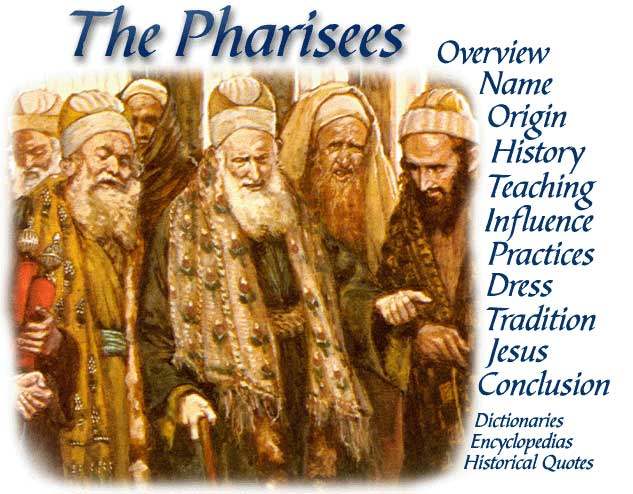
"Pharisee" is from a Greek word (pharisaios) taken from the Heb/Aramaic "Perisha" meaning "Separated one." In the time of Jesus the Pharisees were one of the three chief Jewish sects, the others were the Sadducees and the Essenes. Of the three, the Pharisees were the most separated from the ways of the foreign influences that were invading Judaism, and from the ways of the common Jewish people in the land.
The Pharisee
"There was probably no town or village inhabited by Jews which had not its Pharisees, although they would, of course, gather in preference about Jerusalem with its Temple, and what, perhaps would have been even dearer to the heart of a genuine Pharisee--its four hundred and eighty synagogues, its Sanhedrims (great and small), and its schools of study. There could be no difficulty in recognising such an one. Walking behind him, the chances were, he would soon halt to say his prescribed prayers. If the fixed time for them had come, he would stop short in the middle of the road, perhaps say one section of them, move on, again say another part, and so on, till, whatever else might be doubted, there could be no question of the conspicuousness of his devotions in market-place or corners of streets. There he would stand, as taught by the traditional law, would draw his feet well together, compose his body and clothes, and bend so low "that every vertebra in his back would stand out separate," or, at least, till "the skin over his heart would fall into folds" (Ber. 28 b). The workman would drop his tools, the burden-bearer his load; if a man had already one foot in the stirrup, he would withdraw it. The hour had come, and nothing could be suffered to interrupt or disturb him. The very salutation of a king, it was said, must remain unreturned; nay, the twisting of a serpent around one's heel must remain unheeded." – Alfred Edersheim
Origin and History
The sect of Pharisees is thought to have originated in the 3rd century B.C., in days preceding the Maccabean wars, when under Greek domination and the Greek effort to Hellenize the Jews, there was a strong tendency among the Jews to accept Greek culture with its pagan religious customs. The rise of the Pharisees was a reaction and protest against this tendency among their fellow kinsmen. Their aim was to preserve their national integrity and strict conformity to Mosaic law. They later developed into self-righteous and hypocritical formalists. Later they were among those who had condemned Jesus to death.
How fearfully the prophecy of destruction that Jesus had foretold was fulfilled! In a few brief years the Roman legions of the Emperor Titus utterly destroyed the city and its glorious Temple. Over a million Jews perished in the siege in a few days, and a hundred thousand more were taken away in captivity.
Without its marvelous Temple, the Jewish religion was forced to take on a new character, and after the final Jewish rebellion (132 A.D.) all hope of rebuilding the Temple was lost, and the work of these rabbis took a different direction.
The Mishnah, compiled by the Patriarch Judah (200 A.D.), which is the final work of these rabbis, began a final work in the history of Jewish scholarship. It is a monument of Pharisaic scholarship and a testimony to the final triumph of Pharisaism, which now is compiled into the Talmud which has become synonymous with Judaism.
Jesus and the Pharisees
The Pharisees were the most numerous and influential of the religious sects of Jesus’ day. The were strict legalists. They stood for the rigid observance of the letter and forms of the Law, and also for the Traditions. There were some good men among them, no doubt, but for the most part they were known for their covetousness, self-righteousness and hypocrisy.
Scribes were copyists of the Scriptures and because of their minute acquaintance with the Law they became recognized authorities. They were sometimes called "lawyers." Scribes and Pharisees were the religious leaders of the nation.
The incredible influence of the Pharisees among the masses cannot be mistaken. The were the most honored in Judaism at the time of Christ. When Christ won the favor of the people.
"But the great crowd of people went on hearing Him gladly."
The Words spoken by Jesus in Matt 23 constitute the most bitter denunciation that ever fell from His lips. The enemies of Jesus could not answer Him a word, nor did anyone ever again dare to ask Him anything. The Pharisees were unrepentant, hypocritical, and more determined than ever to seek His destruction. In His final public discourse in the Temple, it was fitting that He should warn His disciples against the hypocrisy of these corrupt and wicked men. Even while He denounced their spiritual blindness, ritualism, and wickedness, He wept over Jerusalem, and ended His discourse with a lamentation, addressed to the beloved but doomed city which had sinned away its day of opportunity.
Maps are essential for any serious Bible study. Our collection of maps are simple and they are free.