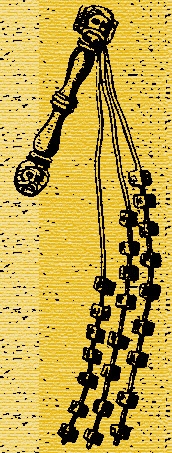
This sketch depicts a Roman Flagrum which was designed to quickly remove the flesh from the body of a victim.
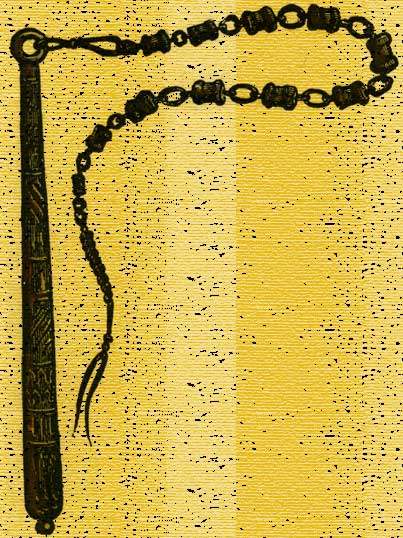
The Romans would, according to custom, scourge a condemned criminal before he was put to death. The Roman scourge, also called the "flagrum" or "flagellum" was a short whip made of two or three leather (ox-hide) thongs or ropes connected to a handle as in the sketch above. The leather thongs were knotted with a number of small pieces of metal, usually zinc and iron, attached at various intervals. Scourging would quickly remove the skin. According to history the punishment of a slave was particularly dreadful. The leather was knotted with bones, or heavy indented pieces of bronze.
Sometimes the Roman scourge contained a hook at the end and was given the terrifying name "scorpion." The criminal was made to stoop which would make deeper lashes from the shoulders to the waist. According to Jewish law (discipline of the synagogue) the number of stripes was forty less one (Deut. 25:3) and the rabbis reckoned 168 actions to be punished by scourging before the judges. Nevertheless, scourging among the Romans was a more severe form of punishment and there was no legal limit to the number of blows, as with the Jews. Deep lacerations, torn flesh, exposed muscles and excessive bleeding would leave the criminal "half-dead." Death was often the result of this cruel form of punishment though it was necessary to keep the criminal alive to be brought to public subjugation on the cross. The Centurion in charge would order the "lictors" to halt the flogging when the criminal was near death.
"But he was wounded for our transgressions, he was bruised for our iniquities: the chastisement of our peace was upon him; and with his stripes we are healed. All we like sheep have gone astray; we have turned every one to his own way; and the LORD hath laid on him the iniquity of us all." - Isaiah 53:5-6
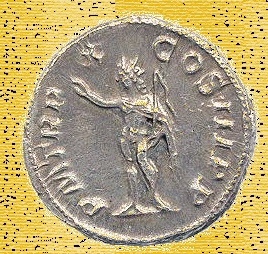
Flagellum, Symbol of Sol
Notice on the above ancient Roman coin the flagellum is the symbol of Sol the sun-god.
In ancient Rome crucifixion was almost always preceded by the "flagrum" and thus it made the vision of the crucified criminal all the more dreadful. Cicero called crucifixion the "extreme and ultimate punishment of slaves" (servitutis extremum summumque supplicium, Against Verres 2.5.169), and the "cruelest and most disgusting penalty." (crudelissimum taeterrimumque supplicium, ibid. 2.5. 165.) and Josephus called it "the most pitiable of deaths." (Jewish War 7:203.)
"I gave my back to those who beat me, my cheeks to those who plucked my beard; my face I did not shield from buffets and spitting." - Isaiah 50:6
"Just as there were many who were appalled at him his appearance was so disfigured beyond that of any man and his form marred beyond human likeness" - Isaiah 52:14
"So, Pilate, wishing to satisfy the crowd, released to them Barabbas; but Jesus he scourged and delivered to be crucified." - Mark 15:15
Matthew 20:19 - And shall deliver him to the Gentiles to mock, and to scourge, and to crucify [him]: and the third day he shall rise again.
The Flagrum
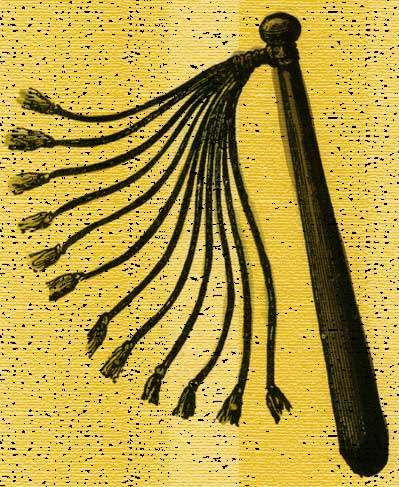
Scourging Whip Made of Chords
Matthew 20:19 - And shall deliver him to the Gentiles to mock, and to scourge, and to crucify [him]: and the third day he shall rise again.
Crucifixion was so horrifying to an enemy of Rome, and it was almost always preceded by scourging.
The Bible Mentions the Word "Scourge"
Matthew 23:34 - Wherefore, behold, I send unto you prophets, and wise men, and scribes: and [some] of them ye shall kill and crucify; and [some] of them shall ye scourge in your synagogues, and persecute [them] from city to city:
John 2:15 - And when he had made a scourge of small cords, he drove them all out of the temple, and the sheep, and the oxen; and poured out the changers' money, and overthrew the tables;
Acts 22:25 - And as they bound him with thongs, Paul said unto the centurion that stood by, Is it lawful for you to scourge a man that is a Roman, and uncondemned?
Matthew 20:19 - And shall deliver him to the Gentiles to mock, and to scourge, and to crucify [him]: and the third day he shall rise again.
Matthew 10:17 - But beware of men: for they will deliver you up to the councils, and they will scourge you in their synagogues;
Mark 10:34 - And they shall mock him, and shall scourge him, and shall spit upon him, and shall kill him: and the third day he shall rise again.
Luke 18:33 - And they shall scourge [him], and put him to death: and the third day he shall rise again.