Brief overview of the character of the Emperor Nero
Good Looking and Short-Sighted
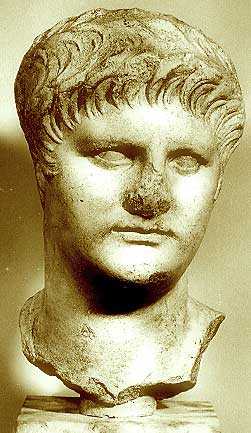
Nero was described as a very handsome man. He was apparently short-sighted which made him squint often and had a lot of freckles. He had dark blond hair and grayish eyes. He maintained his good health even though he had a big belly and a large neck.
note: Presumably Nero was extremely short-sighted. Apparently he had an enormous emerald which he used as a glass to view gladiatorial fights. The Romans believed that emeralds were good for the sight, but Nero's emerald may have been hollowed out to act as a lens to help him see.
Agrippina Runs Things – For Awhile
Nero was a confident leader who was very interested in Roman arts and education. When he was young the control of the empire was in the hands of his mother, Agrippina. In fact on the first day that he began to rule he gave the tribune of the guard the watchword "The best of mothers" and she was authorized to handle all of the business of the empire for Nero. Burrus, the prefect of the Praetorian Guard, and his tutor, Seneca were his trusted advisors. During this time and under their direction Rome prospered, but this did not last.
Nero both loved and hated his mother, who had been continually trying to dominate him. Slowly as Nero became older and more independent, his mother began to lose power.
note: On Roman coins Nero and Agrippina faced each other and on the back was Agrippina's name showing she was more important. Slowly as Nero became older and more independent, his mother began to lose power. The coins showed Nero and his mother facing the same direction and his name was on the back.
Relations between Nero and his mother were at their worst. Nero tried to bestow honor on her in several ways, but she scorned him, and made him feel indebted to her for everything. She finally moved out of the palace in 55 A.D. to her own mansion, which was a sure sign that she was losing power. Agrippina suddenly began to show favor toward Britannicus (Nero’s brother) and so Nero ordered his execution.
By 59 A.D. Nero was fed up with her schemes and ordered her death. This had been the first time and the last time that a woman had ruled Rome.
After Agrippina had left the palace Burrus and Seneca successfully ran the empire. Three years later in 62 A.D. both Burrus and Seneca vanished from the political scene. Burrus apparently died from throat cancer, and Seneca resigned and later committed suicide. Nero appointed two Praetorian Prefects (Faenius Rufus and Gaius Ofonius Tigellinus). Tigellinus was previously exiled by Caligula and Nero called him back to make use of his renowned intelligence skills.
With the help of Tigellinus, Nero divorced Octavia and married Poppaea. Tigellinus framed Octavia on an immorality charge and she was exiled to an island and later executed.
62-63 A.D. marked the beginning of the degeneration of Nero's rule.
Orgies, Gluttony and Lust
Nero lavished himself in his own power, he used golden thread for his fishing nets, he never wore the same robe twice, he had his mules shod with silver. He was heavily into parties and practiced orgies and gluttony, and his dinners sometimes lasted twelve hours, from noon to midnight. He also murdered his 19-year-old wife so that he could marry his mistress, and then later he killed that mistress.
Nero was always interested in the arts, and he was a huge admirer of all things Greek, and he deliberately wore a charioteer's hair style and wore Greek clothing which upset his people continually. Nero was far more interested in writing poetry, acting, dancing, and singing than he was in being emperor. He introduced Greek games and arts contests to the Romans, wrote poetry, played the lyre, and considered himself gifted in them all, including singing (Nero employed the famous lyre player Terpnus to give him lessons). In 64 A.D. at Neapolis Nero performed in a public theater for the first time. He liked to come there and sing for large crowds of people. The first time he appeared on a Roman stage was in 65 A.D. at the second performance of the Neronian Games. Nero was an avid performer but he also suffered from severe stage fright.
He was fascinated by civil engineering and architecture. But his big mistakes were that he left his empire unattended, for example he never visited the legionary camps, and he scorned the Senate. When Nero learned of a senatorial conspiracy in 65 A.D. he had the organizers either killed or banished. Seneca, his own tutor, was among them. Whenever there was a hint of treason Nero ordered their execution or forced them to commit suicide.
Nero apparently slept with beautiful young women and young boys including Britannicus, his brother. He supposedly also slept with his mother Agrippina and had many physical relationships with men older than himself, and with eunuchs. Nero, according to Dio Cassius, "fastened young boys and girls to stakes, and then, after putting on the hide of a wild beast, attacked them and satisfied his brutal lust under the appearance devouring parts of their bodies". Nero wanted to marry a freedwoman, Acte, but this would have been socially unacceptable for an emperor.
Emperor Worship
Nero became even more tyrannical, claiming that he was equal to Apollo and the other gods. He encouraged emperor worship and had a huge statue of himself erected in Rome.
The Pisonian Conspiracy
In 65 A.D. some senators concocted the Pisonian Conspiracy to murder Nero in the Circus Maximus, while the games were going on, and then place Caius Calpurnius Piso in Nero’s position. They were found out and Nero went on a rampage to root out any opposition and there were daily executions. In fact all together there were nineteen executions and suicides. Among the ones killed were Faenius Rufus, Seneca, Lucan and Poppaea. Corbulo commited suicide. In 66 A.D. a second wave of executions took place and some of the important men who perished were Caius Petronius, Paetus Thrasea the Stoic, and Barea Soranus. Almost everyone who was suspected of treason was executed including many senators and prefects.
This all took place in 66 AD, the same time when the horrible Jewish revolt broke out.
Greece – Free from Taxation
In 67 A.D. Nero decided to take a trip to Greece where he participated in a variety of athletic contests and drama spectacles. He was awarded more than 1,800 prizes by the judges. During an oration in the stadium Nero declared Greece free from Roman taxation, though still part of the Roman empire. This was no doubt a huge blunder on Nero’s part and would bring many more revolts.
Nero’s Death
Even though many revolts were breaking out throughout the empire, Nero did not seem to care. It was only a matter of time, his trusted bodyguards deserted him and he fled for his life. When he left Rome the Senate declared him a public enemy and ordered him arrested. Nero went into hiding and soon realized that there was no hope of escape and saw death as the only answer and cried out "Alas, What an Artist Is Dying in Me." He preferred suicide rather than the usual public flogging which was the standard punishments for any enemy of the state, and Nero said "how ugly and vulgar my life has become! This certainly is no credit to Nero." The Praetorian Guard came for him and he raised a knife to his throat and, according to Suetonius said these words "Hark to the sound I hear! It is hooves of galloping horses." And suddenly, with the help of his secretary Epaphroditus, he slit his own throat.
He died in 68 A.D. and the empire was on the verge of Civil War. In fact the Jews in Judea had already begun a revolt.