You are here:HomeBible Maps
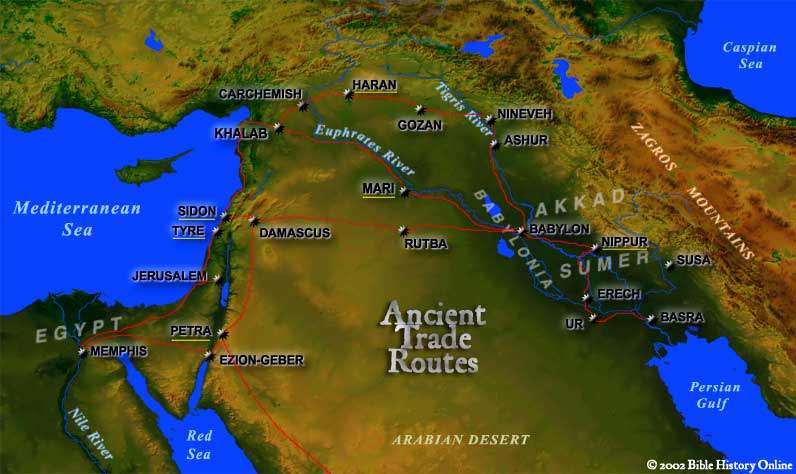
Map of Ancient Trade Routes from Mesopotamia
Map of Ancient Trade Routes From Mesopotamia to Egypt and the Mediterranean
This map reveals the trade routes from ancient Mesopotamia to the Mediterranean world. The underlined cites were important trade centers.
Evidence for Ancient Trade Routes Wikipedia (Read Full Article) The ancient peoples of the Sahara imported domesticated animals from Asia between 6000 and 4000 BCE.
Foreign artifacts dating to the 5th millennium BCE in the Badarian culture of Egypt indicate contact with distant Syria.
In predynastic Egypt, by the 4th millennium BCE shipping was well established, and the donkey and possibly the dromedary had been domesticated. Domestication of the Bactrian camel and use of the horse for transport then followed.
Also by the beginning of the 4th millennium BC, ancient Egyptians in Maadi were importing pottery[11] as well as construction ideas from Canaan.
By the second half of the 4th millennium BC, the gemstone lapis lazuli was being traded from its only known source in the ancient world — Badakshan, in what is now northeastern Afghanistan — as far as Mesopotamia and Egypt. By the 3rd millennium BC, the lapis lazuli trade was extended to Harappa and Mohenjo-daro in the Indus Valley Civilization (Ancient India) of modern day Pakistan and northwestern India. The Indus Valley was also known as Meluhha, the earliest maritime trading partner of the Sumerians and Akkadians in Mesopotamia.
Pottery and other artifacts from the Levant that date to the Naqadan era have been found in ancient Egypt.[12] Also found in ancient Egypt are obsidian from Ethiopia and the Aegean, both dating to the same era.[13] Egyptian artifacts dating to this era have been found in Canaan[14] and other regions of the Near East, including Tell Brak[15] and Uruk and Susa[16] in Mesopotamia.
Routes along the Persian Royal Road, constructed in the 5th century BCE by Darius I of Persia, may have been in use as early as 3500 BC. Charcoal samples found in the tombs of Nekhen, which were dated to the Naqada I and II periods, have been identified as cedar from Lebanon.[17]
Ancient Egyptians already knew how to assemble planks of wood into a ship hull as early as 3000 BC.[18] Woven straps were used to lash the planks together,[18] and reeds or grass stuffed between the planks helped to seal the seams.[18]
In 1994 excavators discovered an incised ceramic shard with the serekh sign of Narmer, dating to circa 3000 BC. Mineralogical studies reveal the shard to be a fragment of a wine jar exported from the Nile valley to Israel. Narmer had Egyptian pottery produced in southern Canaan — with his name stamped on vessels — and then exported back to Egypt.[19] Production sites included Arad, En Besor, Rafiah, and Tel Erani.[19]
The ancient harbor constructed in Lothal, India, around 2400 BCE is the oldest seafaring harbour known.
Mesopotamia - (between the rivers), the entire country between the two rivers, the Tigris and the Euphrates. This is a tract nearly 700 miles long and from 20 to 250 miles broad, extending in a southeasterly direction from Telek to Kurnah. The Arabian geographers term it "the Island," a name which is almost literally correct, since a few miles only intervene between the source of the Tigris and the Euphrates at Telek. But the region which bears the name of Mesopotamia, par excellence, both in Scripture and in the classical writers, is the northwestern portion of this tract, or the country between the great bend of the Euphrates, lat. 35 degrees to 37 degrees 30', and the upper Tigris.
We first hear of Mesopotamia in Scripture as the country where Nahor and his family settled after quitting Ur of the Chaldees. Ge 24:10 Here lived Bethuel and Laban; and hither Abraham sent his servants to fetch Isaac a wife. Ibid. ver. 38. Hither too, a century later, came Jacob on the same errand; and hence he returned with his two wives after an absence of twenty-one years. After this we have no mention of Mesopotamia till the close of the wanderings int he wilderness. De 23:4 About half a century later we find, for the first and last time, Mesopotamia the seat of a powerful monarchy. Jud 3:1 ... Finally, the children of Ammon, having provoked a war with David, "sent a thousand talents of silver to hire them chariots and horsemen out of Mesopotamia, and out of Syria-maachah, and out of Zobah." 1Ch 19:6 According to the Assyrian inscriptions Mesopotamia was inhabited in the early times of the empire, B.C. 1200-1100, by a vast number of petty tribes, each under its own prince, and all quite independent of one another.
The Assyrian monarchs contended with these chiefs at great advantage, and by the time of Jehu, B.C. 880, had fully established their dominion over them. On the destruction of the Assyrian empire, Mesopotamia seems to have been divided between the Medes and the Babylonians. The conquests of Cyrus brought it wholly under the Persian yoke; and thus it continued to the time of Alexander. Since 1516 it has formed a part of the Turkish empire. It is full of ruins and mounds of ancient cities, some of which are now throwing much light on the Scripture.
Mesopotamia (from the Greek meaning "land between the rivers") is an area geographically located between the Tigris and Euphrates rivers, largely corresponding to modern Iraq,[2] as well as northeastern Syria, southeastern Turkey, and the Khūzestān Province of southwestern Iran.
Commonly known as the "cradle of civilization", Bronze Age Mesopotamia included Sumer and the Akkadian, Babylonian and Assyrian empires. In the Iron Age, it was ruled by the Neo-Assyrian Empire and Neo-Babylonian Empire, and later conquered by the Achaemenid Empire. It mostly remained under Persian rule until the 7th century Islamic conquest of the Sassanid Empire. Under the Caliphate, the region came to be known as Iraq.