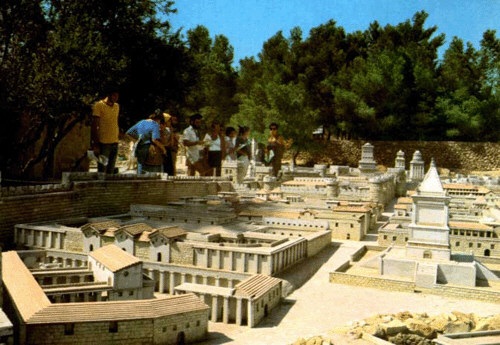
Photo of The Upper City in the Second Temple Model.
The hill east of Herod's Palace was known as the Upper City on Mount Zion. It had been inhabited during biblical times, but was deserted after the Babylonian conquest of Jerusalem in 586 BC. During Herod's reign and in the first century, the Upper City, once more inhabited, was the residential quarter of the Jerusalem aristocracy and priestly families. The Upper Agora, surrounded by porticoes, was the "forum," the place where citizens assembled for business. Another gathering place, this one on the Temple Mount, was the Royal Hall, built by Herod - one of the largest buildings in the Roman Empire. Clearly discernible in the model are luxurious private buildings, remains of which were uncovered recently, mostly in excavations in the Jewish Quarter. The buildings included large rooms decorated with frescoes and mosaics, bathrooms, water cisterns and ritual baths. One such building, revealed in 1970, is known as the "Burnt House." Filled with the implements of everyday life in the first century, it was completely burnt as a result of the conflagration that reduced the Upper City to ashes in 70 AD.