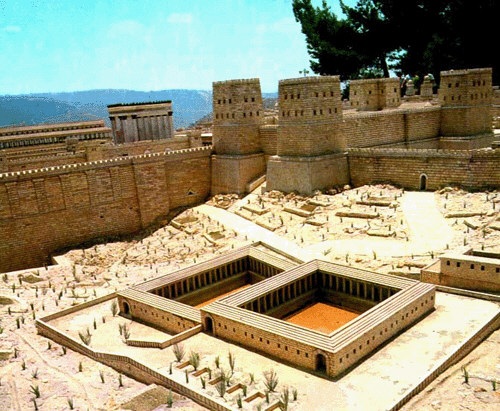
The Pool of Bethesda - First
Century Jerusalem
The Pool of Bethesda in the Second Temple Model at
Jerusalem

The
Pool of the Sheepmarket was just below the Fortress of Antonia.
BETHES'DA (beth-ez'da;
Gk. from Aram. Beth hesda, "house of grace"). A spring-fed pool with five
porches where invalids waited their turn to step into the mysteriously troubled
waters that were supposed to possess healing virtue (John 5:2-4). The last part
of v. 3 and all of v. 4, which mention a periodic disturbance of the water by an
angel, are placed in brackets in the NASB because there is not sufficient
attestation by early texts. Here Jesus healed the man who was lame for
thirty-eight years (5:5-9). The place is now thought to be the pool found during
the repairs in 1888 near St. Anne's Church in the Bezetha quarter of Jerusalem
not far from the Sheep's Gate and Tower of Antonia. It is below the crypt of the
ruined fourth-century church and has a five-arch portico with faded frescoes of
the miracle of Christ's healing.
POOL OF BETHESDA
BETHES'DA Heb. "beth
Chesda" (house of mercy) Gk. from Aram. Beth hesda, "house of grace"). A
spring-fed pool with five porches where invalids waited their turn to step into
the mysteriously troubled waters that were supposed to possess healing virtue (Jn
5:2-4). The disturbance of the water by an angel, are placed in brackets in the
NASB because there is not sufficient attestation by early texts. Here Jesus
healed the man who was lame for thirty-eight years. The historicity of this site
was once in question. Scholars like Dr. Alfred Loisy, claimed the detail of the
five porticoes was invented. They said John made it up to represent the five
books of Moses, which Jesus came to fulfill. But recent archaeological
discoveries have once again confirmed the Biblical account. In 1956, digging at
the ancient Biblical site of Bethesda, archaeologists unearthed a rectangular
pool with a portico on each side and a fifth one dividing the pool into 2
separate compartments.
The place is now
thought to be the pool found during the repairs in 1888 near St. Anne's Church
in the Bezetha quarter of Jerusalem not far from the Sheep's Gate and Tower of
Antonia. It is below the crypt of the ruined fourth-century church and has a
five-arch portico with faded frescoes of the miracle of Christ's healing.
This model is a
Scholar's conception showing how the site may have looked in Jesus' day.

"Whoever has not seen Jerusalem in its splendor has never seen a fine city."–
Babylonian Talmud (Succah, 51b)
Click around on the Picture
Primary Sources for the Study of First Century Jerusalem:
Josephus, The Mishnah, The New Testament,
Pliny.
First Century Jerusalem
The Jerusalem of Herod the Great
The Jerusalem Jesus
knew nowhere near resembled the city David conquered in the tenth century BC. At
that time, it had been a small, isolated hill fortress, valued more for its
location than its size or splendor. Yet from that time on it was known as the
City of David, and the kings of David's dynasty, especially his son Solomon, had
enlarged and beautified it.
In the sixth
century BC, the army of Nebuchadnezzar leveled Jerusalem and drove its citizens
into exile. During the long years of captivity in Babylon, the Jews in exiles'
prayers and longings focused on the distant Holy City. But the city rebuilt by
the Jews who returned a century later was far inferior to its former splendor.
It was, ironically, the hated tyrant Herod the Great who restored Jerusalem to
its former grandeur.
In the 33 years of
his reign (37-4 B.C.), Herod transformed the city as had no other ruler since
Solomon. Building palaces and citadels, a theatre and an amphitheatre, viaducts
(bridges) and public monuments. These ambitious building projects, some
completed long after his death, were part of the king's single-minded campaign
to increase his capital's importance in the eyes of the Roman Empire.
No visitor seeing
Jerusalem for the first time could fail to be impressed by its visual splendor.
The long, difficult ascent from Jericho to the Holy City ended as the traveler
rounded the Mount of Olives, and suddenly caught sight of a vista like few
others in the world. Across the Kidron Valley, set among the surrounding hills,
was Jerusalem, "the perfection of beauty," in the words of Lamentations, "the
joy of all the world."
The view from the
Mount of Olives was dominated by the gleaming, gold-embellished Temple which was
located in the most holy spot in the Jewish world and really God's world. This
was the Lord's earthly dwelling place, He mediated His throne here and raised up
a people to perform rituals and ceremonies here that would foreshadow the coming
of His Messiah kinsman redeemer who would be the lamb of God, slain for the sins
of the whole world.
The Temple stood
high above the old City of David, at the center of a gigantic white stone
platform.
To the south of the
temple was THE LOWER CITY, a group of limestone houses, yellow-brown colored
from years of sun and wind. Narrow, unpaved streets and houses that sloped
downward toward the Tyropean Valley, which ran through the center of Jerusalem.
Rising upward to
the west was THE UPPER CITY, or Zion, where the white marble villas and palaces
of the very rich stood out like patches of snow. Two large arched passageways
spanned the valley, crossing from the Upper City to the temple.
A high, thick, gray
stone wall encircled Jerusalem. It had been damaged, repaired and enlarged over
the centuries, and in Jesus' day it was about 4 miles in circumference, bringing
about 25,000 people into an area about a square mile. At intervals along the
wall were massive gateways. Just inside each gate was a customs station, where
publicans collected taxes on all goods entering or leaving the city.
First
Century Jerusalem
Bible History Online
© Bible History Online (http://www.bible-history.com)
|