Bible History
International Standard Bible Encyclopedia
A B C D E F G H I J K L M N O P Q R S T U V W X Y Z
STAVES
stavz (baddim): Ten or eleven Hebrew words are used in the Old Testament to describe various staffs, bars, and wooden rods used by the Hebrews (compare STAFF; ROD; SCEPTER). One word only is used to describe the staves or wooden poles used for carrying the holy furniture of the tabernacle from place to place. That word is badh (plural baddim), which occurs 28 times in Exodus and Numbers and 5 times in Kings and Chronicles (compare also Job 17:16; Hos 11:6). The only passage in which these staves are mentioned by another name is 1 Ch 15:15, where the staves used for carrying the ark from its captivity into Jerusalem are called motah. The reason for this probably is that the original baddim had been lost during the long absence of the sacred chest from its home in the tabernacle.
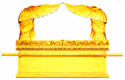
In the wilderness wanderings, arrangements were made that four items of the holy furniture of the portable tabernacle should be carried on the shoulders of Levites, suspended on these staves. These were the golden altar of incense, the golden table for shewbread, the brazen altar of sacrifice, and the ark of the covenant (Ex 35:12-16).
In the case of the large altar of sacrifice, which was in reality a hollow wooden chest covered with brass (bronze) plates (see ALTAR), four rings were attached to the brass grating which rose midway in the chest, and through these rings the staves passed. The staves were of acacia wood and were covered with brass plating. In the case of the three golden utensils of the sanctuary, the staves were of acacia wood, covered with gold plates.
The last mention of any of these staves is in 1 Ki 8:7-9, where it is stated of the ark, in the holy of holies in Solomon's Temple, that the ends of its staves were seen by anyone standing in the adjoining holy place, before (i.e. east of) the oracle. Priests only might view them there, the curtain being withdrawn. The writer of 1 Ki 8 adds that the staves were thus visible when he wrote, an item of evidence worthy of note as to the date of the document.
W. Shaw Caldecott Bibliography Information
Orr, James, M.A., D.D. General Editor. "Definition for 'staves'". "International Standard Bible Encyclopedia". bible-history.com - ISBE; 1915.
Copyright Information
© International Standard Bible Encyclopedia (ISBE)
ISBE Bible Encyclopedia Home
Bible History Online Home
Bible Encyclopedia (ISBE)
Online Bible (KJV)
Naves Topical Bible
Smith's Bible Dictionary
Easton's Bible Dictionary
Schaff's Bible Dictionary
Fausset's Bible Dictionary
Matthew Henry Bible Commentary
Hitchcock's Bible Dictionary
Related Bible History
Popular and Trending:
Meaning of the name Alexander, Alexander the Great, Alexander the Coppersmith,
Syria and Bible Prophecy, Bible Study about Syria, What the Bible Says about Syria and Damascus, Isaiah 17,
The Bible and Palm Trees, Bible Study about the Palm Tree,
The Righteous Will Flourish like a Palm Tree Psalm 92:12
,
Definition of Paraclete, Bible study about the Holy Spirit and the Paraclete, Paracletus in the Greek,
Games in the Bible, What Games Did Kids Play in Biblical Times? Which Kinds of Games Existed in the Time of Jesus?,
The Church at Thyatira, What Was the Message to Thyatira, Revelation 2 and Thyatira, history of Thyatira,
David and Goliath, How Tall Was Goliath, Archaeological Discoveries and Goliath, Goliath And Philistine History,
Who Was Titus in the Bible, Paul's Letter to Titus, Bible Study Lessons in Titus,
Meaning of the Name Tanner, Bible Study about Simon the Tanner, Acts 10:6 Peter Was Staying at the
House of Simon the Tanner, What Was a Tanner