Bible History
International Standard Bible Encyclopedia
A B C D E F G H I J K L M N O P Q R S T U V W X Y Z
ASHDOD
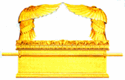
ash'-dod ('ashdodh; Azotos; modern Esdud): One of the five chief cities of the Philistines. The name means stronghold or fortress, and its strength may be inferred by the fact that Psammetik I, of Egypt, besieged it for many years (Herodotus says 29). Some of the Anakim were found there in the days of Joshua (Josh 11:22), and the inhabitants were too strong for the Israelites at that time. It was among the towns assigned to Judah, but was not occupied by her (Josh 13:3; 15:46,47). It was still independent in the days of Samuel, when, after the defeat of the Israelites, the ark was taken to the house of Dagon in Ashdod (1 Sam 5:1,2). We have no account of its being occupied even by David, although he defeated the Philistines many times, and we have no definite knowledge of its coming into the hands of Judah until the time of Uzziah (2 Ch 26:6). Ashdod, like the other Philistine towns, came under the authority of the Assyrian monarchs, and we have mention of it in their records. It revolted against Sargon in 711 BC, and deposed the Assyrian governor, Akhimiti, who had been appointed by him in 720. Sargon at once dispatched a force to subdue the rebels and the city was severely punished. This is referred to by Isaiah (Isa 20:1). Amos had prophesied such a calamity some years before (1:8), and Jeremiah refers to "the remnant of Ashdod" as though it had continued weak until his day (Jer 25:20). Zephaniah (Zeph 2:4) refers to the desolation of Ashdod and Zechariah to its degraded condition (Zec 9:6). It continued to be inhabited, however, for we find the Jews intermarried with them after the return from Babylon (Neh 13:23,24). In the Maccabean period we are told that Judas and Jonathan both took it and purified it of idolatry (1 Macc 5:68; 10:84). In these passages it is called Azotus, as it is also in the New Testament (Acts 8:40). In the 4th century AD it became the seat of a bishopric. It had been restored in the time of Herod, by the Roman general Gabinius, and was presented to Salome, the sister of Herod, by the emperor Augustus. It is now a small village about 18 miles Northeast of Gaza.
H. Porter Bibliography Information
Orr, James, M.A., D.D. General Editor. "Definition for 'ashdod'". "International Standard Bible Encyclopedia". bible-history.com - ISBE; 1915.
Copyright Information
© International Standard Bible Encyclopedia (ISBE)
ISBE Bible Encyclopedia Home
Bible History Online Home
Bible Encyclopedia (ISBE)
Online Bible (KJV)
Naves Topical Bible
Smith's Bible Dictionary
Easton's Bible Dictionary
Schaff's Bible Dictionary
Fausset's Bible Dictionary
Matthew Henry Bible Commentary
Hitchcock's Bible Dictionary
Related Bible History
Popular and Trending:
Meaning of the name Alexander, Alexander the Great, Alexander the Coppersmith,
Syria and Bible Prophecy, Bible Study about Syria, What the Bible Says about Syria and Damascus, Isaiah 17,
The Bible and Palm Trees, Bible Study about the Palm Tree,
The Righteous Will Flourish like a Palm Tree Psalm 92:12
,
Definition of Paraclete, Bible study about the Holy Spirit and the Paraclete, Paracletus in the Greek,
Games in the Bible, What Games Did Kids Play in Biblical Times? Which Kinds of Games Existed in the Time of Jesus?,
The Church at Thyatira, What Was the Message to Thyatira, Revelation 2 and Thyatira, history of Thyatira,
David and Goliath, How Tall Was Goliath, Archaeological Discoveries and Goliath, Goliath And Philistine History,
Who Was Titus in the Bible, Paul's Letter to Titus, Bible Study Lessons in Titus,
Meaning of the Name Tanner, Bible Study about Simon the Tanner, Acts 10:6 Peter Was Staying at the
House of Simon the Tanner, What Was a Tanner