Iraq: Nineveh
Neo-Assyrian Period
Reign of Sennacherib, (689 BC)
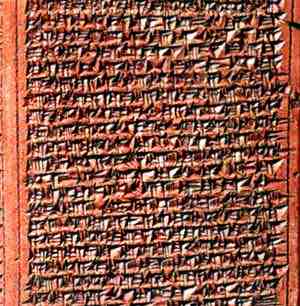
Baked clay, inscribed
38.0 cm H, 14.0 cm W
500 Lines of Writing (cuneiform)
Purchased in Baghdad, 1919
OIM A2793
Sennacherib's Prism
Reveals King Hezekiah
This six-sided hexagonal
clay prism, commonly known as the Taylor Prism, was discovered among
the ruins of Nineveh, the ancient capital of the Assyrian Empire.
It contains the Annals of Sennacherib himself, the Assyrian king who
had besieged Jerusalem in 701 BC during the reign of king Hezekiah. On
the prism Sennacherib boasts that he shut up "Hezekiah the
Judahite" within Jerusalem his own royal city "like a caged
bird." This prism is among the three accounts discovered so far
which have been left by the Assyrian monarch of his campaign against
Israel and Judah.
Who was Sennacherib?
Sennacherib in Akkadian means "Sin (moon god) has multiplied the
brothers". Sennacherib was one of the most powerful monarchs in
the history of the world. He was king of Assyria, and the son of
Sargon. He inherited the vast empire from his father, and ascended the
throne on the twelfth day of Ab (July-August), 705 B.C. Sennacherib was
the king who had besieged Jerusalem during the reign of king Hezekiah
of Judah.
Colonel Taylor,
Hormuzd Rassam and Henry Austen Layard
The Taylor Prism was
discovered among the ruins of ancient Nineveh by Colonel Taylor in
1830. Of all Assyrian documents that have come down to us not one is in
better preservation than this.
Henry Austen Layard
later found the Royal Palace of Sennacherib and many other
archaeological treasures. The work of Layard was continued here and at
other sites until 1847. In 1849 he began another exploring expedition
which lasted three years. Layard had become popular in Britain as he
gave persuasive scholarly accounts of his discoveries to the public,
making remarkable comparisons with the Bible.
In 1878 Hormuzd
Rassam (Assyrian Archaeologist 1826-1910) had resumed work for the
British Museum at Nineveh after Henry Austen Layard's excavations in
1845 for the British Museum at the Mounds of Nimrud. There were clay
tablets discovered in great quantities: and Rassam, without knowing it,
unearthed at Nineveh a portion of the famous library of Assurbanipal
(688-26 B. C.).
The palace at Nineveh
was decorated with massive stone wall panels depicting the siege of
Lachish. These can be seen today at the Lachish Gallery in the British
Museum.
Taylor Prism
Purchased by the Oriental Institute
In 1919 J. H. Breasted
purchased the Taylor Prism for the Oriental Institute in Chicago from a
Baghdad antiquities dealer
Specifications of the
Prism
Language:
Akkadian (Cuneiform)
Medium: Clay prism
Dimensions: 38cm high, 13.3cm wide (top) 14cm wide
(bottom)
the width of the six panels are: 8, 7.6, 7.52, 8, 7.3, 7.7cm
the hole at the top is 2.3cm
the hole at the bottom is 2.5cm
"On the six
inscribed sides of this clay prism, King Sennacherib recorded eight
military campaigns undertaken against various peoples who refused to
submit to Assyrian domination. In all instances, he claims to have been
victorious. As part of the third campaign, he beseiged Jerusalem and
imposed heavy tribute on Hezekiah, King of Judah-a story also related
in the Bible, where Sennacherib is said to have been defeated by
"the angel of the Lord," who slew 185,000 Assyrian soldiers
(II Kings 18-19)." - Oriental Institute
Here is an exact
rendering of Sennacheribs haughty introductory declaration about
himself and his third campaign:
Sennacherib, the
great king, the mighty king, king of the world, king of Assyria,
king of the four quarters, the wise shepherd, favorite of the great
gods, guardian of right, lover of justice, who lends support, who
comes to the aid of the destitute, who performs pious acts, perfect
hero, mighty man, first among all princes, the powerful one who
consumes the insubmissive, who strikes the wicked with the
thunderbolt; the god Assur, the great mountain, an unrivaled
kinship has entrusted to me, and above all those who dwell in
palaces, has made powerful my weapons; from the upper sea of the
setting sun to the lower sea of the rising sun, he has brought the
black-headed people in submission at my feet; and mighty kings
feared my warfare, leaving their homes and flying alone, like the
sidinnu, the bird of the cave, to some inaccessible place...
In my third
campaign, I went against the Hittite-land. Lulê, king of Sidon,
the terrifying splendor of my sovereignty overcame him, and far off
into the midst of the sea he fled. There he died. Great Sidon,
Little Sidon, Bît-Zitti, Zaribtu, Mahalliba, Ushu, Akzib, Akko,
his strong, walled cities, where there were fodder and drink, for
his garrisons, the terrors of the weapon of Assur, my lord,
overpowered them and they bowed in submission at my feet. I seated
Tuba'lu on the royal throne over them, and tribute, gifts for my
majesty, I imposed upon him for all time, without ceasing.
From Menachem, the Shamsimurunite, Tuba'lu the Sidonite, Abdi-liti
the Arvadite, Uru-milki the Gublite, Mitinti the Ashdodite Budu-ilu
the Beth Ammonite, Kammusu-nadbi the Moabite, Malik-rammu the
Edomite, kings of Amurru, all of them, numerous presents as their
heavy tribute, they brought before me for the fourth time, and
kissed my feet.
But Sidka, the king of Ashkelon, who had not submitted to my yoke,
the gods of his father's house, himself, his wife, his sons, his
daughters, his brothers, the seed of his paternal house, I tore
away and brought to Assyria. Sharru-lu-dari, son of Rukibti, their
former king, I set over the people of Ashkelon, and I imposed upon
him the payment of tribute: presents to my majesty. He accepted my
yoke. In the course of my campaign, Beth-Dagon, Joppa, Banaibarka,
Asuru, cities of Sidka, who had not speedily bowed in submission at
my feet, I besieged, I conquered, I carried off their spoil.
The officials, nobles, and people of Ekron, who had thrown Padi
their king—bound by oath and curse of Assyria— into fetters of
iron and had given him over to Hezekiah, the Judahite—he kept him
in confinement like an enemy— their heart became afraid, and they
called upon the Egyptian kings, the bowmen, chariots and horses of
the king of Meluhha [Ethiopia], a countless host, and these came to
their aid. In the neighborhood of Eltekeh, their ranks being drawn
up before me, they offered battle. With the aid of Assur, my lord,
I fought with them and brought about their defeat. The Egyptian
charioteers and princes, together with the Ethiopian king's
charioteers, my hands captured alive in the midst of the battle.
Eltekeh and Timnah I besieged, I captured, and I took away their
spoil.
I approached Ekron and slew the governors and nobles who had
rebelled, and hung their bodies on stakes around the city. The
inhabitants who rebelled and treated (Assyria) lightly I counted as
spoil. The rest of them, who were not guilty of rebellion and
contempt, for whom there was no punishment, I declared their
pardon. Padi, their king, I brought out to Jerusalem, set him on
the royal throne over them, and imposed upon him my royal tribute.
As for Hezekiah the Judahite, who did not submit to my yoke:
forty-six of his strong, walled cities, as well as the small towns
in their area, which were without number, by levelling with
battering-rams and by bringing up seige-engines, and by attacking
and storming on foot, by mines, tunnels, and breeches, I besieged
and took them. 200,150 people, great and small, male and female,
horses, mules, asses, camels, cattle and sheep without number, I
brought away from them and counted as spoil. (Hezekiah) himself,
like a caged bird I shut up in Jerusalem, his royal city. I threw
up earthworks against him— the one coming out of the city-gate, I
turned back to his misery. His cities, which I had despoiled, I cut
off from his land, and to Mitinti, king of Ashdod, Padi, king of
Ekron, and Silli-bêl, king of Gaza, I gave (them). And thus I
diminished his land. I added to the former tribute, and I laid upon
him the surrender of their land and imposts—gifts for my majesty.
As for Hezekiah, the terrifying splendor of my majesty overcame
him, and the Arabs and his mercenary troops which he had brought in
to strengthen Jerusalem, his royal city, deserted him. In addition
to the thirty talents of gold and eight hundred talents of silver,
gems, antimony, jewels, large carnelians, ivory-inlaid couches,
ivory-inlaid chairs, elephant hides, elephant tusks, ebony,
boxwood, all kinds of valuable treasures, as well as his daughters,
his harem, his male and female musicians, which he had brought
after me to Nineveh, my royal city. To pay tribute and to accept
servitude, he dispatched his messengers..
Complete
translations of the records of Sennacherib can be found in Daniel
D. Luckenbill, Ancient Records of Assyria and Babylonia, vol. 2,
and in James Pritchard's Ancient Near Eastern Texts (1950).
The Biblical
Comparison
The best way to see the
accuracy of the Biblical account with this record on Sennacherib's
Prism is to compare 2 Kings 18:13-19:37 and Isaiah 36:1-37:38 with the
last paragraph on the above account.
A Mystery of History
After comparing the
Biblical account with that of the Sennacherib Prism one Scripture
stands out above all of the rest, which remains a mystery even to
today. It is also recorded in the Book of Kings along with the Book of
Isaiah. It is the part where Isaiah gives a Word from the Lord just
after King Hezekiah's awesome prayer.
Isa 37:33-38
"Therefore thus says the LORD concerning the king of Assyria: 'He
shall not come into this city, Nor shoot an arrow there, Nor come
before it with shield, Nor build a siege mound against it. By the way
that he came, By the same shall he return; And he shall not come into
this city,' Says the LORD. 'For I will defend this city, to save it For
My own sake and for My servant David's sake.'" Then the angel of
the LORD went out, and killed in the camp of the Assyrians one hundred
and eighty-five thousand; and when people arose early in the morning,
there were the corpses--all dead. So Sennacherib king of Assyria
departed and went away, returned home, and remained at Nineveh."
This miracle cannot be
substantiated by archaeological discoveries for a reason of which only
God knows, but all of the pieces seem to fit together because even
today no one has determined exactly why Sennacherib did not even enter
Jerusalem with his great army once it was besieged. After reading his
campaigns on his Prism it would seem that this was the thing he had
intended to do, and with all anxiety.
Another revealing fact
is this: At this point in time there was an abrupt discontinuance of
Assyria’s western invasions. Professor George Rawlinson of Oxford
noted:
Sennacherib during his later years made no expedition further westward
than Cilicia; nor were the Assyrian designs against Southern Syria and
Egypt resumed till toward the close of the reign of Esarhaddon
(Historical Illustrations of the Old Testament, 1873, p. 145).
Herodotus and
Josephus on Sennacherib's Campaigns
Herodotus, the father of
ancient Greek history, records what is probably an Egyptian legend
(that grew out of this historical event); he suggests that Sennacherib’s
fighting force was greatly reduced when in one night, a plague of field
mice gnawed the quivers, bowstrings, and shield-straps of his soldiers,
thus making them suddenly vulnerable to their enemies (cf. Edersheim,
Bible History, VII, p.155).
Josephus quotes the
Chaldean historian Berosus as follows:
Now when Sennacherib was returning from his Egyptian war to Jerusalem,
he found his army under Rabshakeh his general in danger [by a plague],
for God had sent a pestilential distemper upon his army; and on the
very night of the siege, a hundred fourscore and five thousand, with
their captains and generals, were destroyed (Antiquities 10.1.5).
But the account of his
death may give us some sort of distant light as to this miracle and the
possibility of his great army being utterly routed.
Sennacherib Murdered
by his own sons.
One interesting note
worth investigating further is where the Bible records what happened to
Sennacherib once he had returned to Nineveh, without his great army.
In reviewing the
background of this situation King Hezekiah was intensely concerned
about the armies of the Assyrian king Sennacherib. He sent his servants
to inquire of the prophet Isaiah just exactly what the Lord was saying
that he needed to do. Once his servants had found Isaiah, he said:
2 Kings 19:6-7 "And
Isaiah said to them, "Thus you shall say to your master, 'Thus
says the LORD: "Do not be afraid of the words which you have
heard, with which the servants of the king of Assyria have blasphemed
Me. Surely I will send a spirit upon him, and he shall hear a rumor and
return to his own land; and I will cause him to fall by the sword in
his own land."
The book of Kings goes
on to record what had actually happened to Sennacherib once he returned
to his capital, Nineveh.
2 Kings 19:37 Now it
came to pass, as he (Sennacherib) was worshiping in the temple of
Nisroch his god, that his sons Adrammelech and Sharezer struck him down
with the sword; and they escaped into the land of Ararat. Then
Esarhaddon his son reigned in his place."
This exact same account
was unearthed, having been recorded on a clay tablet, now in the
British Museum.
'On the twentieth day of the
month Tebet Sennacherib king of Assyria his son slew him in
rebellion... Esarhaddon his son sat on the throne of Assyria.'
This clay tablet
along with 2 Kings 19:37 was the last recorded mention of
Sennacherib, the powerful Assyrian monarch who once ruled the
world.
The Evidence of
Archaeology
The evidence of
archaeology helps to give us:
1. Confidence that the
places and people mentioned in the Bible are accurate, even though
those places and people existed thousands of years in the past.
2. Confidence that the
details of the Biblical accounts have not changed over the centuries
since it was written as we have a "fixed fact" in
history.
3. Confidence that
everything that the Lord speaks will be fulfilled in its time.
Isa 46:8-10
"Remember this, and show yourselves men; Recall to mind, O you
transgressors. Remember the former things of old, For I am God, and
there is no other; I am God, and there is none like Me, Declaring the
end from the beginning, And from ancient times things that are not yet
done, Saying, 'My counsel shall stand, And I will do all My
pleasure,'