
1599 Geneva Bible (GNV)
The Geneva Bible: A Cornerstone of English Protestantism A Testament to Reform The 1599 Geneva Bible... Read More
"He will raise a signal for a nation from afar off, and whistle for it from the ends of the earth; and lo, swiftly, speedily it comes." Isaiah 5:26
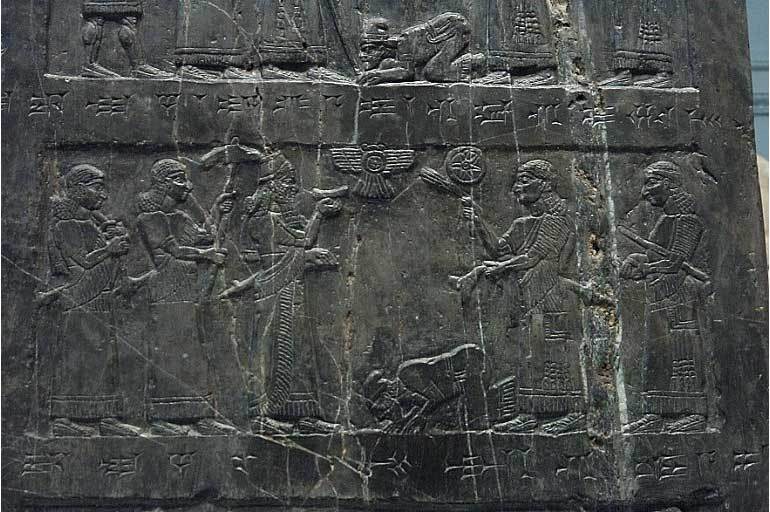
Look closely and notice the man bowing to the king of Assyria
The Black Obelisk of Shalmaneser stands nearly 7 feet tall and 2 feet thick. On each of the 4 sides there are 5 panels with carvings of various kings bringing tribute to king Shalmaneser III.
The second panel from the top of the obelisk reveals king Jehu of Israel bowing at the feet of Shalmaneser of Assyria. This is the same Jehu who is mentioned in Scripture, and this carved relief is the only image in all history of one of the Hebrew kings. On the panel Shalmaneser is offering a libation to his god. The cuneiform text around the panel reads:
"The tribute of Jehu, son of Omri: I received from him silver, gold, a golden bowl, a golden vase with pointed bottom, golden tumblers, golden buckets, tin, a staff for a king [and] spears."
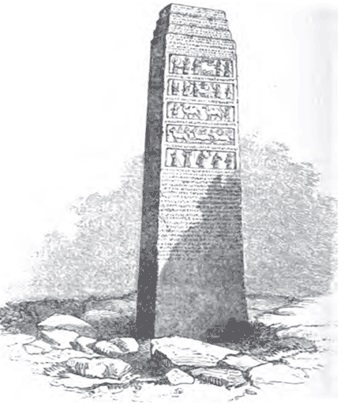
Sketch of the Black Limestone Obelisk
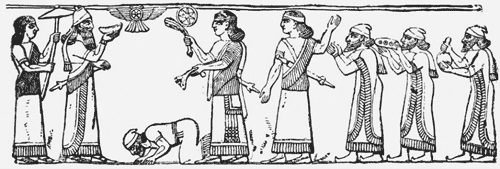
Sketch of the Jehu Relief Panel
Examining the Jehu Panel
1. It reveals how King Jehu paid tribute to Shalmaneser III.
2. King Jehu grovels in the dust before the Assyrian king.
3. Shalmaneser is making a libation to his god.
4. Behind Shalmaneser III stand two officers, one holds a parasol (a royal umbrella) and the other a club.
5. Opposite the monarch two grooms-in-waiting have taken up their stance, one waves a fan and a censer, the other, carrying a scepter under his arm, has his hands respectfully clasped in front of him.
6. There is a bearded officer with an attendant, leading a procession of 13 Israelites laden with precious gifts for the Assyrian king.
7. All the Israelites have beards, and wear peaked caps and bandeaux. A long robe with fringes round the hem and a girdle, a long cloak with a fringed end thrown over the shoulder, and pointed shoes.
8. Shalmaneser beneath a parasol, accepts "the tribute of Iaua of the House of Humri" in 841 BC. This is King Jehu of Israel (2Ki 9-10).
9. The inscription reads: "The tribute of Jehu, son of Omri: I received from him silver, gold, a golden bowl, a golden vase with pointed bottom, golden tumblers, golden buckets, tin, a staff for a king [and] spears."
10. The symbols of the gods Assur (winged sun disc) and Ishtar (star) hover overhead.
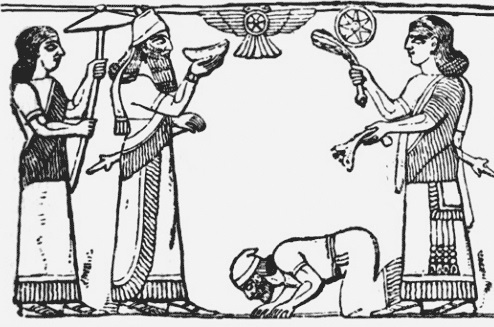
Close up Sketch of Jehu Bowing to the Dust
Another Fragment Mentions Jehu
Jehu is also mentioned on another fragment from the annals of Shalmaneser III that was discovered which says, "Then I took tribute of the Tyrians, of the Sidonians, and of Jehu, of the house of Omri."
"In the 18th year of my reign I crossed the Euphrates for the sixteenth time. Hazael of Damascus trusted in the power of his forces, marshalled his troops in full strength. He made Senir (Mt. Hermon), the summit of the mountain opposite Lebanon, his stronghold. With him I fought, and defeated him. Six thousand of his soldiers I brought down with weapons; 1121 of his chariots, 470 of his horses, together with his camp, I took from him. To save his life he fled; I pursued him; in Damascus, his royal city, I shut him up. His plantations I destroyed. As far as the mountains of Hauran I marched. Towns without number I laid waste, razed, and burnt with fire. There innumerable spoil I carried away. As far as to the mountains of Baal-rasi situated close to the sea (the head land at Dog River), I marched. My royal image I set up in that place. At that time I received the tribute of the Tyrians and Sidonians, and of Jehu the son of Omri." - Shalmaneser III Annals 841 B.C.
Jehu or One of His Messengers?
The fragment mentioned above, the royal garments, Hazael's defeat, and the fact that Shalmaneser mentions Jehu bringing tribute leaves little doubt that the panel on the Black Obelisk of Shalmaneser III reveals king Jehu himself. This cannot be proven with certainty but is a logical conclusion.
British Museum Excerpt
"The archaeologist Henry Layard discovered this black limestone obelisk in 1846 during his excavations of the site of Kalhu, the ancient Assyrian capital. It was erected as a public monument in 825 BC at a time of civil war. The relief sculptures glorify the achievements of King Shalmaneser III (reigned 858-824 BC) and his chief minister. It lists their military campaigns of thirty-one years and the tribute they exacted from their neighbours: including camels, monkeys, an elephant and a rhinoceros. Assyrian kings often collected exotic animals and plants as an expression of their power.
There are five scenes of tribute, each of which occupies four panels round the face of the obelisk and is identified by a line of cuneiform script above the panel. From top to bottom they are:
Sua of Gilzanu (in north-west Iran)
Jehu of Bit Omri (ancient northern Israel)
An unnamed ruler of Musri (probably Egypt)
Marduk-apil-usur of Suhi (middle Euphrates, Syria and Iraq)
Qalparunda of Patin (Antakya region of Turkey)
The second register from the top includes the earliest surviving picture of an Israelite: the Biblical Jehu, king of Israel, brought or sent his tribute in around 841 BC. Ahab, son of Omri, king of Israel, had lost his life in battle a few years previously, fighting against the king of Damascus at Ramoth-Gilead (I Kings xxii. 29-36). His second son (Joram) was succeeded by Jehu, a usurper, who broke the alliances with Phoenicia and Judah, and submitted to Assyria. The caption above the scene, written in Assyrian cuneiform, can be translated
The tribute of Jehu, son of Omri: I received from him silver, gold, a golden bowl, a golden vase with pointed bottom, golden tumblers, golden buckets, tin, a staff for a king [and] spears.
The Geneva Bible: A Cornerstone of English Protestantism A Testament to Reform The 1599 Geneva Bible... Read More
The 21st Century King James Version (KJ21): A Modern Approach to a Classic Text A Balancing Act The ... Read More
The American Standard Version (ASV): A Cornerstone of Modern English Bibles A Product of Scholarly R... Read More
The Amplified Bible (AMP): A Rich and Comprehensive Translation The Amplified Bible (AMP) stands out... Read More
The Amplified Bible, Classic Edition (AMPC): A Timeless Treasure The Amplified Bible, Classic Editio... Read More
The Authorized (King James) Version (AKJV): A Timeless Classic The Authorized King James Version (AK... Read More
The BRG Bible: A Colorful Approach to Scripture A Unique Visual Experience The BRG Bible, an acronym... Read More
The Christian Standard Bible (CSB): A Balance of Accuracy and Readability The Christian Standard Bib... Read More
The Common English Bible (CEB): A Translation for Everyone The Common English Bible (CEB) is a conte... Read More
The Complete Jewish Bible (CJB): A Jewish Perspective on Scripture The Complete Jewish Bible (CJB) i... Read More
The Contemporary English Version (CEV): A Bible for Everyone The Contemporary English Version (CEV),... Read More
The Darby Translation: A Literal Approach to Scripture The Darby Translation, often referred to as t... Read More
The Disciples' Literal New Testament (DLNT): A Window into the Apostolic Mind The Disciples’ Literal... Read More
The Douay-Rheims 1899 American Edition (DRA): A Cornerstone of English Catholicism The Douay-Rheims ... Read More
The Easy-to-Read Version (ERV): A Bible for Everyone The Easy-to-Read Version (ERV) is a modern Engl... Read More
The English Standard Version (ESV): A Modern Classic The English Standard Version (ESV) is a contemp... Read More
The English Standard Version Anglicised (ESVUK): A British Accent on Scripture The English Standard ... Read More
The Evangelical Heritage Version (EHV): A Lutheran Perspective The Evangelical Heritage Version (EHV... Read More
The Expanded Bible (EXB): A Study Bible in Text Form The Expanded Bible (EXB) is a unique translatio... Read More
GOD'S WORD Translation (GW): A Modern Approach to Scripture The GOD'S WORD Translation (GW) is a con... Read More
The Good News Translation (GNT): A Bible for Everyone The Good News Translation (GNT), formerly know... Read More
The Holman Christian Standard Bible (HCSB): A Balance of Accuracy and Readability The Holman Christi... Read More
The International Children's Bible (ICB): A Gateway to Faith The International Children's Bible (ICB... Read More
The International Standard Version (ISV): A Modern Approach to Scripture The International Standard ... Read More
The J.B. Phillips New Testament: A Modern Classic The J.B. Phillips New Testament, often referred to... Read More
The Jubilee Bible 2000 (JUB): A Unique Approach to Translation The Jubilee Bible 2000 (JUB) is a dis... Read More
The King James Version (KJV): A Timeless Classic The King James Version (KJV), also known as the Aut... Read More
The Lexham English Bible (LEB): A Transparent Approach to Translation The Lexham English Bible (LEB)... Read More
The Living Bible (TLB): A Paraphrase for Modern Readers The Living Bible (TLB) is a unique rendering... Read More
The Modern English Version (MEV): A Contemporary Take on Tradition The Modern English Version (MEV) ... Read More
The Mounce Reverse Interlinear New Testament: A Bridge to the Greek The Mounce Reverse Interlinear N... Read More
The Names of God Bible (NOG): A Unique Approach to Scripture The Names of God Bible (NOG) is a disti... Read More
The New American Bible, Revised Edition (NABRE): A Cornerstone of English Catholicism The New Americ... Read More
The New American Standard Bible (NASB): A Cornerstone of Literal Translations The New American Stand... Read More
The New American Standard Bible 1995 (NASB1995): A Refined Classic The New American Standard Bible 1... Read More
The New Catholic Bible (NCB): A Modern Translation for a New Generation The New Catholic Bible (NCB)... Read More
The New Century Version (NCV): A Bible for Everyone The New Century Version (NCV) is an English tran... Read More
The New English Translation (NET): A Transparent Approach to Scripture The New English Translation (... Read More
The New International Reader's Version (NIRV): A Bible for Everyone The New International Reader's V... Read More
The New International Version - UK (NIVUK): A British Accent on Scripture The New International Vers... Read More
The New International Version (NIV): A Modern Classic The New International Version (NIV) is one of ... Read More
The New King James Version (NKJV): A Modern Update of a Classic The New King James Version (NKJV) is... Read More
The New Life Version (NLV): A Bible for All The New Life Version (NLV) is a unique English translati... Read More
The New Living Translation (NLT): A Modern Approach to Scripture The New Living Translation (NLT) is... Read More
The New Matthew Bible (NMB): A Reformation Revival The New Matthew Bible (NMB) is a unique project t... Read More
The New Revised Standard Version (NRSV): A Modern Classic The New Revised Standard Version (NRSV) is... Read More
The New Revised Standard Version Catholic Edition (NRSVCE): A Cornerstone of Modern Catholicism The ... Read More
The New Revised Standard Version, Anglicised (NRSVA): A British Accent on Scripture The New Revised ... Read More
The New Revised Standard Version, Anglicised Catholic Edition (NRSVACE): A Bridge Between Tradition ... Read More
The New Testament for Everyone (NTE): A Fresh Perspective The New Testament for Everyone (NTE) is a ... Read More
The Orthodox Jewish Bible (OJB): A Unique Perspective The Orthodox Jewish Bible (OJB) is a distincti... Read More
The Revised Geneva Translation (RGT): A Return to the Roots The Revised Geneva Translation (RGT) is ... Read More
The Revised Standard Version (RSV): A Cornerstone of Modern English Bibles The Revised Standard Vers... Read More
The Revised Standard Version Catholic Edition (RSVCE): A Cornerstone of English Catholicism The Revi... Read More
The Message (MSG): A Contemporary Paraphrase The Message, often abbreviated as MSG, is a contemporar... Read More
The Voice: A Fresh Perspective on Scripture The Voice is a contemporary English translation of the B... Read More
The Tree of Life Version (TLV): A Messianic Jewish Perspective The Tree of Life Version (TLV) is a u... Read More
The World English Bible (WEB): A Modern Update on a Classic The World English Bible (WEB) is a conte... Read More
The Worldwide English (WE) New Testament: A Modern Take on a Classic The Worldwide English (WE) New ... Read More
The Wycliffe Bible: A Cornerstone of English Scripture A Revolutionary Translation The Wycliffe Bibl... Read More
Young's Literal Translation (YLT): A Literal Approach to Scripture Young's Literal Translation (YLT)... Read More
For enthusiastic readers, managing a collection of books can become challenging. An expanding "to be... Read More
Deuteronomy 18 - "And if you say in your heart, 'How shall we know the word which the LORD has not ... Read More
John 14:26 - "But the Counselor, the Holy Spirit, whom the Father will send in my name, he will teac... Read More
(Enlarge) (PDF for Print) Map of the Origin of Nations and Races that were dispersed by God in Gene... Read More
Modern farming cannot be done without agricultural tractors, and their safe and efficient transporta... Read More
The Journeys of Abraham (Enlarge) (PDF for Print) - Map of Abraham's Journey with Trade Routes Map ... Read More
(Enlarge) (PDF for Print) Map of the Route of the Hebrews from Egypt This map shows the Exodus of t... Read More
Mark 6:52 - For they considered not the miracle of the loaves: for their heart was hardened. God did... Read More
also see:The Encampment of the Children of IsraelThe Children of Israel on the March THE OUTER COURT... Read More
2 Chronicles 36:23 - Thus saith Cyrus king of Persia, All the kingdoms of the earth hath the LORD Go... Read More
All Bible Maps - Complete and growing list of Bible History Online Bible Maps. Old Testament Maps T... Read More
The Bible portrays marriage as a lifelong bond built on love, faith, and commitment, reflecting God'... Read More
Ancient Manners and Customs, Daily Life, Cultures, Bible Lands NINEVEH was the famous capital of an... Read More
Distances From Jerusalem to: Bethany - 2 milesBethlehem - 6 milesBethphage - 1 mileCaesarea - 57 m... Read More
Dagon was the god of the Philistines. This image shows that the idol was represented in the combina... Read More
Map of Israel in the Time of Jesus (Enlarge) (PDF for Print) Map of First Century Israel with Roads... Read More
The Table of Shewbread (Ex 25:23-30) It was also called the Table of the Presence. Now we will pas... Read More
see also:The PriestThe Consecration of the PriestsThe Priestly Garments The Priestly Garments 'The ... Read More
Introduction to the Book of Daniel in the Bible Daniel 6:15-16 - Then these men assembled unto the k... Read More
The Golden Lampstand was hammered from one piece of gold. Exod 25:31-40 "You shall also make a lam... Read More
The Golden Altar of Incense (Ex 30:1-10) The Golden Altar of Incense was 2 cubits tall.It was 1 cub... Read More
Ancient Tax Collector Illustration of a Tax Collector collecting taxes Tax collectors were very des... Read More
also see: Blood Atonement and The Priests The Five Levitical Offerings The Sacrifices The sacrificia... Read More
Genesis 10:32 - These are the families of the sons of Noah, after their generations, in their nation... Read More
Illustration of Jesus Reading from the Book of Isaiah This sketch contains a colored illustration o... Read More
"But the angel said unto him, Fear not, Zacharias: for thy prayer is heard; and thy wife Elisabeth s... Read More
also see: The Encampment of the Children of IsraelThe Children of Israel on the March The brazen a... Read More
In a rapidly evolving world shaped by both timeless values and groundbreaking technology, individual... Read More
Unearth the rich tapestry of biblical history with our extensive collection of over 1000 meticulously curated Bible Maps and Images. Enhance your understanding of scripture and embark on a journey through the lands and events of the Bible.
Start Your Journey Today!