
1599 Geneva Bible (GNV)
The Geneva Bible: A Cornerstone of English Protestantism A Testament to Reform The 1599 Geneva Bible... Read More
"In the nineteenth century, the area was a province at the far eastern edge of the Ottoman Empire, a region of semi autonomous pashaliks each governed primarily by a local pasha, though officially under the control of the Ottoman ruler in Istanbul. Seen by Western travelers as a remote and unwelcoming locale of largely unrelieved desert."
Travelers for many centuries noticed many strange mounds scattered along the Tigris and Euphrates Valley all the way to the Persian Gulf. Some of the mounds were shaped like a box and many stories were told.
In 1811 Claude James Rich, A British businessman was living in Baghdad, 50 miles NE of ancient Babylon. He became aware of some interesting bricks that were found and visited the site of Babylon. He located and documented several mounds in the area of ancient Babylon. He also dug into some of them and found several bricks, tablets and other things with strange inscriptions on them.
In 1820 he visited Mosul in the north and found several mounds which he thought to be the site of ancient Nineveh. He did some digging and found some cuneiform tablets which he could not get deciphered. He donated his discoveries to the British Museum, and word began to circulate in Europe that the remains of Babylon and Nineveh had been located.
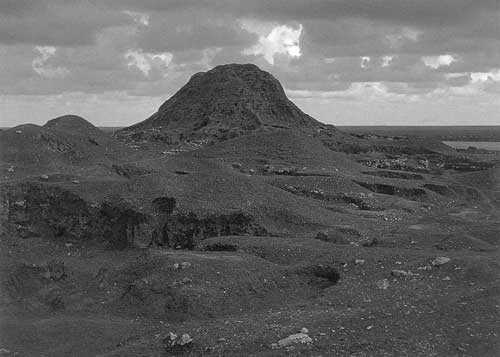
Mounds often contained ruins of ancient cities, built on top of another. In the Near East these sites are called "tells", the Arabic word for "mounds". Some of these mounds reached 100 feet or more in height. Cities were often rebuilt on the same site.
In 1842 Paul Emile Botta, a man sent from France to be consul at Mosul, a city on the upper Tigris River, began excavating some peculiar looking mounds across the Tigris River about 10 miles SE of Mosul. He believed them to be the ruins of ancient Nineveh. Botta's excavations were considered illegal according to Ottoman laws. His excavations led to an astounding discovery, one of the mounds turned out to be ancient Khorsabad, one of the capitals of the great Assyrian Empire. Within 10 years he had unearthed the greatest palace ever discovered, the palace of Sargon (722-705 BC) with all its monuments and winged bulls covering an area of nearly 1 square mile.
France finally received permission from the Ottoman government and his discoveries were brought to the Louvre Museum in France, which are still there today. The Louvre's Assyrian display opened to the public in the presence of King Louis-Philippe on May 1, 1847.
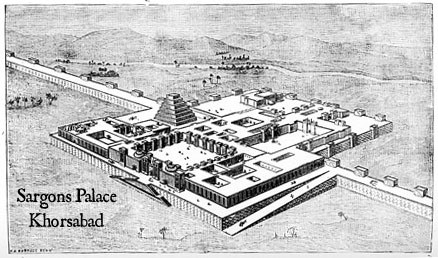
"What can all this mean? Who built this structure? In what century did he live? To what nation did he belong? Are these walls telling me their tales of joy and woe? Is this beautiful cuneiformed character a language? I know not. I can read their glory and their victories in their figures, but their story, their age, their blood, is to me a mystery. Their remains mark the fall of a glorious and a brilliant past, but of a past known not to a living man."
"I had the first revelation of a new world of antiquities.- P.E. Botta
In 1845 Austen Henry Layard, a young English scholar visited some of the mounds and also began digging without formal permission from the Ottoman government. He ended up discovering the ruins of Calah and Nineveh, two more mighty cities of the ancient Assyrian empire.
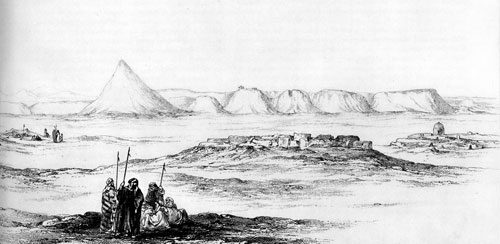
Mounds seen by A. H. Layard from his sketch in "The Monuments of Nineveh".
Layard first discovered ancient Calah or Nimrud, a mound located around 20 miles SE of Mosul and nearly 2 miles east of the Tigris River. He first discovered the palace of Assurnasirpal (884-860 BC), who reigned the same time as king Omri of Israel. He began transporting large colossal items to the British Museum.
Two years later he uncovered the ruins of the famous and evil Nineveh, to which the Bible spoke so much about. The long lost civilization had been buried under the dust for over 25 centuries. He discovered the grand palace of king Sennacherib (705-681 BC).
"As the sun went down, I saw for the first time the great conical mound of Nimrud rising against the clear evening sky. It was on the opposite side of the river and not very distant, and the impression that it made upon me was one never to he forgotten. After my visit to K�y�njik and Nebi Yunus, opposite Mosul, and the distant view of Nimrud, my thought ran constantly upon the possibility of thoroughly exploring with the spade those great ruins." - Austen Henry Layard
Description of the Area of Assyria in the 1800's
A missionary named James Fletcher visited Mesopotamia in the 1800's, and this is how he described the area:
"Yet what a moral might be derived from the present condition of the capital of Assur. In lieu of lofty palaces and gorgeous temples, the eye surveys only the mounds composed of their dust, or the miserable huts which have arisen on their site. The gardens where Sardanapalus revelled are wasted and desolate, the sounds of soft and luxurious music that once floated on the soft Assyrian breezes have yielded to the silence of devastation or decay"
- James Phillips Fletcher, Notes from Nineveh, and Travels in Mesopotamia, Assyria and Syria, 9 vols. (London: Colburn, 1850), vol. 1, 206
The British Museum and Shalmaneser III Artifacts
The British Museum in London contains much of the world's artifacts from ancient Assyria. The museum was originally founded in 1753 to provide a resting place for the great collection of Sir Hans Sloane, which was left to the care of the British nation. Over time it became one of the most famous museums in the world. The Biblical and ancient world artifacts are in great quantity. The main Biblical artifacts related to Shalmaneser III are:
The Black Obelisk, which reveals King Jehu of Israel bowing.
The Monolith from Kurkh, which mentions Ahab the Israelite.
The Bronze Gate from Balawat, which reveals Assyrian assaults and captives.
The Statue of Shalmaneser III, revealing an image of the monarch seated.
There are many other Assyrian items in the British Museum, including numerous artifacts from each of the Assyrian kings who lived and reigned during the period of the kings of Israel and Judah in the Bible. There are also numerous items from Babylon, Egypt, Persia, Judah, Israel, Moab, the ancient Levant, Sumer, Rome, Greece, and many more areas of the ancient world bringing a wealth of knowledge of the antiquities of the ancient world as well as scientific evidence of people, places, and events mentioned in the Bible.
The Geneva Bible: A Cornerstone of English Protestantism A Testament to Reform The 1599 Geneva Bible... Read More
The 21st Century King James Version (KJ21): A Modern Approach to a Classic Text A Balancing Act The ... Read More
The American Standard Version (ASV): A Cornerstone of Modern English Bibles A Product of Scholarly R... Read More
The Amplified Bible (AMP): A Rich and Comprehensive Translation The Amplified Bible (AMP) stands out... Read More
The Amplified Bible, Classic Edition (AMPC): A Timeless Treasure The Amplified Bible, Classic Editio... Read More
The Authorized (King James) Version (AKJV): A Timeless Classic The Authorized King James Version (AK... Read More
The BRG Bible: A Colorful Approach to Scripture A Unique Visual Experience The BRG Bible, an acronym... Read More
The Christian Standard Bible (CSB): A Balance of Accuracy and Readability The Christian Standard Bib... Read More
The Common English Bible (CEB): A Translation for Everyone The Common English Bible (CEB) is a conte... Read More
The Complete Jewish Bible (CJB): A Jewish Perspective on Scripture The Complete Jewish Bible (CJB) i... Read More
The Contemporary English Version (CEV): A Bible for Everyone The Contemporary English Version (CEV),... Read More
The Darby Translation: A Literal Approach to Scripture The Darby Translation, often referred to as t... Read More
The Disciples' Literal New Testament (DLNT): A Window into the Apostolic Mind The Disciples’ Literal... Read More
The Douay-Rheims 1899 American Edition (DRA): A Cornerstone of English Catholicism The Douay-Rheims ... Read More
The Easy-to-Read Version (ERV): A Bible for Everyone The Easy-to-Read Version (ERV) is a modern Engl... Read More
The English Standard Version (ESV): A Modern Classic The English Standard Version (ESV) is a contemp... Read More
The English Standard Version Anglicised (ESVUK): A British Accent on Scripture The English Standard ... Read More
The Evangelical Heritage Version (EHV): A Lutheran Perspective The Evangelical Heritage Version (EHV... Read More
The Expanded Bible (EXB): A Study Bible in Text Form The Expanded Bible (EXB) is a unique translatio... Read More
GOD'S WORD Translation (GW): A Modern Approach to Scripture The GOD'S WORD Translation (GW) is a con... Read More
The Good News Translation (GNT): A Bible for Everyone The Good News Translation (GNT), formerly know... Read More
The Holman Christian Standard Bible (HCSB): A Balance of Accuracy and Readability The Holman Christi... Read More
The International Children's Bible (ICB): A Gateway to Faith The International Children's Bible (ICB... Read More
The International Standard Version (ISV): A Modern Approach to Scripture The International Standard ... Read More
The J.B. Phillips New Testament: A Modern Classic The J.B. Phillips New Testament, often referred to... Read More
The Jubilee Bible 2000 (JUB): A Unique Approach to Translation The Jubilee Bible 2000 (JUB) is a dis... Read More
The King James Version (KJV): A Timeless Classic The King James Version (KJV), also known as the Aut... Read More
The Lexham English Bible (LEB): A Transparent Approach to Translation The Lexham English Bible (LEB)... Read More
The Living Bible (TLB): A Paraphrase for Modern Readers The Living Bible (TLB) is a unique rendering... Read More
The Modern English Version (MEV): A Contemporary Take on Tradition The Modern English Version (MEV) ... Read More
The Mounce Reverse Interlinear New Testament: A Bridge to the Greek The Mounce Reverse Interlinear N... Read More
The Names of God Bible (NOG): A Unique Approach to Scripture The Names of God Bible (NOG) is a disti... Read More
The New American Bible, Revised Edition (NABRE): A Cornerstone of English Catholicism The New Americ... Read More
The New American Standard Bible (NASB): A Cornerstone of Literal Translations The New American Stand... Read More
The New American Standard Bible 1995 (NASB1995): A Refined Classic The New American Standard Bible 1... Read More
The New Catholic Bible (NCB): A Modern Translation for a New Generation The New Catholic Bible (NCB)... Read More
The New Century Version (NCV): A Bible for Everyone The New Century Version (NCV) is an English tran... Read More
The New English Translation (NET): A Transparent Approach to Scripture The New English Translation (... Read More
The New International Reader's Version (NIRV): A Bible for Everyone The New International Reader's V... Read More
The New International Version - UK (NIVUK): A British Accent on Scripture The New International Vers... Read More
The New International Version (NIV): A Modern Classic The New International Version (NIV) is one of ... Read More
The New King James Version (NKJV): A Modern Update of a Classic The New King James Version (NKJV) is... Read More
The New Life Version (NLV): A Bible for All The New Life Version (NLV) is a unique English translati... Read More
The New Living Translation (NLT): A Modern Approach to Scripture The New Living Translation (NLT) is... Read More
The New Matthew Bible (NMB): A Reformation Revival The New Matthew Bible (NMB) is a unique project t... Read More
The New Revised Standard Version (NRSV): A Modern Classic The New Revised Standard Version (NRSV) is... Read More
The New Revised Standard Version Catholic Edition (NRSVCE): A Cornerstone of Modern Catholicism The ... Read More
The New Revised Standard Version, Anglicised (NRSVA): A British Accent on Scripture The New Revised ... Read More
The New Revised Standard Version, Anglicised Catholic Edition (NRSVACE): A Bridge Between Tradition ... Read More
The New Testament for Everyone (NTE): A Fresh Perspective The New Testament for Everyone (NTE) is a ... Read More
The Orthodox Jewish Bible (OJB): A Unique Perspective The Orthodox Jewish Bible (OJB) is a distincti... Read More
The Revised Geneva Translation (RGT): A Return to the Roots The Revised Geneva Translation (RGT) is ... Read More
The Revised Standard Version (RSV): A Cornerstone of Modern English Bibles The Revised Standard Vers... Read More
The Revised Standard Version Catholic Edition (RSVCE): A Cornerstone of English Catholicism The Revi... Read More
The Message (MSG): A Contemporary Paraphrase The Message, often abbreviated as MSG, is a contemporar... Read More
The Voice: A Fresh Perspective on Scripture The Voice is a contemporary English translation of the B... Read More
The Tree of Life Version (TLV): A Messianic Jewish Perspective The Tree of Life Version (TLV) is a u... Read More
The World English Bible (WEB): A Modern Update on a Classic The World English Bible (WEB) is a conte... Read More
The Worldwide English (WE) New Testament: A Modern Take on a Classic The Worldwide English (WE) New ... Read More
The Wycliffe Bible: A Cornerstone of English Scripture A Revolutionary Translation The Wycliffe Bibl... Read More
Young's Literal Translation (YLT): A Literal Approach to Scripture Young's Literal Translation (YLT)... Read More
For enthusiastic readers, managing a collection of books can become challenging. An expanding "to be... Read More
Deuteronomy 18 - "And if you say in your heart, 'How shall we know the word which the LORD has not ... Read More
John 14:26 - "But the Counselor, the Holy Spirit, whom the Father will send in my name, he will teac... Read More
(Enlarge) (PDF for Print) Map of the Origin of Nations and Races that were dispersed by God in Gene... Read More
The Journeys of Abraham (Enlarge) (PDF for Print) - Map of Abraham's Journey with Trade Routes Map ... Read More
(Enlarge) (PDF for Print) Map of the Route of the Hebrews from Egypt This map shows the Exodus of t... Read More
Mark 6:52 - For they considered not the miracle of the loaves: for their heart was hardened. God did... Read More
also see:The Encampment of the Children of IsraelThe Children of Israel on the March THE OUTER COURT... Read More
2 Chronicles 36:23 - Thus saith Cyrus king of Persia, All the kingdoms of the earth hath the LORD Go... Read More
All Bible Maps - Complete and growing list of Bible History Online Bible Maps. Old Testament Maps T... Read More
The Bible portrays marriage as a lifelong bond built on love, faith, and commitment, reflecting God'... Read More
Ancient Manners and Customs, Daily Life, Cultures, Bible Lands NINEVEH was the famous capital of an... Read More
Distances From Jerusalem to: Bethany - 2 milesBethlehem - 6 milesBethphage - 1 mileCaesarea - 57 m... Read More
Dagon was the god of the Philistines. This image shows that the idol was represented in the combina... Read More
Map of Israel in the Time of Jesus (Enlarge) (PDF for Print) Map of First Century Israel with Roads... Read More
The Table of Shewbread (Ex 25:23-30) It was also called the Table of the Presence. Now we will pas... Read More
see also:The PriestThe Consecration of the PriestsThe Priestly Garments The Priestly Garments 'The ... Read More
Introduction to the Book of Daniel in the Bible Daniel 6:15-16 - Then these men assembled unto the k... Read More
The Golden Lampstand was hammered from one piece of gold. Exod 25:31-40 "You shall also make a lam... Read More
The Golden Altar of Incense (Ex 30:1-10) The Golden Altar of Incense was 2 cubits tall.It was 1 cub... Read More
Ancient Tax Collector Illustration of a Tax Collector collecting taxes Tax collectors were very des... Read More
also see: Blood Atonement and The Priests The Five Levitical Offerings The Sacrifices The sacrificia... Read More
Genesis 10:32 - These are the families of the sons of Noah, after their generations, in their nation... Read More
Illustration of Jesus Reading from the Book of Isaiah This sketch contains a colored illustration o... Read More
"But the angel said unto him, Fear not, Zacharias: for thy prayer is heard; and thy wife Elisabeth s... Read More
also see: The Encampment of the Children of IsraelThe Children of Israel on the March The brazen a... Read More
In a rapidly evolving world shaped by both timeless values and groundbreaking technology, individual... Read More
Rome, the Eternal City, has stood as a symbol of history, culture, and religion for over two millenn... Read More
Many teachers assign pieces titled “an essay about god in my life.” The title invites calm thought a... Read More
Exploring identity has become part of the digital life. Social media, streaming, and gaming give you... Read More
Unearth the rich tapestry of biblical history with our extensive collection of over 1000 meticulously curated Bible Maps and Images. Enhance your understanding of scripture and embark on a journey through the lands and events of the Bible.
Start Your Journey Today!