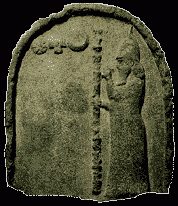
Nabonidus was known to be the king on the throne at the time of the Medo-Persian conquest of Babylon. However, in 1854 archaeologist Sir Henry Rawlinson found an inscription, while excavating at ancient Ur, which stated that Nabonidus associated with him on his throne his eldest son, "Bel-shar-usur", and allowed him the royal title.
Nebuchadnezzar’s Successors
Nebuchadnezzar died in Babylon between the second and sixth month of the fortythird year of his reign. The succession after the death of Nebuchadnezzar in 562 BC was a muddled affair. His son Amel-Marduk (called Evil-Merodach in the Bible) ruled for only two years from 561 to 560 BC, and was succeeded by his brother-in-law, Nergal-shar-usur (Neriglissar) in 559 BC. He had married a daughter of Nebuchadnezzar and had been present at the destruction of Jerusalem. He ruled for three years (559-556 BC) and was succeeded by his young son, Labashi-Marduk, who was murdered in June 556 BC after only two months on the throne. The conspirators then selected a commoner called Nabonidus to be King of Babylon.
Nabonidus appears to have been mentally unstable. He went into a self imposed exile in the Oasis of Temâ in the Arabian desert and was absent from the City of Babylon for a period of seven to ten years. He made his oldest son, Belshazzar, the co-regent of Babylon and put him in charge of his officials and army. Nabonidus ignored the god Marduk and during his absence from Babylon he failed to observe the important religious new year festivals. He attempted to restore the primacy of a religion based on the worship of the moon god Sin and thus became very unpopular with the priests and court of Babylon.
According to the Bible (Daniel 5:1-4) and confirmed by the Greek historian, Herodotus, in October of 539 BC Belshazzar hosted a great feast inside Babylon, wining and dining a thousand exalted guests.