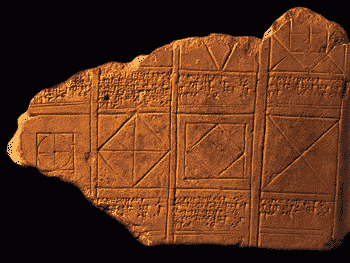
Mathematics Exercise Tablet Geometric Patterns Language: Akkadian Babylonian 1700 BC
This large fragment is from a tablet containing mathematics exercises and questions, written in Akkadian. It dates back to around 1700 BC. The text in the lower right corner says:
"The side of the square equals one. I have drawn four triangles in it. What is the surface area?
Babylonian schools would train young scribes to learn geometry because they were required to draw up accurate deeds and calculate agricultural yields.
This Tablet contained the student’s geometry lesson, the measure of weight, and the medical tract that offered remedies for a variety of illnesses.
Babylonian Number System
The Babylonians had an advanced number system, in some ways more advanced than our present system. It was a positional system with base 60 rather than the base 10 of our present system. Now 10 has only two proper divisors, 2 and 5. However 60 has 10 proper divisors so many more numbers have a finite form.
For mathematical and arithmetical purposes they used the Sumerian sexagesimal system of numbers, which featured a useful device of so-called place-value notation that resembles the present-day decimal system. Measures of length, area, capacity, and weight, standardized earlier by the Sumerians, remained in use.
The Babylonians divided the day into 24 hours, each hour into 60 minutes, each minute into 60 seconds. This form of counting has survived for 4000 years.