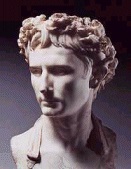
In 43 B.C., Octavian, Lepidus, and Mark Antony were named as the Second Triumvirate, the three rulers who shared the office of emperor.
Civil war broke out after Caesar's assassination. Two of the assassins, Brutus and Cassius, led one side. Octavian and Mark Antony, one of Caesar's lieutenants, took the other. In 2 quick battles, the assassins were crushed.
The victory catapulted young Octavian— or Augustus, as he was later called— into the political limelight. Besides the power of his father's name, Octavian seems to have been rather striking in appearance. One of his chroniclers describes him in this highly personal and informal way.
"He was quite handsome.... Sometimes he would clip his beard; sometimes he would shave it. While his barbers were at work on him, it was not unusual for him to read or write.... His eyes were clear and radiant.... His complexion was between dark and fair. Though only five feet, six inches in height . . his shortness was not too noticeable because of the good proportions of his figure." –SEUTONIUS
While Octavian was growing in political stature, so was Mark Antony. Among the Antony's political friends was Herod, Antipater's son. After Antipater's death by poisoning, Antony helped Herod eventually get the title "King of Judea."
Antony failed to recognize that in Octavian he was dealing with a natural born politician. Octavian never was an imposing figure physically, and he owed his military victories largely to the skill of his able lieutenants. Yet In the political arena he was without peer, rising as a virtual unknown in 44 B.C. to become the first of the Julio-Claudian emperors by 27 B.C.
Antony's days of power were numbered. When Antony had divorced Octavia (Octavian’s sister) to marry Cleopatra, Octavian declared war and a showdown took place at Actium in 31 B.C. Octavian won a decisive victory over Antony, but Antony managed a spectacular escape to Egypt. There, months later, he and his famous lover, Cleopatra, ended their lives in suicide.
When Herod got wind of Antony's death, he knew his own kingship now hung by a thread. He decided to make a bold move. When he was to meet with Octavian, he took off his crown and placed it at the leader's feet. This worked according to plan. Octavian picked up the crown and returned it to Herod, saying in effect: "Serve me as faithfully as you did Antony." Herod did just that, from that moment forward.
After the death of Herod in 4 B.C., his dominions were divided among his sons by Augustus, almost in exact accordance with his will.
In 27 B.C. Octavian became Rome's first emperor, being surnamed Augustus Caesar "majestic." He was saluted as emperor (imperator, military commander in chief originally). Leaving the names and rights of the chief republican officers unchanged, he united them all, one by one, in himself.
Although he wore platform shoes to look taller, Augustus turned out to be a giant, politically. In later years he boasted, not incorrectly, that he had found Rome in bricks and left it in marble.
Augustus was emperor at the birth and during half the lifetime of our Lord, and his name occurs in the Bible (Luke 2:1) as the emperor who ordered the census, and because of this edict Joseph and Mary went to Bethlehem, the place where the Messiah was to be born.
Augustus brought order and prosperity to the Roman Empire after the long period of civil war, and for his successes he was worshiped in many places. With him began the emperor cult, and Herod the Great built temples to the divine Augustus at Caesarea and Samaria; both of these have been excavated. Augustus was worshiped in Ephesus too, and a great lintel with an inscription to the divine Augustus has been excavated there and re-erected over the gate to the Greek agora. Paul would have seen it and passed under it often as he ministered in the city for most of three years on his third missionary journey.