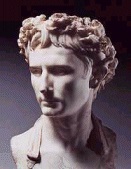
Augustus is very possibly the single most important person in all of Roman history. During his very long and fantastic career, he provided many answers for the major problems of the Republic and his solutions for Roman government remained solid for another three centuries. His system was called the "Principate," and although it had its problems, it brought to the Roman Empire a succession of rulers who controlled an incredibly long period of peace and prosperity, more than Europe and the Middle East had ever known.
Even though most of the rulers had their problems, the achievements of Augustus in establishing this system is amazing. Augustus was a remarkable man, well known for the fact that he could be very ruthless and at the same time be tolerant and forgiving.
Augustus was the imperial title given to Octavius, successor of Julius Caesar. He was born in 63 B.C. and was educated by his great-uncle, Julius Caesar, who eventually made him his heir.
Octavian was the first Roman emperor and the Bible refers to him as "Caesar Augustus". It was this same Emperor who had ordered the census that brought Joseph and Mary to Bethlehem where the real King would be born.
Imagine, the true King of the greatest heavenly kingdom was born during the reign of the greatest earthly king of the greatest earthly kingdom, and it was this earthly king who unknowingly decreed that all the world should be taxed, each going to his own city, and thus the true King would be born in Bethlehem. It is quite possible that this is the reason for the birth of Christ being in the "fullness of times" mentioned in the Bible: Gal. 4:4.
Octavian brought peace to the Roman Empire and became a popular leader. In 27 B.C., the Senate voted to give him the title Augustus, which means "the respected one." He ruled the empire until 14 A.D.
Augustus had learned well from his father's mistakes. He continued many of the reforms that had been started by Caesar. He knew that the people wanted a republic, so he always claimed to be restoring the government of the Roman Republic.
But Augustus was always in charge and held the real power. He controlled nearly all of the military troops. He appointed the most important officials of government, those who governed the provinces. He carefully avoided using the title of king. Instead, he called himself "first citizen" to show that he was one of the people.
Augustus ruled an empire. He is considered to be the first Roman emperor. The people welcomed him because they longed for a strong leader. They desperately wanted peace and order after all of the civil wars and turmoil that followed Julius Caesar's death.
Improved City Life
Augustus’ famous saying was, "I found Rome built of sun-dried bricks. I leave her covered in marble." During the long period (41 years) that he ruled, Augustus built or restored 82 temples. Most of them were dressed in the smooth marble from the quarries that were just discovered north of Rome.
Augustus also worked hard to improve city life in Rome. There were nearly one million people living in Rome, and yet Rome had no city services. Many of the people were hunger and very poor. Violence and disorder increased, and Rome had a major crime problem. One of the worst problems was the fact that fires had regularly swept through the city. Augustus’ solution was creating a new police force and a fire department. He set up a government office that would supply food to the city's citizens.
The Roman Empire beyond Italy was divided into about 40 provinces, or territories. Each province had its own governor, who was appointed by the emperor or named by the Senate. The governors' work mainly included keeping order and collecting taxes.
Augustus and the emperors who followed him expanded the empire by conquering new territories. By the end of the first century A.D. the Roman Empire had a population of about 60 million. This was more than one-fifth of the total population of the world at that time.
The Pax Romana
Augustus's reign marked the beginning of a remarkable period in Rome's history. For more than 200 years, the vast Roman Empire was united and, for the most part, peaceful. This period from 27 B.C. to 180 A.D. is called the Pax Romana, or "Peace of Rome."
Augustus Caesar died at Nola in Campania, in his 76th year, in 14 A.D. After his death, the title "Augustus" was given to all of the Roman emperors.