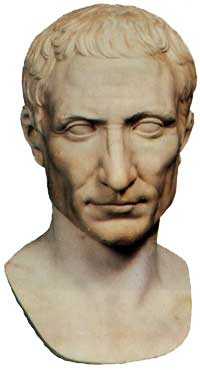
"Beware the ides of March," was what the fortuneteller had whispered in Julius Caesar's ear. "I have seen many warnings of danger in your future." But Caesar, confident of his power in early 44 B.C., simply went on about his business. He was even bold enough to dismiss his bodyguards. However, March 15, referred to in the Roman calendar as the "ides" of March, turned out to be the day of Caesar's gruesome death.
As Caesar entered into the place of the senate that day, a group of men gathered around him as if to pay their respects. One of them took hold of Caesar's robe and said, "Friends, what are you waiting for?" That was the signal to attack. They drew their daggers from their robes and began stabbing Caesar. He tried to defend himself, but then he recognized one of the men. It was Brutus, a man Caesar thought was his friend.
"Et tu, Brute?" ("You too, Brutus?") Caesar asked.
He realized that even his friend had turned against him, and he stopped resisting. Caesar fell to the floor and died. He had been stabbed 23 times.
Brutus jumped up, waving his bloody knife. He announced that he and his men had saved the Roman Republic by killing Caesar. However, the death of Caesar did not restore the Republic. Instead, it ushered in 13 years of civil war as various groups struggled to control Rome.
Caesar had seized control of the government of the Roman world in 49 B.C., making himself dictator for life. As dictator, Caesar seemed to have little respect for the constitution. According to the constitution, a Roman leader was supposed to share power with the senators. But many senators thought Caesar acted as if he were above the law. They thought he treated them as servants. They saw his behavior as haughty and insulting. Many began to think of him as both a personal enemy and an enemy of the Roman Republic.
Senators and other Roman citizens whispered among themselves that Caesar intended to make himself king. If he did so, he could establish a dynasty. His family line would rule the Roman world even after his death, and the Senate would then have no role in choosing the next leader. Outraged, more than 60 senators met secretly. They planned how they would assassinate Caesar and murder him for political reasons. One leader of the group was Brutus, the so-called friend of Caesar.
When Brutus and his men killed Caesar on the ides of March, they thought they had saved the Republic. But by the end of that day, the assassins had to hide from angry mobs of Roman citizens. Many were outraged by Caesar's murder. Caesar was well liked because he made many reforms that improved people's lives. For example, he reorganized the government and lowered taxes. He founded new colonies and gave people land to farm. He hired people to build temples and public buildings. He made citizens of many people in the colonies.
A power struggle followed Caesar's death. Caesar's adopted son Octavian acquired such influence that Antony and Lepidus took him into their triumvirate. He defeated his rivals in 31 B.C. and led Rome into a new era.