Could this be the greatest testimony to the words of Jesus in all of Biblical archaeology?
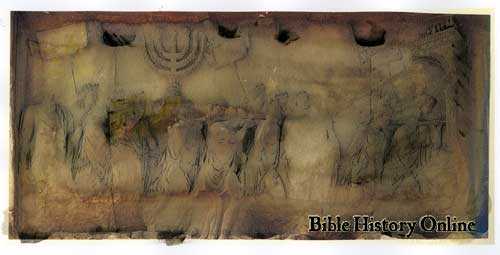
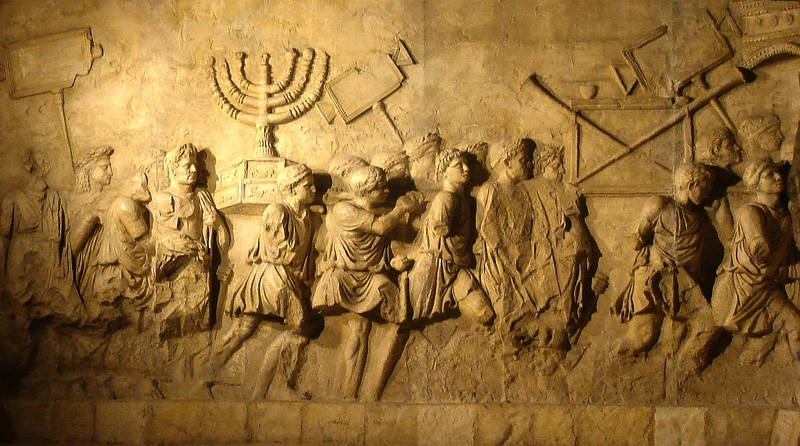
This painting of the Arch of Titus Menorah Relief reveals Roman soldiers carrying the spoils of the Jewish Wars. The destruction of Jerusalem happened in 70 AD when the Roman legions sacked Jerusalem and returned to Rome with the spoils, from the wealthiest city in the Roman Empire, Jerusalem.
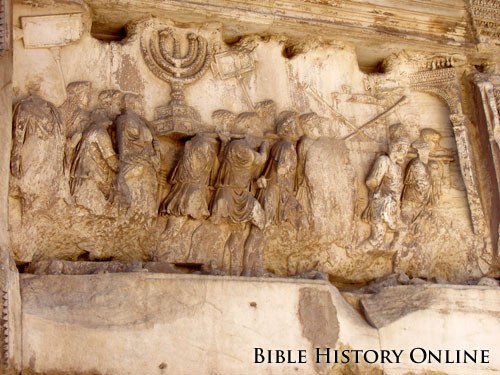
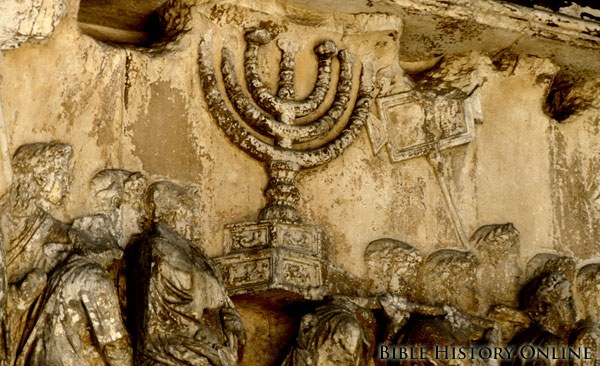
This wall relief on the Arch of Titus reveals one of the most troubling scenes in all history, Roman soldiers carrying spoils from the destruction of the Temple of Jerusalem in 70 A.D. The Temple Menorah* and the Table** of the Shewbread shown at an angle, both of solid gold, and the silver trumpets which called the Jews to the festivals.
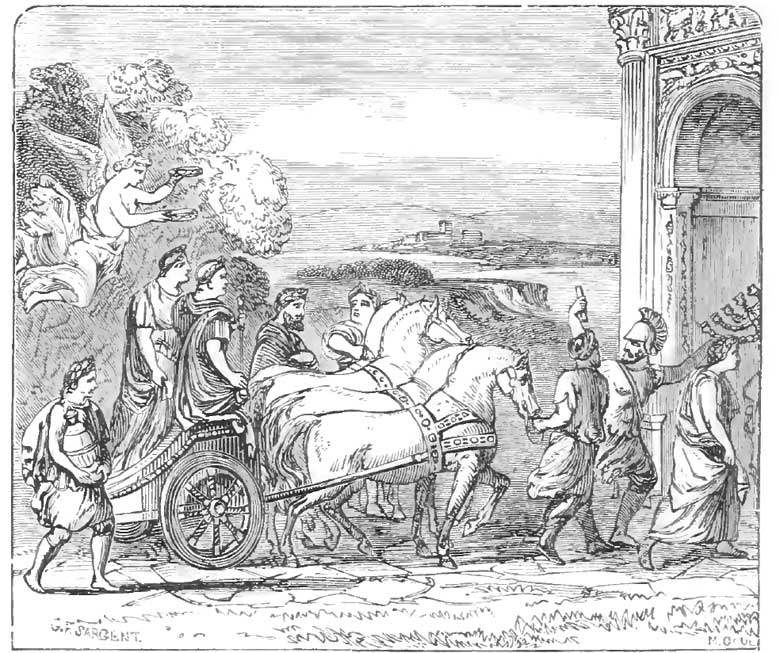
The Romans are in triumphal procession wearing laurel crowns and the ones carrying the Menorah have pillows on their shoulders. The soldiers carry signs commemorating the victories which Titus had won. This group of soldiers is just a few of the hundreds in the actual triumphal procession down Rome's Sacred Way. The whole procession is about to enter the carved arch on the right which reveals the quadriga at the top,
Titus on his 4-horsed chariot with soldiers. The Arch of Titus with its Menorah Relief are high on the list of importance in the study of Biblical Archaeology because it stands today as a testimony that the words of Jesus miraculously came true.
* When the temple was plundered by Antiochus Epiphanes, the candlestick was taken away (1 Macc 1:21); after the cleansing, a new one was made by Judas Maccabeus (1 Macc 4:49,50).
* * The 'table' originally provided for the second Temple had been taken away by Antiochus Epiphanes (about 170 BC); but another was supplied by the Maccabees.
The Roman soldiers carrying spoils from Jerusalem, the Menorah and The Table
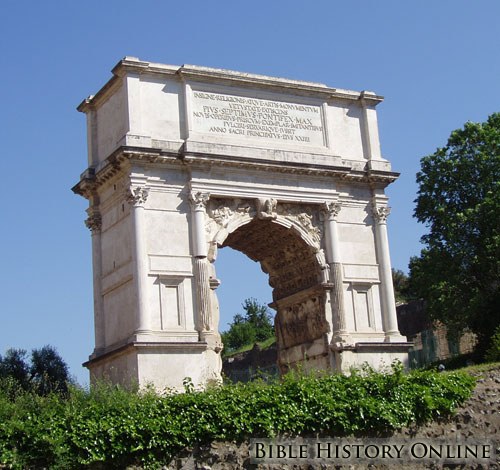
The arch of Titus still spans the ancient Sacra Via at Rome, at the top of the Velian ridge. Its beautiful proportions make it one of the most interesting monuments of the eternal city. Its noble sculptures, unfortunately, have not been well preserved, but still within the vault can be traced the sevenbranched candlestick, the golden table, and the sorrowful train of Jews, as the captives bear the desecrated relics of the destroyed Temple beneath the cruel eyes of their conquerors. So, after eighteen hundred years, the solemn marble commemorates a tragedy than which calamity was never more complete! [The Story of the Jews]
Close up of the Golden 7-branched menorah carried off by the Roman legions in 70 AD,
Luke 19:41-44 "If you had known, even you, especially in this your day, the things that make for your peace! But now they are hidden from your eyes. For days will come upon you when your enemies will build an embankment around you, surround you and close you in on every side, and level you, and your children within you, to the ground; and they will not leave in you one stone upon another, because you did not know the time of your visitation."
Matthew 23:37-39 "O Jerusalem, Jerusalem, the one who kills the prophets and stones those who are sent to her! How often I wanted to gather your children together, as a hen gathers her chicks under her wings, but you were not willing! See! Your house is left to you desolate; for I say to you, you shall see Me no more till you say, 'Blessed is He who comes in the name of the Lord!'"
(Senatus Populusque Romanus divo Tito divi Vespasiani filio Vespasiano Augusto)
which means "The Roman Senate and People (dedicate this) to the divine Titus Vespasianus Augustus, son of the divine Vespasian."
Heart Message
The Arch of Titus
Another witness of stone testifies before the jury of history. Proud and tall the Arch of Titus stoically watches over the highest point of the Via Sacra in Rome. It appears quiet, but as one focuses on its majestic beauty, the story begins to raise its voice. The procession carved in marble shows the Roman General Titus returning victorious, having crushed the Jewish state, carrying the spoils of war stolen from the very Temple of Jerusalem in 70 A.D.
There's the menorah relief, showing a representation of the Golden Candelabra that Moses set in the Holy Place offering light and symbolism for the priests. The same shape that we see in the windows of Jewish homes during Hanukah commemorating a former time of victory for Israel. The Table of the ShewBread is is also carried off by the exulting Romans, the sacred furniture that was restocked with daily bread declaring the sustenance which can only come from God. The silver trumpets are there as well, which were once blown from the Temple and heard over the entire city as the Holy Days and celebration began during a happier time.
One only has to look at this relief and imagine it reversing like a film running backwards to see the dreadful death and destruction that was left behind by the invincible Roman Legion; the thousands that were slaughtered, the glorious city burning and in ruins, and those surviving banished to Europe in chains where their descendants will remain for almost 2,000 years until the miraculous events of 1948 brought Israel back into nationhood once again.
The mighty Arch of Titus tells its story to all who have a moment to listen.
"This happened!" it declares. "But you must seek out for yourself the reason why."
Reproduction of the Arch of Titus Relief
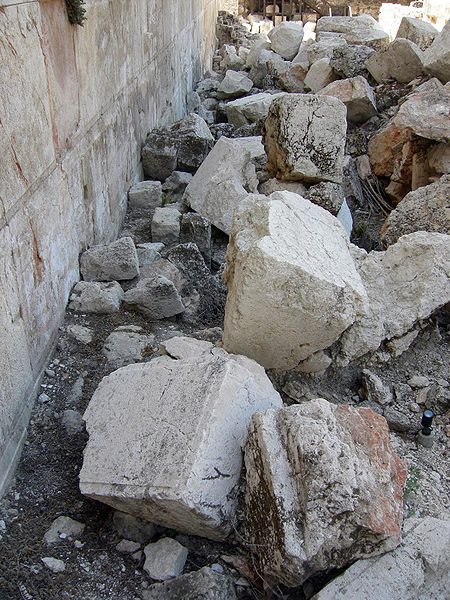
Stones from Jerusalem thrown onto the street by Roman soldiers on Av 9, 70
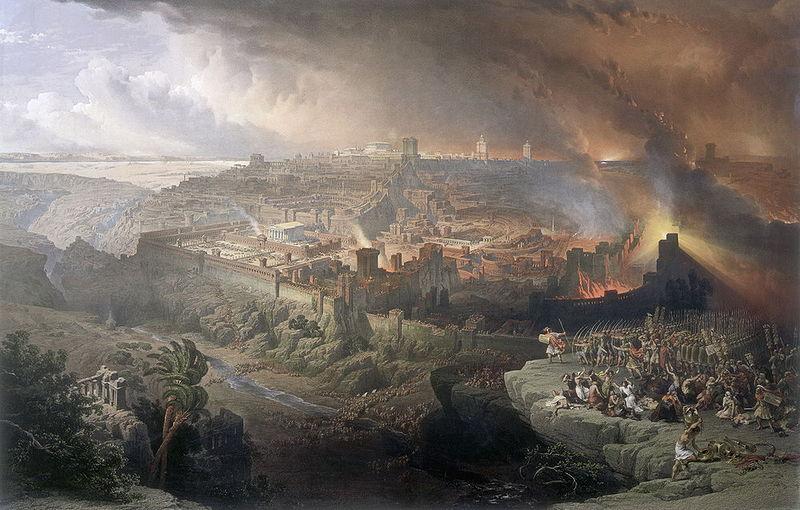
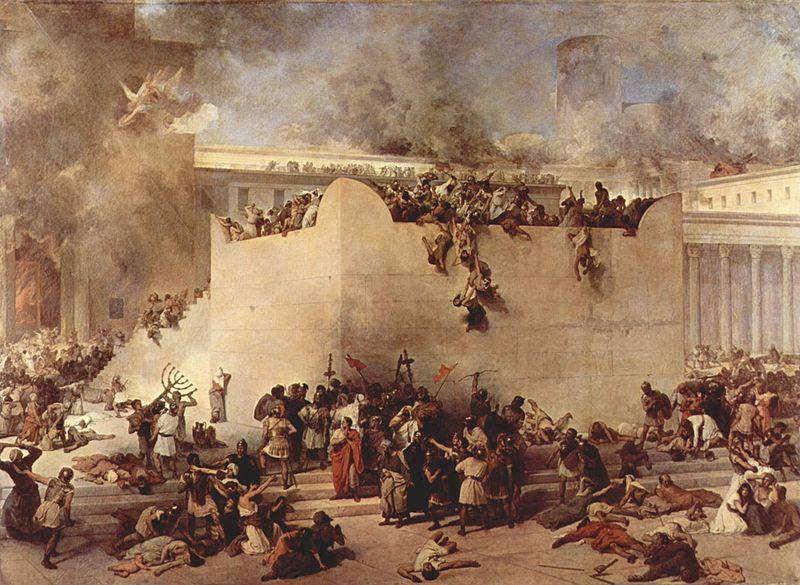
Painting of the Destruction of Jerusalem by the Romans in 70 AD by Ercole de Roberti
Sketch of Vespasian entering the arch on a chariot
===========================
Arch of Titus in Wikipedia The Arch of Titus is a 1st-century honorific arch[1] located on the Via Sacra, Rome, just to the south-east of the Roman Forum. It was constructed in c.82 AD by the Roman Emperor Domitian shortly after the death of his older brother Titus to commemorate Titus' victories, including the Siege of Jerusalem in 70 AD... Significance. The Arch provides one of the few contemporary depictions of Temple period artifacts.[5][6] The seven-branched menorah and trumpets are clearly depicted. It became a symbol of the Jewish diaspora. In a later era, Pope Paul IV made it the place of a yearly oath of submission. Roman Jews refused to walk under it. The menorah depicted on the Arch served as the model for the menorah used on the emblem of the state of Israel... https://en.wikipedia.org/wiki/...
THE ARCH OF TITUS. It was erected in commemoration of the capture and destruction of Jerusalem, and in honour of the successful general, by the Senate and Roman people. Crowning the highest point of the Sacred Way, the Summa Sacra Via, not only is it the most elegant of all the triumphal arches, but also, as from its connection with Scripture history it has been justly styled, " one of the most interesting ruins in Rome." It consists of a single arch of white marble, flanked by a fluted Composke column. During the pontificate of Pius VII. , it was rescued from impending ruin by extensive and judicious restorations ; which, however, unhke the ancient portions, were executed in travertine. The sculptures with which it is embellished are of a very elaborate character. Those of the frieze represent a procession of warriors conducting white bulls or oxen to the sacrificial altar ; the keystone of the arch is adorned with a spirited figure of a Roman warrior. On the attic, he who runs may read the original inscription ; which, it is evident, from the use of the word divo ("divine"), was recorded after the death of Titus, the "delight of the human race," and, probably, by his successor Domitian. It runs thus:
SENATVS . POPVLVSQVE . ROMANVS . DIVO . TITO . DIVI . VESPASIANI . F . VESPASIANO . AVGVSTO.
The piers, under the arch, are covered with bas-reliefs of remarkable interest. On the one side may be seen a body of Roman soldiers bearing the precious spoils from the Temple of Jerusalem ; among which conspi cuously shine the golden table, the silver trumpets, and the seven- ranched candlestick of massive gold, which afterwards fell into the Tiber from the Milvian Bridge, during the flight of the Emperor Maxentius before the victorious arms of Constantine. " The size of this candlestick, as here represented, appears to be nearly a man's height : so that both in size and form these bas- reliefs perfectly correspond with the description of Josephus, and are the only authentic representations of these sacred objects." On the other side we see the Imperator himself, crowned by the goddess Victory, seated in his triumphal quadriga, or chariot drawn by four horses, with the lictors bearing their laurel-wreathed fasces before him, and around him soldiers and citizens, cheering tumultuously, and waving boughs of laurel. The vaulted roof of the arch is richly ornamented with sunk panels and roses, while a central bas- relief is devoted to the apotheosis of Titus. The length of the arch is 49 feet; its breadth, 16 feet 6 inches ; its height is equal to its length. The width of its passage, or opening, is 19 feet. Above the entablature rises an attic, 12 feet in height. The arch is semicircular, and springs from a horizontal moulding, called the impost^ which crosses the front of the building at about 22 feet from the ground. The height of the Composite marble columns on either side of the opening is 22,065 feet, and they stand upon pedestals 9 feet high. [Roman Architecture]
The Arch of Titus. The arch of Titus is the most celebrated as well as the oldest now standing and the smallest of the so-called triumphal arches in Rome. It was erected in summa Sacra via by Domitian, in honor of the deified Titus and in commemoration of his siege of Jerusalem. It suffered serious damage in the middle ages, especially during the twelfth and thirteenth centuries, when it formed part of the city stronghold of the Frangipani family. In 1822 it was taken down and rebuilt. The central portion alone, of Pentelic marble, is original, the two ends being restorations in travertine. The archway is 8.30 metres high and 5.35 metres wide. Above it is a simple entablature, and an attic 4.40 metres in height, on which is the inscription. On each side is an engaged and fluted Corinthian column, standing on a square pedestal. The capital of these columns are the earliest examples of Composite style. On the inner jambs of the arch are the two famous reliefs, that on the south representing the spoils from the temple at Jerusalem, the table of shewbread, the seven-branched candlestick, and the silver trumpets, which are being carried in triumph into the city ; and that on the north representing Titus standing in a quadriga, the horses of which are led by Eoma, while Victory crowns the emperor with laurel as he passes through a triumphal arch. In the centre of the ceiling of the archway, which is finished in soffits (lacunaria), is a relief of the apotheosis of Titus, representing him as being carried up to heaven by an eagle. The frieze is ornamented with small figures representing sacrificial scenes, and in the spandrels are the usual winged Victories. On the keystones are figures of Roma and the Genius Populi Romani (or Fortuna) with a cornucopia. Since the foundations of the arch rest upon the pavement of the clivus Palatinus (cf. p. 312), it has been supposed by some that the arch stood originally farther north and was moved when the temple of Venus and Roma was built, a rather doubtful hypothesis. [Topography of Ancient Rome]
Vespasian (69 a. d.) was made emperor by his army in Judea. An old-fashioned Roman, he sought to revive the ancient virtues of honesty and frugality. His son Titus, after capturing Jerusalem (pp. 85, 284), shared the throne with his father, and finally succeeded to the empire. His generosity and kindness won him the name of the Delight of Mankind. He refused to sign a death-warrant, and pronounced any day lost in which he had not done some one a favor. During this happy period, Agricola conquered nearly all Britain, making it a Roman province; the famous Colosseum at Rome was finished ; but Pompeii and Herculaneum were destroyed by an eruption of Mount Vesuvius. [Political History of Rome]
TITUS Vespasian, son of Vespasian and Flavia Domitilla, became known by his valor in the Roman armies, particularly at the siege of Jerusalem. In the 79th year of the Christian era, he was invested with the imperial purple, and the Roman people had every reason to expect in him the barbarities of a Tiberius, and the debaucheries of a Nero. When raised to the throne, he thought himself bound to be the father of his people, the guardian of virtue, and the patron of liberty ; and Titus is, perhaps, the only monarch who, when invested with uncontrollable power, bade adieu to those vices, those luxuries, and indulgences, which, as a private man, he never ceased to gratify. All informers were banished from his presence, and even severely punished. A reform was made in the judicial proceedings, and trials were no longer permitted to be postponed for years. To do good to his subjects was the ambition of Titus ; and it was at the recollection that he had done no service, or granted no favor one day, that he exclaimed in the memorable words of, "My friends, I have lost a day" Two of the senators conspired against his life, but the emperor disregarded their attempts. He made them his friends by kindness, and, like another Nerva, presented them with a sword to destroy him. During his reign, Rome was three days on fire ; the towns of Campania were destroyed by an eruption of Vesuvius ; and the empire was visited by a pestilence, which carried off an infinite number of inhabitants. In this time of public calamity, the emperor's benevolence and philanthrophy were conspicuous. The Romans, however, had not long to enjoy the favors of this magnificent prince. Titus was taken ill; and as he retired into the country of the Sabines, to his father's house, his indisposition was increased by a burning fever. He died the 13th of September, A.D. 81, in the 41st year of his age, after a reign of two years, two months, and twenty days. [Historical and Biographical]
Vespasian. The Flavians and the Antonines. Vespasian is the first of the good emperors. He restored the discipline of the army and of the Praetorian guards, abolished the treason courts, improved the administration of justice, and filled the state treasury by economy and sagacity. He built the temple of peace, and the Colosseum, whose ruins still excite the admiration of the traveler, brought back the Batavians of the lower Rhine to the obedience, and enlarged the borders of the i empire, by the conquests of Judea and of Britain. The oppressions of the Roman officers who governed Judea, especially the cruelty and greed of Gessius Florus, drove the people finally to rebellion. They fought with the courage of desparation, but were conquered by the Roman legions and forced into Jerusalem, which was besieged at first by Vespasian, and then afterward by his son Titus. The crowded city was so wasted by pestilence and starvation, that thousands plunged into the grave. Titus offered pardon in vain; rage and fanaticism urged the Jews to a desperate struggle. They defended their temple, until the magnificent building broke into flames, and death in every form raged among the vanquished. The victory of Titus was followed by the complete destruction of Jerusalem. Among the prisoners that followed the victorious chariot of the Roman, was the Jewish historian Josephus. The triumphal arch of Titus still standing in Rome, shows pictures of the Jewish sacred vessels, that were carried to the city. The Jews who were left at home, suffered terribly from Roman rule. But sixty years after the destruction of Jerusalem, Hadrian established a pagan colony on its sacred soil, which was called Alia Capitoltna : and erected on the heights, where the temple of Jehovah had been built by Solomon, a temple to Jupiter. The exasperated Jews, led by the fanatical Simon, " son of the star," took arms again to prevent this insult. In a murderous war of three years, in which half a million inhabitants were slaughtered, they were conquered by tlie Romans. The survivors wandered out in throngs. The laud resembled a desert, and the Jewish commonwealth came to an end. Since then the Jews live scattered over the whole earth, faithful to their customs, their religion, and their superstition ; but wholly separate from other peoples. Subsequently, the exiles were allowed, once a year, on payment of a certain sum, to weep over the ruins of their sacred city. During the reign of Vespasian, Agricola, the father-in-law of Tacitus, conquered Britain as far as the Scotch highlands, and introduced Roman institutions, customs, and speech. Britain remained subject to the Romans 400 years. The religion of the Druids yielded gradually to Roman paganism, and the foreign civilization struck root in the land. But the warlike strength of the people was weakened by' this contact with the Romans, so that the Britains were unable to resist the rough Picts and Scots, from whom the wall, erected by Hadrian, was not sufficient to protect them. The plain but powerful Vespasian was succeeded by his son Titus. The faults and sins of his youth were laid aside by the new emperor, and he earned for himself the splendid name " Love and Delight of the Human Race." During his reign Herculaneum and Pompeii were destroyed by the eruption of Vesuvius. Pliny, the elder, lost his life in this eruption, as we learn from a letter of his nephew to the historian Tacitus. The excavations made at these buried cities, especially at Pompeii, have been of immense importance to our knowledge of antiquity, and to the art of our own times. [Ancient World]
The Destruction of Jerusalem. Vespasian committed the care of the war against the Jews to his son Titus ; for after the ascension of our Saviour, the Jews, in addition to their wickedness against him, were now incessantly plotting mischief against his apostles. First they slew Stephen by stoning him, next James, who first obtained the episcopal seat at Jerusalem, after the ascension of our Saviour. . . . But the rest of the apostles they harassed in many ways with a view to destroying them, and they drove them from the land of Judea. These apostles accordingly went to preach the gospel to all nations, relying upon the aid of Christ, when he said, " Go and teach all nations in my name." The whole body of the church at Jerusalem, however,— when commanded by a divine revelation given to men of approved piety there before the war, — removed from the city, and dwelt at a certain town called Pella beyond the Jordan. The Jews formed their line close under their walls, whence if successful they might venture to advance, and where if repulsed they had a refuge at hand. . . . The Romans then began to prepare for an assault. It seemed beneath them to await the result of famine. . . . But the commanding situation of the city the Jews had strengthened by enormous works which would have been a thorough defense even for level ground. Two hills of great height they fenced in with walls skillfully bent inward in such a manner that the flank of an assailant was exposed to missiles. The work ended in a precipice ; the towers they had raised to a height of sixty feet where the hill lent its aid to the fortification ; where the ground fell, they were a hundred and twenty feet high. These towers presented a marvelous appearance, and to a distant spectator seemed to be of uniform height. There had been prodigies, which this nation, prone to superstition but hating all religious rites, did not deem it lawful to expiate by offerings and sacrifice. They had seen hosts joining battle in the skies, the fiery gleam of arms, the temple illuminated by a sudden radiance from the clouds. The doors of the inner shrine suddenly opened, and a voice of more than mortal tone was heard to cry that the Gods were going away. At the same instant there was a mighty stir as of departure. A few put a fearful meaning on these events, but in most people was a firm persuasion that the ancient records of their priests contained a prediction that at this very time the East was to grow powerful, and rulers from Judea were to acquire universal empire. These mysterious prophecies had pointed to Vespasian and Titus ; but the common people, with the usual blindness of ambition, had interpreted these mighty omens in their own favor, and could not be brought even by disasters to believe the truth. In computing the whole number of the slain, the historian says, that eleven hundred thousand perished by famine, and that the rest, including factions and robbers, mutually informing against each other after the capture, were put to death. Of the young men the tallest and those distinguished for beauty were kept for the triumph. Of the remaining multitude all above seventeen were sent as prisoners to labor in the mines of Egypt. Great numbers, however, were distributed among the provinces, to be destroyed by the sword or by wild beasts in the theatres. Those under seventeen were carried away to be sold as slaves. In the last named class alone were as many as ninety thousand. Vespasian died on the eighth of the calends of July at the age of sixty-nine years. [Story of Rome]
The First Jewish–Roman War (66–73 CE), sometimes called The Great Revolt (Hebrew: המרד הגדול, ha-Mered Ha-Gadol), was the first of three major rebellions by the Jews of Judaea Province (Iudaea), against the Roman Empire. The second was the Kitos War in 115–117 CE; the third was Bar Kokhba's revolt of 132–135 CE). The Great Revolt began in the year 66 CE, initially due to Greek and Jewish religious tensions, but later escalated due to anti-taxation protests and attacks upon Roman citizens.[2] The Roman military garrison of Judaea was quickly overrun by rebels and the pro-Roman king Agrippa II fled Jerusalem, together with Roman officials to Galilee. Cestius Gallus, the legate of Syria, brought the Syrian army, based on XII Fulminata, reinforced by auxiliary troops, to restore order and quell the revolt. The legion, however, was ambushed and defeated by Jewish rebels at the Battle of Beth Horon, a result that shocked the Roman leadership. The Roman command of the revolt's suppression was then handed to general Vespasian and his son Titus, who assembled four legions and began cleansing the country, starting with Galilee, in the year 67 CE. The revolt ended when legions under Titus besieged and destroyed the center of rebel resistance in Jerusalem in the year 70 CE, and defeated the remaining Jewish strongholds later on. [Wikipedia]
The Fall of Jerusalem. The siege of Jerusalem, the capital city, had begun early in the war, but had turned into a stalemate. Unable to breach the city's defences, the Roman armies established a permanent camp just outside the city, digging a trench around the circumference of its walls and building a wall as high as the city walls themselves around Jerusalem. Anyone caught in the trench attempting to flee the city would be captured, crucified, and placed in lines on top of the dirt wall facing into Jerusalem. The two Zealot leaders, John of Gischala and Simon Bar Giora, only ceased hostilities and joined forces to defend the city when the Romans began to construct ramparts for the siege. Those attempting to escape the city were crucified, with as many as five hundred crucifixions occurring in a day. Titus Flavius, Vespasian's son, led the final assault and siege of Jerusalem. During the infighting inside the city walls, a stockpiled supply of dry food was intentionally burned by Sicarii to induce the defenders to fight against the siege instead of negotiating peace; as a result many city dwellers and soldiers died of starvation during the siege. Zealots under Eleazar ben Simon held the Temple, Sicarii led by Simon Bar Giora held the upper city. Titus eventually wiped out the last remnants of Jewish resistance. By the summer of 70, the Romans had breached the walls of Jerusalem, ransacking and burning nearly the entire city. The Romans began by attacking the weakest spot: the third wall. It was built shortly before the siege so it did not have as much time invested in its protection. They succeeded towards the end of May and shortly afterwards broke through the more important second wall. The Second Temple (the renovated Herod's Temple) was destroyed on Tisha B'Av (29 or 30 July 70). Tacitus, a historian of the time, notes that those who were besieged in Jerusalem amounted to no fewer than six hundred thousand, that men and women alike and every age engaged in armed resistance, everyone who could pick up a weapon did, both sexes showed equal determination, preferring death to a life that involved expulsion from their country. All three walls were destroyed and in turn so was the Temple, some of whose overturned stones and their place of impact can still be seen. John of Giscala surrendered at Agrippa II's fortress of Jotapata and was sentenced to life imprisonment. The famous Arch of Titus still stands in Rome: it depicts Roman legionaries carrying the Temple of Jerusalem's treasuries, including the Menorah, during Titus's triumphal procession in Rome... The defeat of the Jewish revolt altered the Jewish diaspora, as many of the Jewish rebels were scattered or sold into slavery. Josephus claims that 1,100,000 people were killed during the siege, a sizeable portion of these were at Jewish hands and due to illnesses brought about by hunger. "A pestilential destruction upon them, and soon afterward such a famine, as destroyed them more suddenly." 97,000 were captured and enslaved and many others fled to areas around the Mediterranean. The Jewish Encyclopedia article on the Hebrew Alphabet states: "Not until the revolts against Nero and against Hadrian did the Jews return to the use of the old Hebrew script on their coins, which they did from motives similar to those which had governed them two or three centuries previously; both times, it is true, only for a brief period." Titus reportedly refused to accept a wreath of victory, claiming that he had "lent his arms to God". [Wikipedia]
Josephus Describes the Siege. "Now as soon as the army had no more people to slay or to plunder, because there remained none to be the objects of their fury (for they would not have spared any, had there remained any other work to be done), [Titus] Caesar gave orders that they should now demolish the entire city and Temple, but should leave as many of the towers standing as they were of the greatest eminence; that is, Phasaelus, and Hippicus, and Mariamne; and so much of the wall enclosed the city on the west side. This wall was spared, in order to afford a camp for such as were to lie in garrison [in the Upper City], as were the towers [the three forts] also spared, in order to demonstrate to posterity what kind of city it was, and how well fortified, which the Roman valor had subdued; but for all the rest of the wall [surrounding Jerusalem], it was so thoroughly laid even with the ground by those that dug it up to the foundation, that there was left nothing to make those that came thither believe it [Jerusalem] had ever been inhabited. This was the end which Jerusalem came to by the madness of those that were for innovations; a city otherwise of great magnificence, and of mighty fame among all mankind... And truly, the very view itself was a melancholy thing; for those places which were adorned with trees and pleasant gardens, were now become desolate country every way, and its trees were all cut down. Nor could any foreigner that had formerly seen Judaea and the most beautiful suburbs of the city, and now saw it as a desert, but lament and mourn sadly at so great a change. For the war had laid all signs of beauty quite waste. Nor had anyone who had known the place before, had come on a sudden to it now, would he have known it again. But though he [a foreigner] were at the city itself, yet would he have inquired for it... The slaughter within was even more dreadful than the spectacle from without. Men and women, old and young, insurgents and priests, those who fought and those who entreated mercy, were hewn down in indiscriminate carnage. The number of the slain exceeded that of the slayers. The legionaries had to clamber over heaps of dead to carry on the work of extermination." [Josephus]
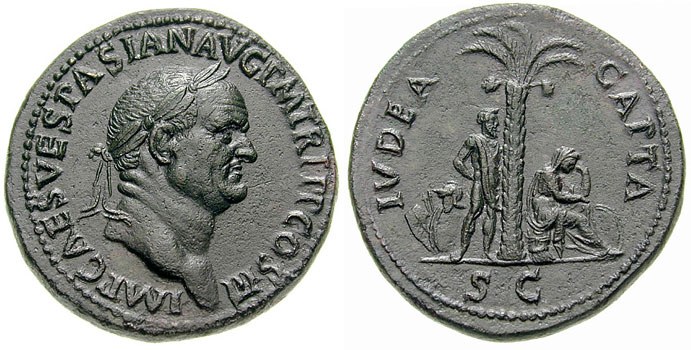
Vespasian coin with 'Judea Capta' on the back, IVDEA CAPTA, "Judaea conquered". The coin was Issued in 71 AD to celebrate the victory of the Romans in the Jewish Revolt.
Judaea Capta coins were originally issued by the Roman Emperor Vespasian to commemorate the capture of Judaea and the destruction of the Jewish Temple in Jerusalem by his son Titus in 70 AD during the First Jewish Revolt.
Josephus. The main account of the revolt comes from Josephus, the former Jewish commander of Galilee who, after capture by the Romans after the Siege of Yodfat, attempted to end the rebellion by negotiating with the Judeans on Titus's behalf. Josephus and Titus became close friends, and later Josephus was granted Roman citizenship and a pension. He never returned to his homeland after the fall of Jerusalem, living in Rome as a historian under the patronage of Vespasian and Titus. He wrote two works, The Jewish War (c. 75) and Jewish Antiquities (c. 94) which, on occasion, are contradictory. These are the only surviving source materials containing information on specific events occurring during the fighting. But the material has been questioned because of claims that cannot be verified by secondary sources and because of Josephus' potential bias as a client of the Romans and defender of the Roman cause. Only since the discovery of the Dead Sea scrolls has some solid confirmation been given to the events he describes. [Wikipedia]
Painting of the horrors of the Destruction of the Jerusalem Temple on the ninth of Av in 70 AD.
The Word "Caesar" is Mentioned many Times in the Bible (Note: It was not always Tiberius because he died in 37 A.D.)
Luke 3:1 - Now in the fifteenth year of the reign of Tiberius Caesar, Pontius Pilate being governor of Judaea, and Herod being tetrarch of Galilee, and his brother Philip tetrarch of Ituraea and of the region of Trachonitis, and Lysanias the tetrarch of Abilene.
Matthew 22:21 - They say unto him, Caesar's. Then saith he unto them, Render therefore unto Caesar the things which are Caesar's; and unto God the things that are God's.
Luke 3:1 - Now in the fifteenth year of the reign of Tiberius Caesar, Pontius Pilate being governor of Judaea, and Herod being tetrarch of Galilee, and his brother Philip tetrarch of Ituraea and of the region of Trachonitis, and Lysanias the tetrarch of Abilene,
John 19:15 - But they cried out, Away with [him], away with [him], crucify him. Pilate saith unto them, Shall I crucify your King? The chief priests answered, We have no king but Caesar.
John 19:12 - And from thenceforth Pilate sought to release him: but the Jews cried out, saying, If thou let this man go, thou art not Caesar's friend: whosoever maketh himself a king speaketh against Caesar.
Luke 20:25 - And he said unto them, Render therefore unto Caesar the things which be Caesar's, and unto God the things which be God's.
Mark 12:14 - And when they were come, they say unto him, Master, we know that thou art true, and carest for no man: for thou regardest not the person of men, but teachest the way of God in truth: Is it lawful to give tribute to Caesar, or not?
Mark 12:17 - And Jesus answering said unto them, Render to Caesar the things that are Caesar's, and to God the things that are God's. And they marvelled at him.
Acts 27:24 - Saying, Fear not, Paul; thou must be brought before Caesar: and, lo, God hath given thee all them that sail with thee.
Luke 23:2 - And they began to accuse him, saying, We found this [fellow] perverting the nation, and forbidding to give tribute to Caesar, saying that he himself is Christ a King.
Acts 11:28 - And there stood up one of them named Agabus, and signified by the Spirit that there should be great dearth throughout all the world: which came to pass in the days of Claudius Caesar.
Acts 25:11 - For if I be an offender, or have committed any thing worthy of death, I refuse not to die: but if there be none of these things whereof these accuse me, no man may deliver me unto them. I appeal unto Caesar.
Acts 25:21 - But when Paul had appealed to be reserved unto the hearing of Augustus, I commanded him to be kept till I might send him to Caesar.
Acts 17:7 - Whom Jason hath received: and these all do contrary to the decrees of Caesar, saying that there is another king, [one] Jesus.
Luke 2:1 - And it came to pass in those days, that there went out a decree from Caesar Augustus, that all the world should be taxed.
Acts 28:19 - But when the Jews spake against [it], I was constrained to appeal unto Caesar; not that I had ought to accuse my nation of.
Matthew 22:17 - Tell us therefore, What thinkest thou? Is it lawful to give tribute unto Caesar, or not?
Acts 25:8 - While he answered for himself, Neither against the law of the Jews, neither against the temple, nor yet against Caesar, have I offended any thing at all.
Acts 26:32 - Then said Agrippa unto Festus, This man might have been set at liberty, if he had not appealed unto Caesar.
Luke 20:22 - Is it lawful for us to give tribute unto Caesar, or no?
Acts 25:12 - Then Festus, when he had conferred with the council, answered, Hast thou appealed unto Caesar? unto Caesar shalt thou go.
Some Scriptures mentioning the word "Rome"
Acts 23:11 - And the night following the Lord stood by him, and said, Be of good cheer, Paul: for as thou hast testified of me in Jerusalem, so must thou bear witness also at Rome.
2 Timothy 4:22 - The Lord Jesus Christ [be] with thy spirit. Grace [be] with you. Amen. <[The second [epistle] unto Timotheus, ordained the first bishop of the church of the Ephesians, was written from Rome, when Paul was brought before Nero the second time.]>
Acts 18:2 - And found a certain Jew named Aquila, born in Pontus, lately come from Italy, with his wife Priscilla; (because that Claudius had commanded all Jews to depart from Rome:) and came unto them.
Colossians 4:18 - The salutation by the hand of me Paul. Remember my bonds. Grace [be] with you. Amen. <[Written from Rome to Colossians by Tychicus and Onesimus.]>
Ephesians 6:24 - Grace [be] with all them that love our Lord Jesus Christ in sincerity. Amen. <[To [the] Ephesians written from Rome, by Tychicus.]>
Philemon 1:25 - The grace of our Lord Jesus Christ [be] with your spirit. Amen. <[Written from Rome to Philemon, by Onesimus a servant.]>
Acts 2:10 - Phrygia, and Pamphylia, in Egypt, and in the parts of Libya about Cyrene, and strangers of Rome, Jews and proselytes,
Acts 19:21 - After these things were ended, Paul purposed in the spirit, when he had passed through Macedonia and Achaia, to go to Jerusalem, saying, After I have been there, I must also see Rome.
Acts 28:16 - And when we came to Rome, the centurion delivered the prisoners to the captain of the guard: but Paul was suffered to dwell by himself with a soldier that kept him.
Romans 1:7 - To all that be in Rome, beloved of God, called [to be] saints: Grace to you and peace from God our Father, and the Lord Jesus Christ.
Galatians 6:18 - Brethren, the grace of our Lord Jesus Christ [be] with your spirit. Amen. <[To [the] Galatians written from Rome.]>
Philippians 4:23 - The grace of our Lord Jesus Christ [be] with you all. Amen. <[To [the] Philippians written from Rome, by Epaphroditus.]>
Acts 28:14 - Where we found brethren, and were desired to tarry with them seven days: and so we went toward Rome.
Romans 1:15 - So, as much as in me is, I am ready to preach the gospel to you that are at Rome also.
2 Timothy 1:17 - But, when he was in Rome, he sought me out very diligently, and found [me].
Daniel 2:40 - "And the fourth kingdom shall be strong as iron: forasmuch as iron breaketh in pieces and subdueth all [things]: and as iron that breaketh all these, shall it break in pieces and bruise."
Acts 23:11 - And the night following the Lord stood by him, and said, Be of good cheer, Paul: for as thou hast testified of me in Jerusalem, so must thou bear witness also at Rome.
Related Pages:
Bible History Online - Arch of Titus Menorah Relief - 1 - This wall relief on the Arch of Titus reveals one of the most troubling scenes in all history, Roman soldiers carrying spoils from the destruction of the Temple of ...
Bible History Online - Arch of Titus Chariot Relief - 2 - This second scene on the Arch of Titus reveals the actual triumphal procession of Roman soldiers who conquered Jerusale m in 70 AD. Titus is in his chariot with ...
Rome: Biblical Archaeology - Bible History Links - Arch of Titus Chariot Relief Was Titus an instrument of God in destroying Jerusalem in 70 ... This second scene on the Arch of Titus reveals the actual triumphal ...
Arch of Titus - Meaning of Arch of Titus in Smiths Bible Dictionary - Arch of Titus: Biblical Meaning of Arch of Titus in Smiths Bible Dictionary (Bible History Online)
Bible History Online Images and Resources for Biblical History - ... The Tax Collector, The Pool of Bethesda, Flavian Amphitheatre, Arch of Titus, Tomb of Cyrus, Pilate Inscription, Fall of Babylon, Winemaking, Tiberius Caesar, ...
Art & Images: Ancient Rome - Bible History Links - Ancient and Modern Inscriptions on the Arch of Titus First, the ancient ... Arch of< Titus, Rome Roman Empire: Arch of Titus, Rome: view from W. [through the ...
Bible History Online - What's New - For example the Ishtar Gate, the Entrance to Sargon's Palace, the Arch of Titus, the Pyramid of Gizeh, the Parthenon, Solomon's Temple, and more. Important ...https://bible-history.com/biblehistoryonline_whatsnew.php
Rome: Biblical Archaeology - Bible History Links - Arch of Titus Chariot Relief Was Titus an instrument of God in destroying Jerusalem in 70 ... This second scene on the Arch of Titus reveals the actual triumphal ...
Arch of Titus - Meaning of Arch of Titus in Smiths Bible Dictionary - Arch of Titus: Biblical Meaning of Arch of Titus in Smiths Bible Dictionary (Bible History Online)
Bible History Online Images and Resources for Biblical History - ... The Tax Collector, The Pool of Bethesda, Flavian Amphitheatre, Arch of Titus, Tomb of Cyrus, Pilate Inscription, Fall of Babylon, Winemaking, Tiberius Caesar, ...https://bible-history.com/
Art & Images: Ancient Rome - Bible History Links (Ancient Biblical - Ancient and Modern Inscriptions on the Arch of Titus First, the ancient ... Arch of< /b> Titus, Rome Roman Empire: Arch of Titus, Rome: view from W. [through the ...
Bible History Online - What's New - For example the Ishtar Gate, the Entrance to Sargon's Palace, the Arch of Titus, the Pyramid of Gizeh, the Parthenon, Solomon's Temple, and more. Important ...https://bible-history.com/biblehistoryonline_whatsnew.php
Arches - Ancient Roman Monuments - Images and Illustrations - Illustration of the Arch of Titus at Rome. Candlesticks, Trumpet, And Table. The candlestick, trumpets and table for shewbread, as represent ed on the Arch of ...
Rome: Biblical Archaeology - Bible History Links (Ancient Biblical - Arch of Titus Chariot Relief Was Titus an instrument of God in destroying Jerusalem in 70 ... This second scene on the Arch of Titus reveals the actual triumphal ...
Bible History Online Images and Resources for Biblical History - ... The Tax Collector, The Pool of Bethesda, Flavian Amphitheatre, Arch of Titus, Tomb of Cyrus, Pilate Inscription, Fall of Babylon, Winemaking, Tiberius Caesar, ...https://bible-history.com/
Art & Images: Ancient Rome - Bible History Links - Ancient and Modern Inscriptions on the Arch of Titus First, the ancient ... Arch of< /b> Titus, Rome Roman Empire: Arch of Titus, Rome: view from W. [through the ...
Bible History Online - What's New - For example the Ishtar Gate, the Entrance to Sargon's Palace, the Arch of Titus, the Pyramid of Gizeh, the Parthenon, Solomon's Temple, and more. Important ...https://bible-history.com/biblehistoryonline_whatsnew.php
Arches - Ancient Roman Monuments - Images and Illustrations - Illustration of the Arch of Titus at Rome. Candlesticks, Trumpet, And Table. The candlestick, trumpets and table for shewbread, as represent ed on the Arch of ...
Arch of Titus Reliefs - Ancient Roman Stone ... - Bible History Online - Triumphal Procession. Relief from the Arch of Titus in the Roman Forum. Portion Of Bas Relief O n Arch Of Titus Showing The Golden Candlestick. Illustration of a ...
The Jewish Revolt - When Nero heard about the bitter defeat of the 12th Legion, he dispatched his most able commander, General Titus Flavius Vespasian, to put down the rebellion ...
Vespasian: People - Ancient Rome - Bible History Links - People - Ancient Rome: Vespasian Born Titus Flavius Vespasianus, he was Roman Emperor ruling from 69 to 79. Vespasi?nus, Titus Flavius Sab?nus in ...
Tacitus - HISTORIES - Titus Vespasian had been sent from Judaea by his father while Galba still lived, and alleged as a reason for his journey the homage due to the Emperor, and his ...
And she..."shall sit on the ground" - ... over the knee, and some with the hands tied behind the back, with a Roman soldier standing in front of her. (see coins of Titus, Vespasian, and Domitian ). ...
Tacitus - HISTORIES - These mysterious prophecies had pointed to Vespasian and Titus, but the common people, with the usual blindness of ambition, had interpreted these mighty ...
The Antonia Fortress - Overview - Titus Vespasian attacked the city of Jerusalem from the north side in 70 A.D. and overcame it. The legions of Rome slaughtered over a million Jews and 9500 0 ...
Antonia Fortress - Location - (It is important to note that Titus Vespasian attacked the city of Jerusalem from the north in 70 A.D.) The Antonia Fortress was located on the northwest corner of ...
Timeline - 69 Vespasian is sole emperor until 79. 70 Siege and fall of Jerusalem under military leadership of Vespasian's son, Titus. 70 Coliseum begun by Emperor ...
Vespasian: People - Ancient Rome - Bible History Links - People - Ancient Rome: Vespasian Born Titus Flavius Vespasianus, he was Roman Emperor ruling from 69 to 79. Vespasi?nus, Titus Flavius Sab?nus in ...
Tacitus - HISTORIES - Titus Vespasian had been sent from Judaea by his father while Galba still lived, and alleged as a reason for his journey the homage due to the Emperor, and his ...
And she..."shall sit on the ground" - ... over the knee, and some with the hands tied behind the back, with a Roman soldier standing in front of her. (see coins of Titus, Vespasian, and Domitian ). ...
Tacitus - HISTORIES - These mysterious prophecies had pointed to Vespasian and Titus, but the common people, with the usual blindness of ambition, had interpreted these mighty ...
The Antonia Fortress - Overview - Titus Vespasian attacked the city of Jerusalem from the north side in 70 A.D. and overcame it. The legions of Rome slaughtered over a million Jews and 9500 0 ...
Antonia Fortress - Location - (It is important to note that Titus Vespasian attacked the city of Jerusalem from the north in 70 A.D.) The Antonia Fortress was located on the northwest corner of ...< /b>
Timeline - 69 Vespasian is sole emperor until 79. 70 Siege and fall of Jerusalem under military leadership of Vespasian's son, Titus. 70 Coliseum begun by Emperor ...
Bible History Online - The Arch of Titus (Biblical Archaeology) - The Arch of Titus is one of Rome's most famous monuments. It was built to commemorate the victories of Titus and Vespasi an in the war against the Jews and ...
Tacitus - HISTORIES - Titus Vespasian had been sent from Judaea by his father while Galba still lived, and alleged as a reason for his journey the homage due to the Emperor, and his ...
And she..."shall sit on the ground" - ... over the knee, and some with the hands tied behind the back, with a Roman soldier standing in front of her. (see coins of Titus, Vespasian, and Domitian ). ...
Tacitus - HISTORIES - These mysterious prophecies had pointed to Vespasian and Titus, but the common people, with the usual blindness of ambition, had interpreted these mighty ...
The Antonia Fortress - Overview - Titus Vespasian attacked the city of Jerusalem from the north side in 70 A.D. and overcame it. The legions of Rome slaughtered over a million Jews and 9500 0 ...
Antonia Fortress - Location - (It is important to note that Titus Vespasian attacked the city of Jerusalem from the north in 70 A.D.) The Antonia Fortress was located on the northwest corner of ...< /b>
Timeline - 69 Vespasian is sole emperor until 79. 70 Siege and fall of Jerusalem under military leadership of Vespasian's son, Titus. 70 Coliseum begun by Emperor ...
Bible History Online - The Arch of Titus (Biblical Archaeology) - The Arch of Titus is one of Rome's most famous monuments. It was built to commemorate the victories of Titus and Vespasi an in the war against the Jews and ...
Domitian: People - Ancient Rome - Bible History Links - Domiti?nus, Titus Flavius in Harpers Dictionary The second son of Vespasian, born at Ro me A.D. 51. Vespasian, well aware of his natural disposition, reposed ...
Bible History Online - Bust of Vespasian (Biblical Archaeology) - The face of the Roman Emperor, Vespasian. The bust of Vespasian is important in the study of Biblical Archaeology, it reveals the i mage of the Roman general ...
Bible History Online - Vespasian Coin - Vespasian Coin Vespasian Coin. Coin showing the image of the Emperor Vespasian. Return to Ancient Sketches ╖ Return to Bible History Online.
Suetonius story about Vespasian - One day the emperor Vespasian approached the foremost comedian of his day and said "why do you never tell jokes about me?" to which the wag shot back "I ...
Bible History Online - Vespasian Statue - Vespasian Statue Vespasian Statue. Statue of the Emperor Vespasian. Return to Ancient Sketches ╖ Return to Bible History Online.
Vespasian - Ancient Roman People - Images and Illustrations - Ancient Roman People. Vespasian. The Emperor Vespasian. From a bronze bust in the Louvre. Illustra ted Bible History ╖ Background Bible Study. If you notice a ...
Bible History Online - Bust of Vespasian (Biblical Archaeology) - The face of the Roman Emperor, Vespasian. The bust of Vespasian is important in the study of Biblical Archaeology, it reveals the i mage of the Roman general ...
Bible History Online - Vespasian Coin - Vespasian Coin Vespasian Coin. Coin showing the image of the Emperor Vespasian. Return to Ancient Sketches ╖ Return to Bible History Online.
Suetonius story about Vespasian - One day the emperor Vespasian approached the foremost comedian of his day and said "why do you never tell jokes about me?" to which the wag shot back "I ...
Bible History Online - Vespasian Statue - Vespasian Statue Vespasian Statue. Statue of the Emperor Vespasian. Return to Ancient Sketches ╖ Return to Bible History Online.
Vespasian - Ancient Roman People - Images - Ancient Roman People. Vespasian. The Emperor Vespasian. From a bronze bust in the Louvre. Illustrate d Bible History ╖ Background Bible Study. If you notice a ...
Vespasian - Ancient Roman People - Images - Syrian Walls and Gates ╖ Weapons and Warfare ╖ back. Ancient Roman People - Vespasian. The Emperor Vespasian. From a bronze bust in the Louvre.
Bible History Online - Vespasian Coin - Vespasian Coin Vespasian Coin. Coin showing the image of the Emperor Vespasian. Return to Ancient Sketches ╖ Return to Bible History Online.
Suetonius story about Vespasian - One day the emperor Vespasian approached the foremost comedian of his day and said "why do you never tell jokes about me?" to which the wag shot back "I ...
Bible History Online - Vespasian Statue - Vespasian Statue Vespasian Statue. Statue of the Emperor Vespasian. Return to Ancient Sketches ╖ Return to Bible History Online.
The Jewish Revolt - Titus Vespasian was a very skilled military strategist and planned his attack starting ... Nero had committed suicide on June 9th, 68 A.D. and Titus Vespasian was ...
Timeline - 67 Nero appoints Vespasian to head campaign against Jews. 68 After ... 69 Year of the four emperors: Galba, Otho, Vitellius, and Vespasian. 69 Vespasian is ...
Vespasian - Ancient Roman People - Images- Ancient Roman People. Vespasian. The Emperor Vespasian. From a bronze bust in the Louvre. Illustrate d Bible History ╖ Background Bible Study. If you notice a ...
Vespasian - Ancient Roman People - Images - Syrian Walls and Gates ╖ Weapons and Warfare ╖ back. Ancient Roman People - Vespasian. The Emperor Vespasian. From a bronze bust in the Louvre.
Domitian: People - Ancient Rome- Vespasian, well aware of his natural disposition, reposed no confidence in him during ... Upon the death of Vespasian he endeavoured to foment troubles in the ...