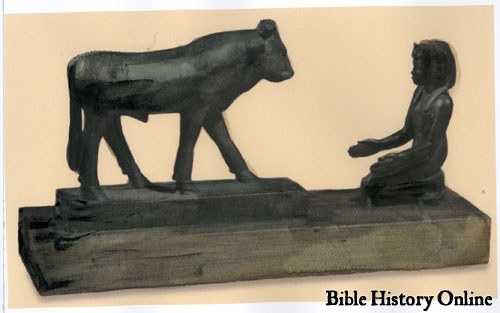
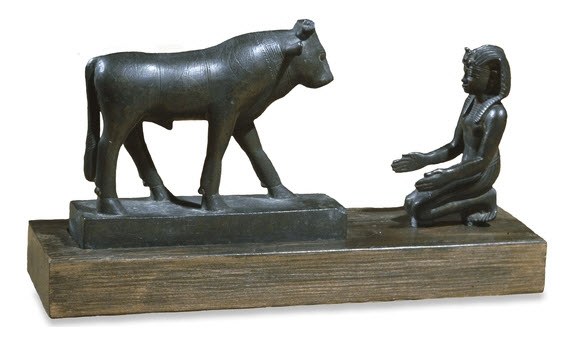
This painting depicts a bronze votive group statuette of an unnamed ruler kneeling before an Apis bull, his hands held out in offering. It was dedicated by a 7th century Egyptian king of the 26th Dynasty, who is named on the bull's pedestal. It is 12.5 cm in length.
Was this the Golden Calf of the Exodus?
The ancient Egyptians believed that Apis, the sacred bull of Memphis was a manifestation of Ptah upon the earth. Whenever an Apis bull died in Memphis it was embalmed and mummified. Each bull had its own huge sarcophagus and its birth and death were recorded, carved onto the walls.
The Pharaoh Kneeling Before the Bull Deity discovery is important in the study of Biblical Archaeology.
After the Israelites were delivered from Egypt, Moses came down from the mountain and found Aaron had set up a golden calf or young bull, that the people might worship God in this form. When the northern kingdom of Israel divided from their brothers in the south, Jeroboam introduced bull worship and set up two idols (calves of gold), one at Bethel and the other at Dan.
"The Apis is the calf of a cow which is never afterwards able to have another. The Egyptian belief is that a flash of light descends upon the cow from heaven, and this causes her to conceive Apis. The Apis-calf has distinctive marks: it is black, with a white square on its forehead, the image of an eagle on its back, the hair on its tail double, and a scarab under its tongue. Herodotus, Histories 3.28
Exodus 32:3,4 "And all the people brake off the golden earrings which were in their ears, and brought them unto Aaron. And he received them at their hand, and fashioned it with a graving tool, after he had made it a molten calf: and they said, These be thy gods, O Israel, which brought thee up out of the land of Egypt."
1 Kings 12:28-29 "Whereupon the king took counsel, and made two calves of gold, and said unto them, It is too much for you to go up to Jerusalem: behold thy gods, O Israel, which brought thee up out of the land of Egypt. And he set the one in Bethel, and the other put he in Dan."
Egyptian King Kneeling Before the Apis Bull
British Museum Excerpt
Bronze statuette group of the king before the Apis bull
From Egypt, Late Period, after 600 BC Height: 12.300 cm Length: 14.700 cm EA 22920 Room 61: Egyptian life
The king offering before the Apis bull
The Apis bull was sacred to the god Ptah of Memphis. Only one Apis bull existed at a time, unlike other sacred animals, such as the ibises of Thoth and the cats of Bastet. Each time an Apis bull died the priests searched the country for its successor, which they identified by the bull's particular markings. The search for a new Apis bull is described by the Greek historian Herodotus (about 485-425 BC), who visited Egypt in the mid-fifth century BC.
The Apis was regarded as a representative of Ptah on earth. The bull was kept in splendid accommodation, its every action watched in case it was a message from the god. The bull was used as an intermediary in oracular consultations (foretelling the future); questions were put to it, and its movements interpreted. When it died, the bull was mummified and placed in a sarcophagus. This huge coffin was laid alongside those of the bull's predecessors, in a series of galleries known as the Serapeum at Memphis.
According to Herodotus, anyone who harmed the Apis bull would suffer severe consequences. The Persian conqueror Cambyses scorned the gods of Egypt and wounded the Apis bull, causing its death. He was later injured in the same way, just as he was about to reach the high point of his career.
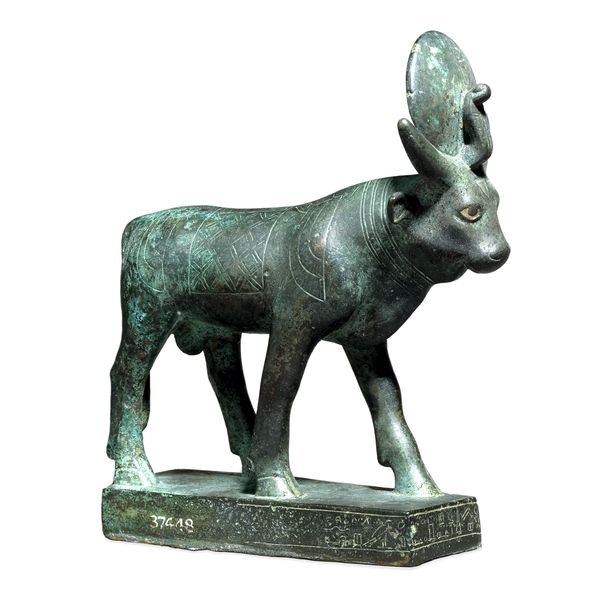
Another Bronze figure of Apis, the sacred bull.. More
Apis in Egyptian mythology
"In Egyptian mythology, Apis or Hapis (alternatively spelt Hapi-ankh), was a bull-deity worshipped in the Memphis region.
According to Manetho, his worship was instituted by Kaiechos of the Second Dynasty. Hape (Apis) is named on very early monuments, but little is known of the divine animal before the New Kingdom. Ceremonial burials of bulls indicate that ritual sacrifice was part of the worship of the early cow deities and a bull might represent a king who became a deity after death. He was entitled "the renewal of the life" of the Memphite god Ptah: but after death he became Osorapis, i.e. the Osiris Apis, just as dead humans were assimilated to Osiris, the king of the underworld. This Osorapis was identified with the Hellenistic Serapis, and may well be identical with him. Greek writers make the Apis an incarnation of Osiris, ignoring the connection with Ptah.
Apis was the most important of all the sacred animals in Egypt, and, as with the others, its importance increased as time went on. Greek and Roman authors have much to say about Apis, the marks by which the black bull-calf was recognized, the manner of his conception by a ray from heaven, his house at Memphis with court for disporting himself, the mode of prognostication from his actions, the mourning at his death, his costly burial, and the rejoicings throughout the country when a new Apis was found. Mariette's excavation of the Serapeum at Memphis revealed the tombs of over sixty animals, ranging from the time of Amenophis III to that of Ptolemy Alexander. At first each animal was buried in a separate tomb with a chapel built above it. Khamuis, the priestly son of Ramesses II (c. 1300 B.C.), excavated a great gallery to be lined with the tomb chambers; another similar gallery was added by Psammetichus I. The careful statement of the ages of the animals in the later instances, with the regnal dates for their birth, enthronization, and death have thrown much light on the chronology from the Twenty-second dynasty onwards. The name of the mother-cow and the place of birth often are recorded. The sarcophagi are of immense size, and the burial must have entailed enormous expense. It is therefore remarkable that the priests contrived to bury one of the animals in the fourth year of Cambyses." (Wikipedia - Apis (Egyptian mythology)
In Egyptian Mythology Apis was a god depicted as a bull, symbolizing fertility and strength in war. [Oxford Dictionary]
Apis Sacred bull who served as the BA (physical manifestation) or 'herald' of the god PTAH, His principal sanctuary was therefore located near the temple of Ptah at Memphis, in the vicinity of which the 'embalming house' of the Apis bulls has been unearthed. Unlike many other sacred animals the Apis bull was always a single individual animal, selected for his particular markings. According to the Greek historian Herodotus, the Apis bull, conceived from a bolt of lightning, was black with a white diamond on the forehead, the image of a vulture on its back, double hairs on its tail, and a scarab-shaped mark under its tongue. The cult of the Apis probably dates back to the beginning of Egyptian history, although Manetho, the Ptolemaic historian, claims that it originated in the 2nd Dynasty. The bul! was closely linked with the pharaoh, both being dhine manifestations of a god who were crowned at the time of their installation. Like the king, the Apis bull had his own 'window of appearances' (see palaces) and, at least from the Late Period, he was thought to provide ORACLES. From the 22nd Dynasty onwards, the bull was represented on private coffins, as if accompanying the deceased westwards to the tomb or eastwards (presumably towards a new life) and serving as a protector of the dead. At the death of each of the Apis bulls, there was national mourning, and the embalmed corpse was taken along the sacred way from Memphis to Saqqara, for burial in a granite sarcophagus in the underground catacombs known as the serapeum, which were in use from at least as early as the New Kingdom. According to Herodotus, the Persian ruler Cambyses (525-522 bc) mocked the cult and caused the death of the Apis bull of the time, although it has been suggested that this story mav simplv have been an attempt to discredit the Persians, since it appears to be contradicted by a textual record of an Apis burial actually conducted by Cambyses. Because of the divine nature of his birth, the mothers of the Apis bulls were venerated as manifestations of the goddess ISIS.; thev were accorded similar burials to their offspring, in the Iseum1 (or 'mothers of Apis' catacomb), a set of galleries further to the north in Saqqara which were excavated in 1970 by Bryan Emery. The 'calves of the Apis' were also buried ceremoniallv, but their catacombs, like the early Pharaonic Apis galleries, remain undiscovered. After his death, the Apis bull became identified with OSIRIS, being described as the svncretic deity Osiris-Apis or Osorapis. In the early Ptolemaic period the cult of SERAPIS was introduced, combining the traits of the Greek gods Zeus, Llelios, Llades, Dionvsos and Asklepios with those of Osorapis. [British Museum Text]
In Egyptian mythology, Apis or Hapis (alternatively spelled Hapi-ankh), was a bull-deity worshipped in the Memphis region.According to Manetho, his worship was instituted by Kaiechos of the Second Dynasty. Hape (Apis) is named on very early monuments, but little is known of the divine animal before the New Kingdom. Ceremonial burials of bulls indicate that ritual sacrifice was part of the worship of the early cow deities and a bull might represent a king who became a deity after death. He was entitled "the renewal of the life" of the Memphite god Ptah: but after death he became Osorapis, i.e. the Osiris Apis, just as dead humans were assimilated to Osiris, the king of the underworld. This Osorapis was identified with the Hellenistic Serapis, and may well be identical with him. Greek writers make the Apis an incarnation of Osiris, ignoring the connection with Ptah. Apis was the most important of all the sacred animals in Egypt, and, as with the others, its importance increased as time went on. Greek and Roman authors have much to say about Apis, the marks by which the black bull-calf was recognized, the manner of his conception by a ray from heaven, his house at Memphis with court for disporting himself, the mode of prognostication from his actions, the mourning at his death, his costly burial, and the rejoicings throughout the country when a new Apis was found. Mariette's excavation of the Serapeum at Memphis revealed the tombs of over sixty animals, ranging from the time of Amenophis III to that of Ptolemy Alexander. At first each animal was buried in a separate tomb with a chapel built above it. Khamuis, the priestly son of Ramesses II (c. 1300 B.C.), excavated a great gallery to be lined with the tomb chambers; another similar gallery was added by Psammetichus I. The careful statement of the ages of the animals in the later instances, with the regnal dates for their birth, enthronization, and death have thrown much light on the chronology from the Twenty-second dynasty onwards. The name of the mother-cow and the place of birth often are recorded. The sarcophagi are of immense size, and the burial must have entailed enormous expense. It is therefore remarkable that the priests contrived to bury one of the animals in the fourth year of Cambyses. [Wikipedia]
Apis in an Egyptian Context. As an Egyptian deity, Apis belonged to a complex religious, mythological and cosmological belief system developed in the Nile river basin from earliest prehistory to 525 B.C.E.[3] Indeed, it was during this relatively late period in Egyptian cultural development, a time when they first felt their beliefs threatened by foreigners, that many of their myths, legends and religious beliefs were first recorded.[4] The cults within this framework, whose beliefs comprise the myths we have before us, were generally fairly localized phenomena, with different deities having the place of honor in different communities.[5] Despite this apparently unlimited diversity, however, the gods (unlike those in many other pantheons) were relatively ill-defined. As Frankfort notes, ?the Egyptian gods are imperfect as individuals. If we compare two of them ? we find, not two personages, but two sets of functions and emblems. ? The hymns and prayers addressed to these gods differ only in the epithets and attributes used. There is no hint that the hymns were addressed to individuals differing in character.?[6] One reason for this was the undeniable fact that the Egyptian gods were seen as utterly immanental?they represented (and were continuous with) particular, discrete elements of the natural world.[7] Thus, those who did develop characters and mythologies were generally quite portable, as they could retain their discrete forms without interfering with the various cults already in practice elsewhere. Also, this flexibility was what permitted the development of multipartite cults (i.e., the cult of Amun-Re, which unified the domains of Amun and Re), as the spheres of influence of these various deities were often complimentary. The worldview engendered by ancient Egyptian religion was uniquely appropriate to (and defined by) the geographical and calendrical realities of its believer?s lives. Unlike the beliefs of the Hebrews, Mesopotamians and others within their cultural sphere, the Egyptians viewed both history and cosmology as being well ordered, cyclical and dependable. As a result, all changes were interpreted as either inconsequential deviations from the cosmic plan or cyclical transformations required by it.[9] The major result of this perspective, in terms of the religious imagination, was to reduce the relevance of the present, as the entirety of history (when conceived of cyclically) was ultimately defined during the creation of the cosmos. The only other aporia in such an understanding is death, which seems to present a radical break with continuity. To maintain the integrity of this worldview, an intricate system of practices and beliefs (including the extensive mythic geographies of the afterlife, texts providing moral guidance (for this life and the next) and rituals designed to facilitate the transportation into the afterlife) was developed, whose primary purpose was to emphasize the unending continuation of existence.[10] Given these two cultural foci, it is understandable that the tales recorded within this mythological corpus tended to be either creation accounts or depictions of the world of the dead, with a particular focus on the relationship between the gods and their human constituents. Given that Apis (as deity) was actually understood to be the sacred bull, his cult presents another permutation of the highly concrete and immanental understanding of theology common in Ancient Egypt. {New World Encyclopedia]
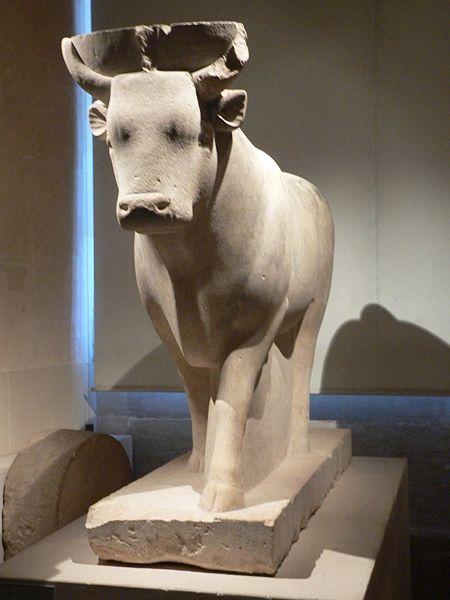
Apis in the Louvre Museum
In Ancient Egypt, Apis or Hapis (alternatively spelt Hapi-ankh) was a bull-deity worshiped in the Memphis region and thought to represent rulership and masculine vigor. Though originally a local deity, his popularity grew throughout the dynastic history, such that, by the Ptolemaic period, he was "a kind of national mascot."[1] The worship of Apis was certainly the most popular of the three great bull cults of ancient Egypt (the others being the bulls Mnevis and Buchis.)
Though Hape (Apis) is named on some of the earliest monuments in ancient Egypt, the most detailed accounts of his cult can be traced back to the New Kingdom period (1570?1070 B.C.E.). He was originally seen as "the renewal of the life" of the Memphite god Ptah, but after death he became Osorapis, (the Osiris Apis).[2]. Under the Ptolemaic dynasty, this deity became Serapis, a Hellenistic syncretism between the popular Egyptian cult and the iconography (and characterization) of the Greek god, Hades.
APIS, a sacred bull worshipped at Memphis from the earliest period, having probably been introduced into the religious system as early as the 2nd dynasty by the king Kaiechos, who instituted the worship of Apis and the bull Mnevis.
His name in hieroglyphs was Hapi, and meant "the hidden," as he had to be discovered amidst the cattle, which was done by certain diacritical marks. According to the hieroglyphic inscriptions which accompany his form, he was the second birth or living incarnation of the god Ptah, the Egyptian Hephaestos or Vulcan. Apis is first mentioned and appears in the monuments of the 4th dynasty. The two bulls Apis and Mnevis are considered to have respectively represented the moon and sun, and seem both to have been buried at Memphis.
He was supposed to have been born of a virgin cow, rendered pregnant by a moonbeam or a flash of lightning. The mother of Apis, according to Strabo, had a part of the temple of the Apis reserved for her use; and the hieroglyphic inscriptions record a prophet or priest attached to her service. On the monuments she shares the honours of the bull, and is represented under the attributes of Athor as a goddess with a cow?s head. This cow had her especial name, these animals having each a separate appellation. According to the Greek writers Apis was the image of Osiris, and worshipped because Osiris was supposed to have passed into a bull, and to have been soon after manifested by a succession of these animals. The hieroglyphic inscriptions identify the Apis with Osiris, adorned with horns or the head of a bull, and unite the two names as Hapi-Osor, or Apis Osiris. According to this view the Apis was the incarnation of Osiris manifested in the shape of a bull. But besides this title, the monuments style Apis the son of Ptah, who was supposed to be his father by the sacred cow, or the second life of Ptah. Other monuments, indeed, declare him to have had no father, and to have been Onnophris or Osiris, but this conflict of ideas must have arisen from his material and spiritual nature, uniting the soul of Osiris or Ptah mystically with the sacred animal. Besides the mother of the Apis, a cow was annually exhibited to him decorated with the same insignia -- that is, a disk between the horns and a housing on the back, to judge from the insignia found on the bronze figures of the Apis -- and then slaughtered the same day, for no issue of the divine animal was permitted to exist.
According to other authorities several cows were kept in the Apeum on the announcement of the birth of an Apis, the sacred scribes and priests proceeded to verify the characters of the calf. The marks of the Apis were a black coloured hide, with a white triangular spot on the forehead, the hair arranged in the shape of an eagle on the back, and a knot under the tongue in shape of a scarabaeus, the sacred insect and emblem of Ptah, a white spot resembling a lunar crescent at his right side. These marks have been supposed to be for the most part certain arrangements of the hairs of the hide as seen in some animals. A house was built to the calf Apis facing the east, in which for four months he was nourished with milk. When he had grown up he was conducted, at the time of the new moon, to a ship by the sacred scribes and prophets, and conducted to the Apeum at Memphis, where there were courts, places for him to walk in, and a drinking fountain. According to Diodorus, he was first led to Nilopolis, and kept there 40 days, then shipped in a boat with a gilded cabin to Memphis, and he was there allowed to be seen for 40 days only by women, who exposed themselves to him. Like all the sacred animals his actions were oracular, and he had two chambers, his passage into one of which was deemed fortunate, and into the other unlucky. Thus the licking the garments of a visitor was supposed to prognosticate a tranquil but short life, and his refusal of the food offered to him by the hand of Germanicus, the approaching death of that hero. The actions of the children who played around his shrine or accompanied his processions were also considered oracular. The day of his birth was kept as an annual festival.
His life was not allowed to exceed 25 years, and should it have attained that maximum reckoned from the date of his enthronisation, the Apis was killed and thrown into a well, in which the priests asserted he had precipitated himself. This well was known to no one, and no one was allowed to reveal the place of burial. If the Apis died before the 25 years he received a splendid burial at Memphis in the Serapeum, for after death he was called the osor-hapi, or Serapis. This funeral was expensive; his body was placed in a barge, and accompanied by a procession of a Bacchanalian character, passing through the brazen doors of Memphis. As universal joy prevailed at his discovery, so his death threw all Egypt into a general mourning, and every one shaved off his beard. This mourning continued till the discovery of another Apis.
His birthday was celebrated by an annual feast, the natales Apidis, of seven days? duration, during which it was supposed the crocodiles were innocuous, and a silver cup was thrown on the occasion into a certain part of the Nile, which was considered a flux of Apis. This festival coincided with the rise of the Nile.
On the mummy coffins an Apis is often seen on the foot-board of those of the 7th and 6th centuries B.C. bearing on the back the mummy of the deceased to the sepulcher. The discovery by M. Mariette of the Seraoeum at Memphis described by Strabo has thrown great light on the worship and history of the Apis, the mode of burial, and the sequence of the bulls. (See SERAPEUM.)
The oldest Apis mentioned was one of the reign of Amenophis III., and he was followed in the 18th dynasty by bulls which had died in the reigns of Tutankhamen and Horus. There was a succession under the 19th dynasty, commencing with Seti or Sethos I., besides three which died in the 16th, 26th, and 30th years if Rameses II., and three others, the dates of whose deaths are unknown. Under the 20th dynasty there was an Apis which died in the 26th year of Rameses III., one in the reign of Rameses IX., others of the date of Rameses XI. And XIV., and four others whose dates are not determined, besides three more which died under the 21st dynasty. Of bulls deceased in the 22nd dynasty, there is one of the 23rd year of Osorkon II., another of the 14th year of Takellothis I., and a third of the 28th year of Sheshank or Shishak III.
It is not till the reign of this monarch that the dates connected with the Apis become of chronological importance. On the sepulchral tablet of the Apis which was born in the reign of Shishak III., is found the formula of the date of the birth and inauguration of the bull. It was born on the 20th of the month Payni, in the 28th year of the king?s reign, and enthroned on the 1st of Paophi of the same year, having died in the 2nd year of the king Pamai, and been buried on the 1st of the month Mechir of the same year. It had attained the age of 26 years. Three other bulls died in the 4th, 11th and 37th years of Shishak IV. Important statements like these show the intervals of time which elapsed between the regnal years of different kings, and check the chronology of the 22nd and subsequent dynasties, but owing to unfortunate lacunae the chronology of Egypt is conjectural, and not positive till the reign of Tirhakah. The dates of the other Apis are, one which died on the 5th of the month Thoth, in 6th year of Bekenrenf, or Bocchoris, another of the 2nd year of Shabak or Sabaco, and that buried on the 23rd Pharmouthi of the 24th year of Tirhakah, 730 B.C. The dates of the other bulls prior to the conquest of Egypt by Alexander the Great, 332 B.C., are: one born in the 26th year of Tirhakah, enthroned on the 9th Pharmouthi, the same year deceased, in the 20th year of Psammetichus I., and buried on ! the 25th Paophi, of the 23rd year of Psammetichus; another deceased in the 52nd year of the same king; a third born in the 53d year of Psammetichus I, enthroned on the 12th of Athor of the 54th year, deceased on the 6th of Paophi, and buried on the 10th Choiak of the 16th year of Necho, having lived 16 years 7 months and 17 days; another born on 7th Paophi of the 16th year of Necho, enthroned 9th Epiphi of the 1st year of Psammetichus I., died on the 12th Pharmouthi of the 12th year of Apries, and buried the 21st Payni of the same year, aged 17 years 6 months and 5 days; another born in the 5th year of Amasis, inaugurated on the 18th Payni of the same year, died on the 6th Phamenoth, was buried on the 15th Pashons of the 23rd year of the same king, aged 18 years and 7 months. The Apis which died after this, and of which a sarcophagus was found dated in the 4th year of Cambyses, is the one supposed to have been killed by Cambyses on his return from Aethiopia. Another born in the month Pharmouthi of the 5th year of Cambyses, died in the 4th year of Darius, and was buried on the 2nd Pashons of the 5th year of darius, and had lived upwards of 7 years. It is the Apis of Darius, alluded to by Polyaenus, for the successor of which Darius offered 100 talents as a reward to the fortunate discoverer. Another Persian king Ochus is said to have killed and eaten an Apis, 338 B.C. The death of an Apis soon after the death of Alexander the Great, 323 B.C. is also recorded. The sepulchral tablets in the demotic characters according to M. Brugsch, record the birth of an Apis in the month of Phamenoth, in the 29th year of Ptolemy Euergetes I., 231 B.C., which died in the 51st year, 179 B.C.; and another older, probably of Ptolemy Philadelphus II., 253 B.C.; another of the 14th year of Ptolemy Epiphanes IV., 211 B.C.; another in the 20th year of Ptolemy IV., 185 B.C.; another in the 17th year of Ptolemy Philometor VII., 164 B.C.; and another born in the 53d year (118-117 B.C.) of Ptolemy Euergetes II., died 15 years old, 103 B.C., in the reign of Ptolemy XI. In the Roman times the discovery of an Apis in the reign of Hadrian, 121 A.D., caused a tumult at Alexandria; and the last known Apis is that brought to the Emperor Julian II., 362-363 A.D., after which the Apis disappears from Egypt altogether.
The Apis was embalmed at great cost, but the operation consisted in preparing with bitumen the skull and a few of the principal bones of the bull made up into an appropriate shape. The second genius of the Karneter, or Egyptian Hades, was also called Hapi or Apis, but he was quite distinct from the bull god and the son of Osiris. His type was that of a human mummy with the head of a Cynocephalus ape. Bronze native figures of the Apis are not uncommon, and those of stone are occasionally found, but porcelain ones are extremely rate. [1902 Encyclopedia Britannica]
Apis, the ancient Egyptian bull god from Memphis
APIS or Hapis, the sacred bull of Memphis, in Egyptian Hp, Hope, Hope. By Manetho his worship is said to have been instituted by Kaiechos of the Second Dynasty. Hape is named on very early monuments, but little is known of the divine animal before the New Kingdom. He was entitled ?the renewal of the life? of the Memphite god Ptah: but after death he became Osorapis, i.e. the Osiris Apis, just as dead men were assimilated to Osiris, the king of the underworld. This Osorapis was identified with Serapis, and may well be really identical with him (see Serapis): and Greek writers make the Apis an incarnation of Osiris, ignoring the connexion with Ptah. Apis was the most important of all the sacred animals in Egypt, and, like the others, its importance increased as time went on. Greek and Roman authors have much to say about Apis, the marks by which the black bull-calf was recognized, the manner of his conception by a ray from heaven, his house at Memphis with court for disporting himself, the mode of prognostication from his actions, the mourning at his death, his costly burial and the rejoicings throughout the country when a new Apis was found. Mariette?s excavation of the Serapeum at Memphis revealed the tombs of over sixty animals, ranging from the time of Amenophis III. to that of Ptolemy Alexander. At first each animal was buried in a separate tomb with a chapel built above it. Khamuis, the priestly son of Rameses II. (c. 1300 B.C.), excavated a great gallery to be lined with the tomb chambers; another similar gallery was added by Psammetichus I. The careful statement of the ages of the animals in the later instances, with the regnal dates for their birth, enthronization and death have thrown much light on the chronology from the XXIInd dynasty onwards. The name of the mother-cow and the place of birth are often recorded. The sarcophagi are of immense size, and the burial must have entailed enormous expense. It is therefore remarkable that the priests contrived to bury one of the animals in the fourth year of Cambyses. [1911 Encyclopedia Britannica]
Calf in Smith's Bible Dictionary. The calf was held in high esteem by the Jews as food. 1Sa 28:24; Lu 15:23 The molten calf prepared by Aaron for the people to worship, Ex 32:4 was probably a wooden figure laminated with gold, a process which is known to have existed in Egypt. [AARON] Cal'neh, or Cal'no (fortress of Anu), appears in Ge 10:10 among the cities of Nimrod. Probably the site is the modern Niffer. In the eighth century B.C. Caneh was taken by one of the Assyrian kings, and never recovered its prosperity. Isa 10:9; Am 6:2
Calf in Eastons Bible Dictionary. Calves were commonly made use of in sacrifices, and are therefore frequently mentioned in Scripture. The "fatted calf" was regarded as the choicest of animal food; it was frequently also offered as a special sacrifice (1 Sam. 28:24; Amos 6:4; Luke 15:23). The words used in Jer. 34:18, 19, "cut the calf in twain," allude to the custom of dividing a sacrifice into two parts, between which the parties ratifying a covenant passed (Gen. 15:9, 10, 17, 18). The sacrifice of the lips, i.e., priase, is called "the calves of our lips" (Hos. 14:2, R.V., "as bullocks the offering of our lips." Comp. Heb. 13:15; Ps. 116:7; Jer. 33:11). The golden calf which Aaron made (Ex. 32:4) was probably a copy of the god Moloch rather than of the god Apis, the sacred ox or calf of Egypt. The Jews showed all through their history a tendency toward the Babylonian and Canaanitish idolatry rather than toward that of Egypt. Ages after this, Jeroboam, king of Israel, set up two idol calves, one at Dan, and the other at Bethel, that he might thus prevent the ten tribes from resorting to Jerusalem for worship (1 Kings 12:28). These calves continued to be a snare to the people till the time of their captivity. The calf at Dan was carried away in the reign of Pekah by Tiglath-pileser, and that at Bethel ten years later, in the reign of Hoshea, by Shalmaneser (2 Kings 15:29; 17:33). This sin of Jeroboam is almost always mentioned along with his name (2 Kings 15:28 etc.).
Calf Worship in Faussets Bible Dictionary. (See AARON.) The Israelites "in Egypt" had served the Egyptian idols (Joshua 24:14), including the sacred living bulls Apis, Basis, and Mnevis, and sacred cows Isis and Athor; worshipped for their utility to man, and made symbols of the sun and Osiris. In fact Nature, not the personal Creator, God, was symbolized by the calf and worshipped. But Aaron's golden calf he expressly calls, "thy Elohim which brought thee up out of Egypt"; and the feast to it "a feast to Jehovah" (Exodus 32:4-8; Exodus 32:17-19). Israel too had just seen that "upon Egypt's gods Jehovah executed judgments" (Numbers 33:4). What they yearned for therefore was not the vanquished Egyptian idols, but some visible symbol of the unseen Jehovah; the cherubic emblem, the calf or ox, furnished this. So Psalm 106:20, "they changed their glory (i.e. God) into the similitude of an ox that eateth grass"; indeed the Egyptians used to offer a bottle of hay to Apis. The rites of Mnevis' feast at Heliopolis, boisterous revelry, dancing, offerings, etc., which the Israelites were familiar with in Egypt, they transferred to Jehovah's calf image. Acts 7:40-41 marks this first stage of idolatry. The second more glaring stage surely followed: "God turned, and gave them up to worship the host of heaven" (Acts 7:42-43). Jeroboam's calves, which his exile in Egypt familiarized him with, and which he subsequently set up at Dan and Bethel similarly, were not set up to oppose Jehovah's worship, but to oppose His worship by Jeroboam's subjects at Jerusalem, lest they should thereby be alienated from him (1 Kings 12:26-29). It was notorious that it was Jehovah who delivered Israel out of Egypt; and, like Aaron, Jeroboam says of the calves, thereby identifying them with Jehovah, "Behold thy gods, O Israel, which brought thee up out of Egypt." Jehu's worship of the calves is markedly distinguished from the Baal worship of Ahab which he overthrew (2 Kings 10:18-29). Baal worship breaks the first commandment by having other gods besides Jehovah. The calf worship breaks the second by worshipping Jehovah with an image or symbol; Rome's sin in our days. Moreover, there was only one Apis, there were two calves answering to the two cherubim. Hence, this was the only idolatry into which Judah never fell. As having the original cherubim in the temple at Jerusalem, she did not need the copies at Dan and Bethel. The prophets of the calves regarded themselves as "prophets of Jehovah" (1 Kings 22:5-6). Hosea denounces the calf worship, and calls Bethel Bethaven, the house of vanity, instead of the house of God (Hosea 8:5-6; Hosea 10:5-6). Kissing them was one mode of adoration (Hosea 13:2); contrast God's command," Kiss the Son, lest He be angry and ye perish" (Psalm 2:12). Tiglath Pileser carried away the calf at Daniel Shalmaneser, 10 years later, carried away that at Bethel (2 Kings 15:29; 2 Kings 17:6). In Hosea 14:2 we read "calves of our lips": instead of calves which we can no longer offer in our exile, we present praises of our lips; so Hebrews 13:15.
Ancient Calf Worship in the ISBE Bible Dictionary. The origin of animal worship is hidden in obscurity, but reverence for the bull and cow is found widespread among the most ancient historic cults. Even in the prehistoric age the influence of the bull symbol was so powerful that it gave its name to one of the most important signs of the Zodiac, and from early historic times the horns of the bull were the familiar emblem of the rays of the sun, and solar gods were very commonly represented as bull-gods (Jensen, Kosmologie, 62-90; Winckler, Altorientalische Forschungen, 1901-5, passim; Jeremias, Das Alter der bah. Astronomie, 1909, passim). The Egyptians, close neighbors of the Hebrews, in all eras from that of the Exodus onward, worshipped living bulls at Memphis (not Mendes, as EB) and Hellopolls as incarnations of Ptah and Ra, while one of the most elaborate rituals was connected with the life-size image of the Hathor-cow (Naville, Deir el Bahari, Part I (1907), 163-67), while the sun was revered as the "valiant bull" and the reigning Pharaoh as "Bull of Bulls." But far more important in this connection is the fact that "calf" worship was almost if not quite universal among all the ancient Semitic peoples. If the immediate ancestors of Abraham did not revere this deity, they were certainly quite unlike their relatives, the Babylonians, among whom, according to all tradition, they lived before they migrated to Israel (Gen 11:28,30; Josephus, Ant, I, vi, 5), for the Babylonians revered the bull as the symbol of their greatest gods, Ann and Sin and Marduk--the ideograph of a young bullock forming a part of the latter's name--while Hadadrimmon, an important Amorite deity, whose attributes remarkably resemble those of Yahweh (see Ward, AJSL, XXV, 175-85; Clay, Amurru (1909), 87-89), is pictured standing on the back of a bull. In Phoenicia also the bull was a sacred animal, as well as in northern Syria where it ranked as one of the chief Hittite deities its images receiving devout worship (see further, Sayce, Encyclopedia of Rel. and Ethics, under the word "Bull"). Among all these peoples the cow goddess was given at least equal honor. In Babylonia the goddess Ishtar has the cow for her symbol on very ancient seal cylinders, and when this nude or half-nude goddess appears in Israel she often stands on a bull or cow (see William Hayes Ward, Cylinders and Other Ancient Oriental Seals), and under slightly different forms this same goddess is revered in Arabia, Moab, Phoenicia, Syria and elsewhere, while among the Semitic Canaanites the bull was the symbol of Baal, and the cow of Astarte (see particularly Barton, Hebraica, IX, 133-63; X, 1-74, and Semitic Origins, chapter vii; Driver, "Astarte" in DB). Recent excavations in Israel have shown that during all eras no heathen worship was as popular as that of Astarte in her various forms (see S. A. Cook, Rel. of Ancient Israel, 1909). That she once is found wearing ram's horns (PEFS (1903), 227) only reveals her nature more clearly as the goddess of fertility. Her relation to the sacred fish at Carnion in Gilead and to the doves of Ascalon, as well as to female prostitution and to Nature's "resurrection" and fruitage, had been previously well known, as also her relation to the moon which governs the seasons. Is there any rational motif which can account for this widespread "calf" worship? Is it conceivable that this cult could so powerfully influence such intelligent and rather spiritually-minded nations as the Egyptians and Babylonians if it were wholly irrational and contained no spiritual content? And is there no rational explanation behind this constant fusion of the deity which controls the breeding of cattle with the deity which controls vegetation? How did the bull come to represent the "corn spirit," so that the running of a bull through the corn (the most destructive act) came to presage good crops; and how did the rending of a bull, spilling his life blood on the soil, increase fertility? (See Fraser, Golden Bough, II, 291-93, 344.) The one real controlling motif of all these various representations and functions of the "calf" god may be found in the ancient awe, especially among the Semites, for the Mystery of Life. This seems to offer a sufficient reason why the bull, which is a most conspicuous example of life-giving power, should be so closely connected with the reproductive processes of the animal and vegetable kingdoms and also with the sun, which from earliest historic times was considered as preeminently the "giver of life." Bull worship was not always an exhibition of gross animalism, but, certainly in Bible times, often represented a concept which was the product of reflection upon one of the deepest mysteries of Nature. Few hymns in Egypt or Babylon express higher spiritual knowledge and aspiration than those addressed to the bull gods or to others honored with this title, e.g. this one to the god Sin of Ur, the "heifer of Anu," "Strong young bull; with strong horns, .... with beard of lapislazuli color .... self-created, full of developed fruit .... Mother-womb who has taken up his abode, begetter of all things, exalted habitation among living creatures; O merciful gracious father, in whose hand rests the life of the whole world; O Lord, thy divinity is full of awe like the far-off heaven and the broad ocean!" (Rogers, Religion of Babylonia and Assyria (1908), 164). Many modern scholars believe that the primitive Egyptians and Babylonians really thought of their earthly and heavenly gods as animals (see especially Maspero, Bulletin critique, 1886; Revue de l'histoiredes religions, 1888), but it seems certain that at least as early as the date of the Exodus these stars and beasts were not regarded by all as being themselves deities, but rather as symbols or representations of deity (Davis and Cobern, Ancient Egypt, 281-89; Brugsch, Die Aegyptologie, I, 135; Chwolsohn, Die Ssabier u. der Ssabismus, II, 134). Read about the Golden Calf
Timeline of Ancient Egypt
Greek Dynasty- (332 - 30 B.C.) Persian Period II - (342 - 332 B.C.) Late Period II - (425 - 342 B.C.) Persian Period I - (517 - 425 B.C.) Late Period I - (1069 - 517 B.C.) New Kingdom -(1550 - 1069 B.C.E.) Intermediate Period II - (1650 - 1550 B.C.) Middle Kingdom - (2125 - 1650 B.C.) Intermediate Period I -(2181 - 2125 B.C.) Old Kingdom - (3100 - 2181 B.C.) Archaic Period - (3414 - 3100 B.C.) Predynastic Period - (5464 - 3414 B.C.)
List of Egyptian Kings
EARLY DYNASTIC PERIOD
1st Dynasty (3050 - 2890)
Little actual history is known of the pharaohs of the early dynasties. Their monuments, however, are some of the most studied artifacts in the world.
Horus Aha Djer (Itit) Djet (Wadj) Den (Udimu) Anendjib Semerkhet Qa'a
Teti 2345 - 2333 Pepy I (Meryre) 2332 - 2283 Merenre Nemtyemzaf 2283 2278 Pepy II (Neferkare) 2278 - 2184
FIRST INTERMEDIATE PERIOD
This was a very troubled time. There was a breakdown of centralized government, with many kings having overlapping reigns. Montuhotep established order from his capital at Thebes.
7th and 8th Dynasties (2150 - 2135)
Netrikare Menkare Neferkare II Neferkare III Djedkare II Neferkare IV Merenhor Menkamin I Nikare Neferkare V Neferkahor Neferkare VI Neferkamin II Ibi I Neferkaure Neferkauhor Neferirkare II
Attested Kings about whom nothing more is known
Wadjkare Sekhemkare Iti Imhotep Isu Iytenu
9th and 10th Dynasties (2135 - 1986)
Neferkare several kings named Kheti Meri-Hathor (?) Merikare 11th Dynasty Inyotef I (Sehertawy) 2134 - 2117 Inyotef II (Wahankh) 2117-2069 Inyotef III (Nakhtnebtepnefer) 2069 - 2060
MIDDLE KINGDOM
This period is marked with foreign trade and enormous building projects. There is a refinement in the making of jewelry. Prosperity and renaissance existed for a long period of time, but eventually, internal problems become apparent.
11th Dynasty
Mentuhotep II 2055 -2004 Mentuhotep III (Sankhkare) 2004 - 1992 Mentuhotep IV (Nebtawyre) 1992 - 1987
12th Dynasty
Amenemhet I (Sehetepibre) 1991 - 1962 Senusret I (Kheperkare) 1956 - 1911 Amenemhet II (Nubkaure) 1911 - 1877 Senusret II (Khakheperre) 1877 - 1870 Senusret III (Khakaure) 1836 - 1817 Amenemhet III (Nimaatre) 1817 - 1772 Amenemhet IV (Maakherure) 1772 - 1763 Neferusobek (Sobekkare) 1763 - 1759
SECOND INTERMEDIATE PERIOD
The Hyksos invade and conquer. Eventually the Theban princes regain power. Kamose defeats the Hyksos.
13th Dynasty
Wegaf 1783-1779 Amenemhat-senebef Sekhemre-khutawi Amenemhat V Sehetepibre I Iufni Amenemhat VI Semenkare Sehetepibre II Sewadjkare Nedjemibre Sobekhotep I Reniseneb Hor I Amenemhat VII Sobekhotep II Khendjer Imira-mesha Antef IV Seth Sobekhotep III Neferhotep I 1696 - 1686 Sihathor 1685 - 1685 Sobekhotep IV 1685 - 1678 Sobekhotep V 1678 - 1674 Iaib 1674 - 1664 Ay 1664 - 1641 Ini I Sewadjtu Ined Hori Sobekhotep VI Dedumes I Ibi II Hor II Senebmiu Sekhanre I Merkheperre Merikare
Antef V Rahotep Sobekemzaf I Djehuti Mentuhotep VII Nebirau I Nebirau II Semenenre Suserenre Sobekemzaf II Antef VI Antef VII Tao I (Senakhtenre) Tao II (Sekenenre) Kamose (Wadjkheperre)
NEW KINGDOM
Extreme prosperity and renaissance in art and building projects mark the beginning of this period. Towards the end of the 19th Dynasty the increasing power of the priesthood corrupts the central government. During the 20th Dynasty tomb robbing is done by officials. The priesthood becomes hereditary and begins to assume secular power. The government breaks down.
18th Dynasty
Ahmose (Nebpehtyre) 1539 - 1514 Amenhotep I (Djeserkare) 1514 - 1493 Thutmose I (Akheperkare) 1493 - 1481 Thutmose II (Akheperenre) 1491 - 1479 Hatshepsut (Maatkare) 1473 - 1458 Thutmose III (Menkheperre) 1504 - 1450 Amenhotep II (Akheperure) 1427 - 1392 Thutmose IV (Menkheperure) 1419 - 1386 Amenhotep III (Nebmaatre) 1382 - 1344 Amenhotep IV / Akhenaten 1350 - 1334 Smenkhkare (Ankhkheperure) 1336-1334 Tutankhamun (Nebkheperure) 1334 - 1325 Ay (Kheperkheperure) 1325 - 1321 Horemheb (Djeserkheperure) 1323 - 1295
Setakht (Userkhauremeryamun) 1186 - 1184 Ramesses III (Usermaatremeryamun) 1184 - 1153 Ramesses IV (Hekamaatresetepenamun) 1153 - 1147 Ramesses V (Usermaatresekheperenre) 1147 - 1143 Ramesses VI (Nebmaatremeryamun) 1143 - 1136 Ramesses VII (Usermaatresetepenre) 1136 - 1129 Ramesses VIII (Usermaatreakhenamun) 1129 - 1126 Ramesses IX (Neferkaresetepenre) 1126 - 1108 Ramesses X (Khepermaatresetepenre) 1108 - 1099 Ramesses XI (Menmaatresetepenptah) 1099 - 1069
THIRD INTERMEDIATE PERIOD
The capital moves from Tanis to Libyan, to Nubia, to Thebes, to SAIS, and then back to Nubia and Thebes.
21st Dynasty
Northern Kings
Southern Rulers at Thebes
Smedes 1070-1044 Herihor 1080-1074 Amenemnisu 1040 Piankh 1074-1070 Psusennes I 1040-992 Pinedjem I 1070-1032 Amenope 993-984 Masaherta 1054-1046 Osochor 984-978 Menkheperre 1045-992 Siamun 978-959 Smendes II 992-990 Psusennes II 959-945 Pinedjem II 990-969 Psusennes III 969-945
22nd Dynasty
Shoshenq I 945-924 Osorkon I 924-909 Takelot 909--? Shoshenq II ?--883 Osorkon II 883-855 Takelot II 860-835 Shoshenq III 835-783 Pami 783-773 Shoshenq IV 773-735 Osorkon IV 735-712
23rd Dynasty
Pedubaste I 828-803 Osorkon IV 777-749 Peftjauwybast 740-725
24th Dynasty
Shepsesre Tefnakht I 725-720 Wahkare Bakenranef 720-715
LATE KINGDOM
The Nubians fall under the Assyrians invasion. The Greeks help re-establish order. A renaissance in the arts of the 25th Dynasty shows a return to the Old Kingdom style.
Psammetichus I (Psam-tik) 664-610 Nekau (Necho) II 610-595 Psammetichus II 595-589 Apries 589-570 Amasis 570-526 Psammetichus III 526-525
27th Dynasty
Cambyses 525-522 Darius I 521-486 Xerxes I 486-466 Artaxerxes I 465-424 Darius II 424-404
28th Dynasty
Amyrtaios 404-399
29th Dynasty
Nepherites I 399-393 Psammuthis 393 Hakoris 393-380 Nepherites II 380
30th Dynasty
The 30th Dynasty contains the last of the Egyptian-born Pharaohs. Nectanebo I 380-362 Teos 365-360 Nectanebo II 360-343
SECOND PERSIAN PERIOD (343-332 B.C.)
31st Dynasty
The 31st Dynasty is also known as the Second Persian Period and was added after Manetho created his list of kings..
Ochus (Artaxerxes III) 343-338 Arses 338-336 Darius III Codomannus 335-332
GRECO-ROMAN PERIOD (332 B.C. - 395 A.D.)
Macedonian Kings - Alexandria Alexander the Great 332-323
Some Scriptures mentioning the word "Calf"
Exodus 32:8 - They have turned aside quickly out of the way which I commanded them: they have made them a molten calf, and have worshipped it, and have sacrificed thereunto, and said, These [be] thy gods, O Israel, which have brought thee up out of the land of Egypt.
Exodus 32:4 - And he received [them] at their hand, and fashioned it with a graving tool, after he had made it a molten calf: and they said, These [be] thy gods, O Israel, which brought thee up out of the land of Egypt.
Exodus 32:19 - And it came to pass, as soon as he came nigh unto the camp, that he saw the calf, and the dancing: and Moses' anger waxed hot, and he cast the tables out of his hands, and brake them beneath the mount.
Exodus 32:24 - And I said unto them, Whosoever hath any gold, let them break [it] off. So they gave [it] me: then I cast it into the fire, and there came out this calf.
Exodus 32:35 - And the LORD plagued the people, because they made the calf, which Aaron made.
Deuteronomy 9:21 - And I took your sin, the calf which ye had made, and burnt it with fire, and stamped it, [and] ground [it] very small, [even] until it was as small as dust: and I cast the dust thereof into the brook that descended out of the mount.
Nehemiah 9:18 - Yea, when they had made them a molten calf, and said, This [is] thy God that brought thee up out of Egypt, and had wrought great provocations;
Psalms 106:19 - They made a calf in Horeb, and worshipped the molten image.
Acts 7:41 - And they made a calf in those days, and offered sacrifice unto the idol, and rejoiced in the works of their own hands.
Some Scriptures mentioning "Egypt"
Exodus 34:18 - The feast of unleavened bread shalt thou keep. Seven days thou shalt eat unleavened bread, as I commanded thee, in the time of the month Abib: for in the month Abib thou camest out from Egypt.
Genesis 46:7 - His sons, and his sons' sons with him, his daughters, and his sons' daughters, and all his seed brought he with him into Egypt.
Jeremiah 2:18 - And now what hast thou to do in the way of Egypt, to drink the waters of Sihor? or what hast thou to do in the way of Assyria, to drink the waters of the river?
Jeremiah 44:14 - So that none of the remnant of Judah, which are gone into the land of Egypt to sojourn there, shall escape or remain, that they should return into the land of Judah, to the which they have a desire to return to dwell there: for none shall return but such as shall escape.
Isaiah 19:22 - And the LORD shall smite Egypt: he shall smite and heal [it]: and they shall return [even] to the LORD, and he shall be intreated of them, and shall heal them.
2 Kings 17:4 - And the king of Assyria found conspiracy in Hoshea: for he had sent messengers to So king of Egypt, and brought no present to the king of Assyria, as [he had done] year by year: therefore the king of Assyria shut him up, and bound him in prison.
Exodus 23:15 - Thou shalt keep the feast of unleavened bread: (thou shalt eat unleavened bread seven days, as I commanded thee, in the time appointed of the month Abib; for in it thou camest out from Egypt: and none shall appear before me empty:)
Exodus 10:13 - And Moses stretched forth his rod over the land of Egypt, and the LORD brought an east wind upon the land all that day, and all [that] night; [and] when it was morning, the east wind brought the locusts.
Exodus 9:25 - And the hail smote throughout all the land of Egypt all that [was] in the field, both man and beast; and the hail smote every herb of the field, and brake every tree of the field.
Jeremiah 44:30 - Thus saith the LORD; Behold, I will give Pharaohhophra king of Egypt into the hand of his enemies, and into the hand of them that seek his life; as I gave Zedekiah king of Judah into the hand of Nebuchadrezzar king of Babylon, his enemy, and that sought his life.
Ezekiel 20:5 - And say unto them, Thus saith the Lord GOD; In the day when I chose Israel, and lifted up mine hand unto the seed of the house of Jacob, and made myself known unto them in the land of Egypt, when I lifted up mine hand unto them, saying, I [am] the LORD your God;
Numbers 11:18 - And say thou unto the people, Sanctify yourselves against to morrow, and ye shall eat flesh: for ye have wept in the ears of the LORD, saying, Who shall give us flesh to eat? for [it was] well with us in Egypt: therefore the LORD will give you flesh, and ye shall eat.
1 Kings 8:16 - Since the day that I brought forth my people Israel out of Egypt, I chose no city out of all the tribes of Israel to build an house, that my name might be therein; but I chose David to be over my people Israel.
Joshua 5:6 - For the children of Israel walked forty years in the wilderness, till all the people [that were] men of war, which came out of Egypt, were consumed, because they obeyed not the voice of the LORD: unto whom the LORD sware that he would not shew them the land, which the LORD sware unto their fathers that he would give us, a land that floweth with milk and honey.
Jeremiah 43:11 - And when he cometh, he shall smite the land of Egypt, [and deliver] such [as are] for death to death; and such [as are] for captivity to captivity; and such [as are] for the sword to the sword.
Genesis 47:6 - The land of Egypt [is] before thee; in the best of the land make thy father and brethren to dwell; in the land of Goshen let them dwell: and if thou knowest [any] men of activity among them, then make them rulers over my cattle.
Ezekiel 29:12 - And I will make the land of Egypt desolate in the midst of the countries [that are] desolate, and her cities among the cities [that are] laid waste shall be desolate forty years: and I will scatter the Egyptians among the nations, and will disperse them through the countries.
Exodus 12:42 - It [is] a night to be much observed unto the LORD for bringing them out from the land of Egypt: this [is] that night of the LORD to be observed of all the children of Israel in their generations.
Deuteronomy 16:1 - Observe the month of Abib, and keep the passover unto the LORD thy God: for in the month of Abib the LORD thy God brought thee forth out of Egypt by night.
Deuteronomy 17:16 - But he shall not multiply horses to himself, nor cause the people to return to Egypt, to the end that he should multiply horses: forasmuch as the LORD hath said unto you, Ye shall henceforth return no more that way.
Joshua 24:4 - And I gave unto Isaac Jacob and Esau: and I gave unto Esau mount Seir, to possess it; but Jacob and his children went down into Egypt.
Judges 6:8 - That the LORD sent a prophet unto the children of Israel, which said unto them, Thus saith the LORD God of Israel, I brought you up from Egypt, and brought you forth out of the house of bondage;
Genesis 41:36 - And that food shall be for store to the land against the seven years of famine, which shall be in the land of Egypt; that the land perish not through the famine.
Deuteronomy 13:5 - And that prophet, or that dreamer of dreams, shall be put to death; because he hath spoken to turn [you] away from the LORD your God, which brought you out of the land of Egypt, and redeemed you out of the house of bondage, to thrust thee out of the way which the LORD thy God commanded thee to walk in. So shalt thou put the evil away from the midst of thee.
Joshua 24:32 - And the bones of Joseph, which the children of Israel brought up out of Egypt, buried they in Shechem, in a parcel of ground which Jacob bought of the sons of Hamor the father of Shechem for an hundred pieces of silver: and it became the inheritance of the children of Joseph.
Joshua 5:5 - Now all the people that came out were circumcised: but all the people [that were] born in the wilderness by the way as they came forth out of Egypt, [them] they had not circumcised.
Genesis 45:23 - And to his father he sent after this [manner]; ten asses laden with the good things of Egypt, and ten she asses laden with corn and bread and meat for his father by the way.
Exodus 8:17 - And they did so; for Aaron stretched out his hand with his rod, and smote the dust of the earth, and it became lice in man, and in beast; all the dust of the land became lice throughout all the land of Egypt.
Ezekiel 30:6 - Thus saith the LORD; They also that uphold Egypt shall fall; and the pride of her power shall come down: from the tower of Syene shall they fall in it by the sword, saith the Lord GOD.
2 Chronicles 6:5 - Since the day that I brought forth my people out of the land of Egypt I chose no city among all the tribes of Israel to build an house in, that my name might be there; neither chose I any man to be a ruler over my people Israel