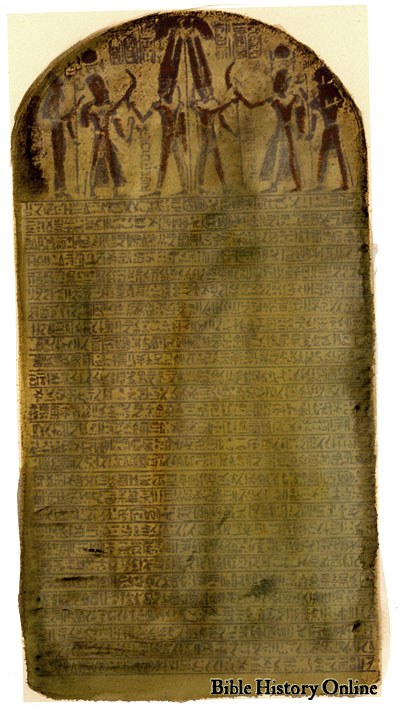
Does this stone mention a decisive victory over "Israel" around 1215 B.C.?
The Israel Stela also known as the Merneptah Stele is a slab of rock which was found in 1896 at Thebes, Egypt. The monument was found where it had once stood in ancient Egypt, at the temple that honored Pharaoh Merneptah. Some refer to the stone as the "Victory Stele" because it records the military campaigns and victories of Pharaoh Merneptah, the son of the mighty Ramesses II who reigned in Egypt around 1215 BC., during the time of the Judges in Israel. The writing on the stele is in hieroglyphs and very clearly mentions the name of Israel on it. Israel was considered by the Pharaoh of Egypt important enough to mention as a significant victory. The Hebrews had conquered the land of Canaan around 1400 B.C.
The period of the Judges was a dark time in Israel's history because they had continually forsaken the Lord and served other gods, and there was continual turmoil in the land of Israel.
Judges 10:6 - And the children of Israel did evil again in the sight of the LORD, and served Baalim, and Ashtaroth, and the gods of Syria, and the gods of Zidon, and the gods of Moab, and the gods of the children of Ammon, and the gods of the Philistines, and forsook the LORD, and served not him.
The discovery of the Israel Stela is very important in the study of Biblical Archaeology. It is the oldest evidence for the existence of Israel in the land of Canaan in ancient times outside of the Bible. The text on the stone reads:
"Canaan is plundered with every evil way. Ashkelon is conquered and brought away captive, Gezer seized, Yanoam made nonexistent; Israel is wasted, bare of seed." - Merneptah Stele
Hieroglyphic Text on the Merneptah Stele
The Merneptah Stele Text reads as follows:
Year 5, 3rd month of summer, day 3, under the Majesty of Horus: Mighty Bull, Rejoicing in Maat; the King of Upper and Lower Egypt: Banere-meramun; the Son of Re: Merneptah, Content with Maat, magnified by the power, exalted by the strength of Horus; strong bull who smites the Nine Bows, whose name is given to eternity forever.
Recital of his victories in all lands, to let all lands together know, to let the glory of his deeds be seen: the King of Upper and Lower Egypt: Banere-meramun; the Son of Re: Merneptah, Content with Maat; the Bull, lord of strength who slays his foes, splendid on the field of valour when his attack is made:
Shu who dispelled the cloud that was over Egypt, letting Egypt see the rays of the sun disk. Who removed the mountain of copper from the people's neck, that he might give breath to the imprisoned folk. Who let Hut-ka-Ptah exult over its foes, letting Tjenen triumph over his opponents. Opener of Memphis' gates that were barred, who allowed the temples to receive their foods. The King of Upper and Lower Egypt, Banere-meramun, the Son of Re, Merneptah, Content with Maat. The Sole One who steadied the hearts of hundred thousands, breath entered their nostrils at the sight of him. Who destroyed the land of the Tjemeh in his lifetime, cast abiding terror in the heart of the Meshwesh. He turned back the Libyans who trod Egypt, great is dread of Egypt in their hearts.
Their leading troops were left behind, Their legs made no stand except to flee, Their archers abandoned their bows, The hearts of their runners grew weak as they sped, They loosened their waterskins, cast them down, Their packs were untied, thrown away. The vile chief, the Libyan foe, Fled in the deep of night alone, No plume on his head, his feet unshod, His wives were carried off from his presence, His food supplies were snatched away, He had no drinking water to sustain him. The gaze of his brothers was fierce to slay him, His officers fought among each other, Their tents were fired, burnt to ashes, All his goods were food for the troops. When he reached his country he was in mourning Those left in his land were loath to receive him "A chief, ill-fated, evil-plumed", All said of him, those of his town. "He is in the power of the gods, the lords of Memphis The Lord of Egypt has made his name accursed; Merey is the abomination of Memphis, So is son after son of his kin forever. Banere-meramun will be after his children, Merneptah, Content with Maat is given him as fate. He has become a [proverbial saying] for Libya, Generation says to generation of his victories: It was never done to us since the time of Re;" So says every old man speaking to his son.
Woe to Libyans, they have ceased to live In the good manner of roaming the field; In a single day their stride was halted In a single year were the Tjehenu burned! Seth turned his back upon their chief, By his word their villages were ruined; There's no work of carrying [loads] these days. Hiding is useful, it's safe in the cave. The great Lord of Egypt, might and strength are his, Who will combat, knowing how he strides? A witless fool is he who takes him on, He knows no tomorrow who attacks his border! As for Egypt, "Since the gods," they say, "She is the only daughter of Pre; His son is he who's on the throne of Shu, None who attacks her people will succeed. The eye of every god is after her despoiler, It will make an end of all its foes", So say they who gaze toward their stars, And know all their spells by looking to the winds.
A great wonder has occurred for Egypt, Her attacker was placed captive (in) her hand, Through the counsels of the godly king, Who prevailed against his foes before Pre. Merey who stealthily did evil To all the gods who are in Memphis, He was contended with in On, The Ennead found him guilty of his crimes. Said the Lord-of-all: "Give the sword to my son, The right-hearted, kind, gracious Banere-meramun, Who cared for Memphis, who avenged On, Who opened the quarters that were barred. He has freed the many shut up in all districts, He has given the offerings to the temples, He has let incense be brought to the gods, He has let the nobles retain their possessions, He has let the humble frequent their towns". Then spoke the lords of On in behalf of their son, Merneptah, Content with Maat: "Grant him a lifetime like that of Re, To avenge those injured by any land; Egypt has been assigned him as portion, He owns it forever to protect its people". Lo, when one dwells in the time of the mighty, The breath of life comes readily. The brave bestows wealth on the just, The cheat cannot retain his plunder; What a man has of ill-gotten wealth Falls to others, not (his) children.
This (too) shall be said: Merey the vile foe, the Libyan foe Had come to attack the walls of Ta-tenen, Whose lord had made his son arise in his place, The King of Upper and Lower Egypt, Banere-meramun, Son of Re, Merneptah, Content with Maat. Then said Ptah concerning the vile Libyan foe: "His crimes are all gathered upon his head. Give him into the hand of Merneptah, Content with Maat, He shall make him spew what he gorged like a crocodile. Lo, the swift will catch the swift, The lord who knows his strength will snare him; It is Amun who curbs him with his hand, He will deliver him to his ka in Southern On, The King of Upper and Lower Egypt, Banere-meramun, Son of Re, Merneptah, Content with Maat".
Great joy has arisen in Egypt, Shouts go up from Egypt's towns; They relate the Libyan victories Of Merneptah, Content with Maat: "How beloved is he, the victorious ruler! How exalted is he, the King among the gods! How splendid is he, the lord of command! O how sweet it is to sit and babble!" One walks free-striding on the road, For there's no fear in people's hearts; Fortresses are left to themselves, Wells are open for the messengers' use. Bastioned ramparts are becalmed, Sunlight only wakes the watchmen; Medjai are stretched out asleep, Nau and Tekten are in the fields they love. The cattle of the field are left to roam, No herdsmen cross the river's flood; There's no calling out at night: "Wait, I come," in a stranger's voice. Going and coming are with song, People don't [lament] and mourn; Towns are settled once again, He who tends his crop will eat it. Re has turned around to Egypt, The Son is ordained as her protector, The King of Upper and Lower Egypt, Banere-meramun, Son of Re, Merneptah, Content with Maat.
The princes are prostrate saying: "Shalom!" Not one of the Nine Bows lifts his head: Tjehenu is vanquished, Khatti at peace, Canaan is captive with all woe. Ashkelon is conquered, Gezer seized, Yanoam made nonexistent; Israel is wasted, bare of seed, Khor is become a widow for Egypt. All who roamed have been subdued. By the King of Upper and Lower Egypt, Banere-meramun, Son of Re, Merneptah, Content with Maat, Given life like Re every day.
Israel Stela at the Egyptian Museum
Name: VICTORY STELA OF MERENPTAH, ALSO CALLED "THE ISRAEL STELA" Category: ARCHITECTURAL King Name: Merenptah Date: New Kingdom , 19th Dynasty Material: Gray Granite Floor: ground, Room: 13 JE 31408, CG 34025
Egyptian Museum Excerpt
This commemorative monument was erected in Merenptah's funerary temple to celebrate his victory against the Libyan coalition which had come to invade Egypt. In the lunette, two almost identical scenes in sunk relief show the king receiving from the god Amon the sickle of victory and the sceptre of royalty. Behind him, goddess Mut, on the left, and Khonsu, on the right, offer him the staff of millions of years. The 28 lines of inscription which follow are a metered poetical composition conceived as a hymn to glorify the victorious deeds of the king. It includes an account of subdued peoples and places as a result of Merenptah's campaigns. The name Israel is included among the list of defeated peoples, hence the name Israel stela, referring not to a country but to a tribe of the same name. The stela however, was reused by Merenptah as its original decoration shows Amenhotep III offering to Amon-Re.
Judges 10:6 - And the children of Israel did evil again in the sight of the LORD, and served Baalim, and Ashtaroth, and the gods of Syria, and the gods of Zidon, and the gods of Moab, and the gods of the children of Ammon, and the gods of the Philistines, and forsook the LORD, and served not him.