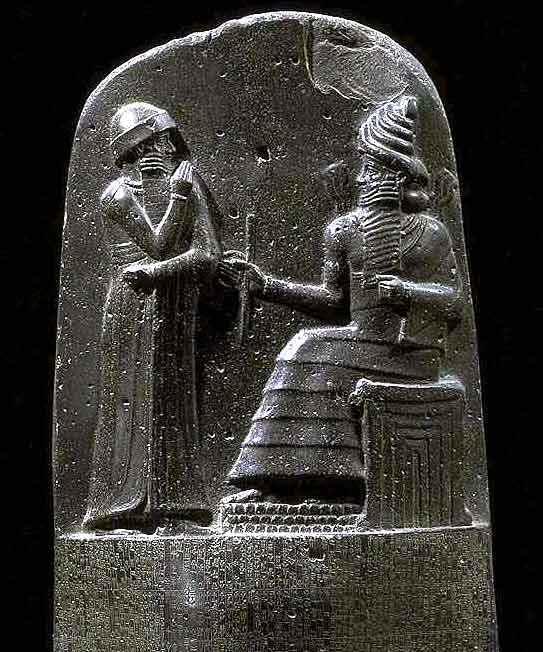
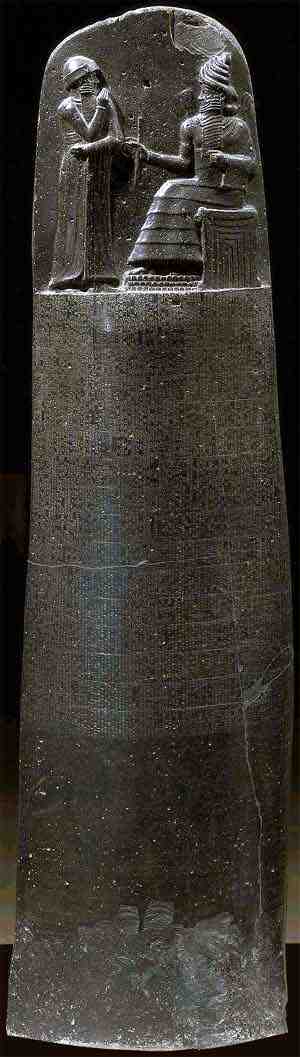
This black basalt stele contains the law code of Hammurabi of Babylon who ruled Babylon in the 18th century BC. It was discovered in the ruins of ancient Susa.
Louvre Excerpt
Law-Codex of Hammurabi Susa First half of the 18th century BC Basalt H 2.25 m Sb 8
Description
"Like a series of other remarkable works from the Mesopotamian civilization, this tall stele originally stood in a town of Babylon and was taken as spoil to Susa by the Elamites in the 12th century. It was discovered by the de Morgan expedition and its text was translated in six months by Father Vincent Scheil. Hammurabi was the 6th king of the first Babylonian dynasty, and he was first to establish the supremacy of his city which had been of modest standing only. What he had engraved on this stele is not so much a "code" as a collection of exemplary royal pronouncement in keeping with a tradition established by the Sumerians. The bas-relief at the top is a sober representation of the meeting of king and god. The king wears the royal headpiece like Gudea; he holds his hand before his face in the act of prayer. The sun-god Shamash, patron of justice, is recognizable from the flames flaring on his shoulders." - Louvre