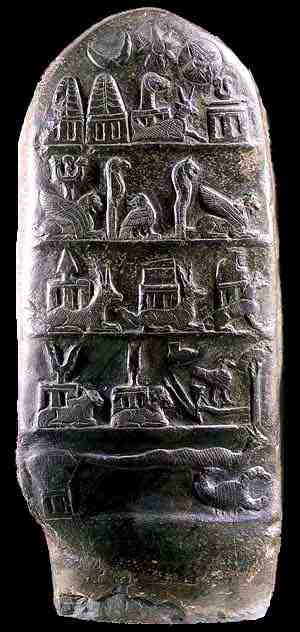
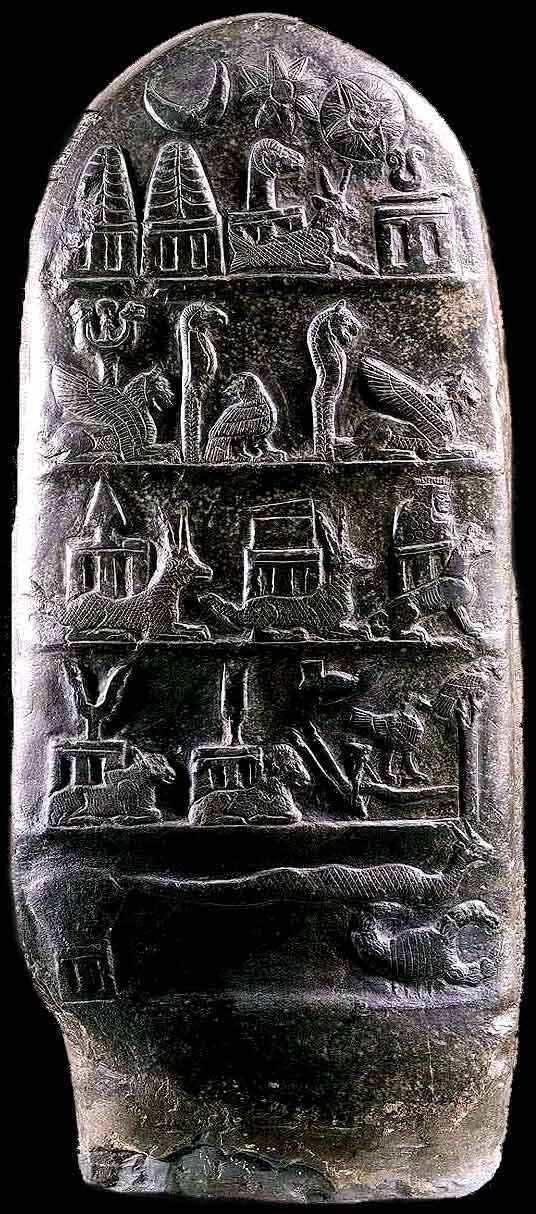
This gray limestone relief was a Kudurru (large boundary stone) bearing the records of gifts and land grants made by various kings of the Kassite dynasty of ancient Babylon. The slab of stone bears many symbols of ancient deities who were invoked to protect from encroachment.
Louvre Excerpt
Kudurru of Melishihu Taken from Babylonia to Susa Kassite period (1202-1188 BC) Gray Limestone H 0.65 m; W 0.30 m Sb 22
Description
"The kings of Babylon from the Kassite dynasty made generous gifts to their vassals. Record of this was, in principle, kept on the boundary posts, the kudurru of the lands that had been made over. In actual fact it was inscribed on great slabs, or standing stones, kept in the temples. These lists of donations were placed under the protection of the greatest possible number of gods, most often represented in their symbolic form and arranged according to the hierarchy of the pantheon. However, at the top, are symbols of the three heavenly gods; Sin (moon), Shamash (sun) and Ishtar (Venus), in order of their position in the heavens, rather than their importance. They were surpassed by the supreme triad: Anu (sky), Enlil (air) symbolized by their horned crowns and Ea (fresh water from the abyss), symbolized by a kind of sceptre carried by a goat-fish. Below we find the emblems of several other gods; that of Marduk, patron-god of Babylon, is identifiable as a pointed hoe placed on a stand and the serpent-dragon which guards the underworld of the god. The same dragon carries the scribe's stylet, which is the emblem of Nabu, Marduk's son. These emblems were difficult to interpret, even for the ancients who sometimes inscribed the name of the gods symbolized next to the symbols themselves" - Louvre
"Then the king of Assyria brought people from Babylon, Cuthah, Ava, Hamath, and from Sepharvaim, and placed them in the cities of Samaria instead of the children of Israel; and they took possession of Samaria and dwelt in its cities. " - 2 Kings 17:24