What Happened to the Jews During the Greek Empire?
Up to this time the great powers of the world had been in Asia and Africa. But looming ominously on the western horizon was the rising power of Greece. The beginnings of Greek history are veiled in myth. It is thought to have commenced about the 12th century B.C., the time of the Biblical Judges. Then came the Trojan War, and Homer, about 1,000 B.C., the age of David and Solomon. The beginning of authentic Greek history has usually been reckoned from the First Olympiad, 776 B.C. Then came the Formation of Hellenic States, 776-500 B.C. Then the Persian Wars, 500-331 B.C. And the famous battles: Marathon, 490; Thermopylae and Salamis, 480. Then the brilliant era of Pericles, 465-429, and Socrates, 469-399, contemporaneous with Ezra and Nehemiah.
Alexander the Great
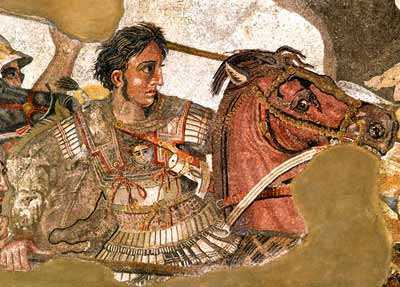
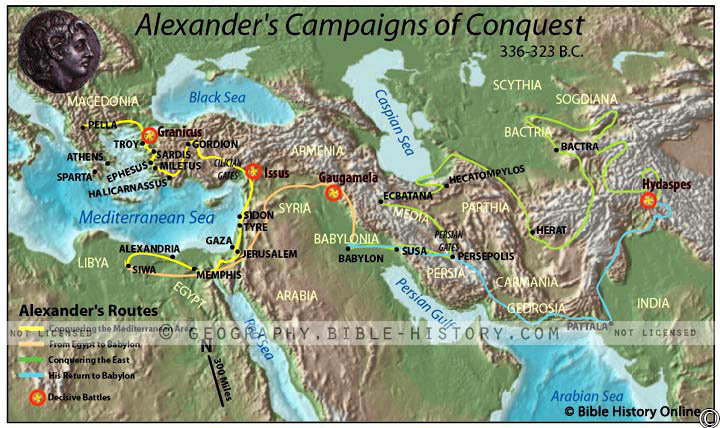
Alexander the Great, 336 B.C., at the age of 20, assumed command of the Greek army, and, like a meteor, swept eastward over the lands that had been under the dominion of Egypt, Assyria, Babylon, and Persia. By 331 B.C. the whole world lay at his feet. On his invasion of Palestine, 332 B.C., he showed great consideration to the Jews, spared Jerusalem, and offered immunities to the Jews to settle in Alexandria. He established Greek cities all over his conquered domains, and along with them Greek culture and the Greek language. After a brief reign he died, 323 B.C.
When Alexander the great defeated the Persian Empire and conquered the whole world it changed everything. When he conquered a city he would not just leave it in ruins, he would Hellenized it. Hellenization means that the Greeks would bring in their way of life into their newly conquered territories. They would Grecianize everything, new libraries, new buildings, new laws, new military, new government, and an entirely new way of living, and the language of Greece "koine" would be on everyone's tongue quickly because of its amazing ease of reproduction. The whole world was united by the simplicity of a common language known as koine Greek. Little did the world know that it was God's purpose to use Hellenism to prepare the world for the gospel of Jesus Christ which would come a few centuries later. Not even the greatest mastermind could have devised such a plan, let alone bring it to fruition with a man who was a military genius and statesman like Alexander the Great. As Hellenism was spreading the Greek way of life was permeating Judaism in a major way. Most of the common people became very Grecianized, and the scribes and religious leaders separated themselves even more as the staunch pillars of Judaism. The beginning of Orthodox Judaism was forming within interesting new approach to interpreting Scripture because of the influence of Hellenism.
Alexander's Four Generals - The Ptolemies (Egypt) and the Seleucids (Syria)
On Alexander's death his empire was divided to four of his generals, the two eastern sections were taken by - Syria by Seleucus, and Egypt by Ptolemy. Israel, lying between Syria and Egypt, went first to Syria, but shortly after was assessed to Egypt (301 B.C.), and remained under the control of Egypt until 198 B.C.
Under the kings of Egypt, called the "Ptolemies," the condition of the Jews was mainly peaceful and happy. Those that were in Egypt built synagogues in all their settlements. Alexandria became an influential center of Judaism.
The Ptolemies, Greek Kings of Egypt, were: Ptolemy I (323-285 B.C.). Ptolemy II (285-247) . Ptolemy III (247-222) . Ptolemy IV (222-205) . Ptolemy V (205-182) . Ptolemy VI (182-146) . Ptolemy VII (146-117). The Jews were caught in the middle of two kingdoms who were envious and opposed to one another with Israel right in the middle. Syria finally re-conquered Israel under the rule of Antiochus the Great (198 B.C.), and Israel passed back to the kings of Syria, called the "Seleucids."
Note: In 250 B.C. the Septuagint was written (a translation of the Hebrew Torah into the Greek language) (See Septuagint)
Antiochus Epiphanes
Antiochus Epiphanes (175-164 B.C.), was violently bitter against the Jews and forced them to convert entirely to Hellenism. He made a furious and determined effort to exterminate the Jews and their religion. He devastated Jerusalem (168 B.C.), defiled the Temple, offered a pig on its altar, erected an altar to Jupiter, prohibited Temple worship, made circumcision a capital offense, sold thousands of Jewish families into slavery, destroyed all copies of Scripture that could be found, slaughtered everyone discovered in possession of such copies, and resorted to every conceivable torture to force Jews to renounce their religion. The prophet Daniel predicted the coming of Antiochus Epiphanes and pictured him as a smaller type of the Antichrist who would come in the end times. The events of Antiochus Epiphanes led to the Maccabean revolt, one of the most heroic feats in all of history.